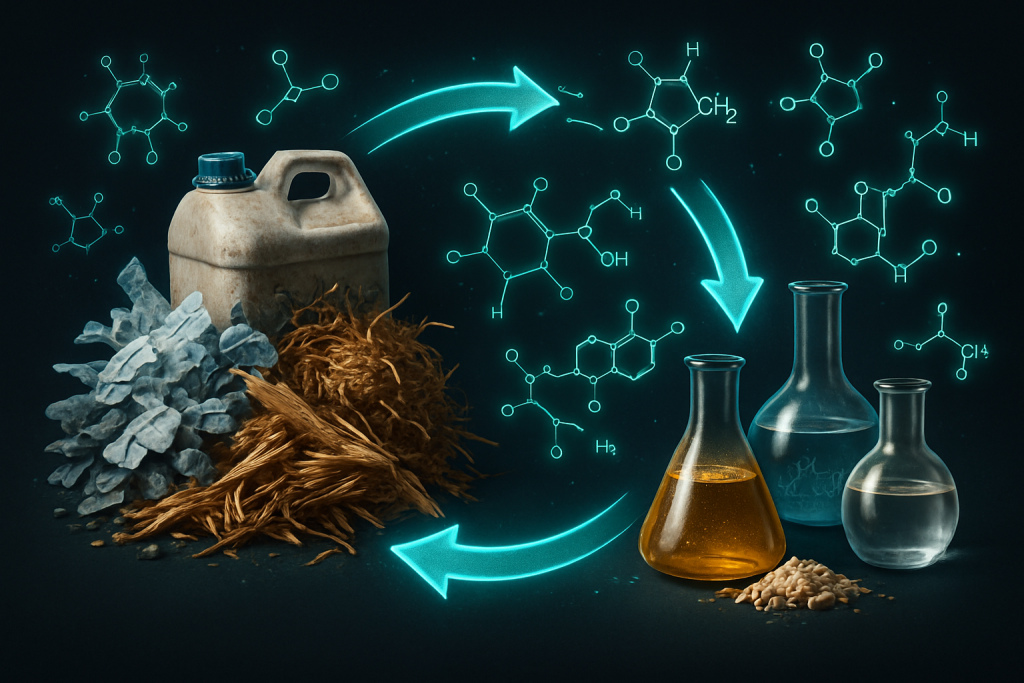
Image generated by AI
Every year, humanity generates roughly 2 billion tons of solid waste, much of it destined for landfills where it persists for decades or centuries. Yet buried within this mountain of refuse lie valuable chemical compounds and energy sources waiting to be liberated. What if we could view industrial waste not as a problem to be disposed of, but as a reservoir of raw materials—a vast, untapped feedstock for creating new products? This fundamental shift in perspective is driving a quiet revolution in chemistry, one that promises to transform how we manufacture everything from plastics to fuels to pharmaceuticals.
Waste valorization and circular chemistry represent more than just environmental good intentions; they are becoming economic imperatives in a world facing resource scarcity and climate change. As governments impose stricter environmental regulations and consumers demand sustainable products, industries are discovering that turning waste into valuable chemicals often makes financial sense. The transition from a linear “take-make-dispose” economy to a circular one where materials loop continuously through production systems is no longer a distant ideal—it is rapidly becoming the architecture of modern manufacturing.
What Is Waste Valorization and Circular Chemistry?
Waste valorization is the process of converting waste materials—whether industrial byproducts, municipal solid waste, or agricultural residues—into useful chemicals, materials, or energy. Rather than viewing waste as the end point of production, waste valorization treats it as a starting material for new chemical synthesis. Circular chemistry, the broader framework within which valorization operates, is a philosophy that redesigns chemical production itself to minimize waste generation at the source and ensure that any unavoidable waste can be reused or recovered. Together, these approaches aim to create closed-loop systems where the waste from one process becomes the feedstock for another, mimicking the cyclical flows found in nature.
The concept emerged in earnest during the early 2000s, though its intellectual roots reach back to the pioneering work of chemists and engineers who recognized that conventional linear manufacturing was unsustainable. Paul Anastas and John Warner, pioneers of green chemistry, articulated principles that emphasized designing chemicals and processes to reduce or eliminate the generation of hazardous substances. Their work laid the foundation for thinking about how to make chemistry itself more circular. In the decades since, researchers and industrial chemists have developed increasingly sophisticated methods to extract value from waste streams, transforming what was once considered worthless into a legitimate commodity.
The Chemistry Behind It
At its core, waste valorization relies on several classes of chemical transformations. Depolymerization breaks down large polymers—like plastics or rubber—into smaller molecular building blocks called monomers, which can then be recombined into new materials or different products entirely. Fermentation processes harness microorganisms to convert organic waste like food scraps or agricultural residues into biochemicals such as lactic acid or ethanol. Catalytic conversion uses specially designed catalysts to rearrange molecular structures at lower temperatures and pressures than traditional synthesis, making the process both more economical and less energy-intensive. Pyrolysis, another key technique, heats waste materials in the absence of oxygen to break them down into useful oils and gases. These diverse chemical pathways all share a common goal: extracting maximum chemical value from materials that would otherwise be discarded.
Consider plastic waste as a concrete example. Traditional plastic, once used and discarded, sits in landfills for centuries because the polymer chains are too stable to break down naturally. A chemist working in waste valorization might apply a process called chemical recycling, where plastic waste is heated with specialized catalysts or treated with chemical solvents to break the polymer chains back into their constituent monomers. These monomers can then be purified and repolymerized into virgin-quality plastic, completing a loop. It is as if you melted down a broken bicycle, separated the iron from the paint and rubber, and then used that pure iron to forge a new bicycle—except at the molecular level, where you regain the original building blocks rather than merely a degraded alloy.
Where It Is Used Today
Waste valorization is already transforming industrial practice across multiple sectors. In petroleum refining, heavy fuel oils and bituminous residues that would once be burned off are now being converted into high-value chemicals through catalytic cracking and hydroprocessing. In the textile industry, companies are developing processes to break down polyester fabrics and polyurethane foams into their monomeric components for remanufacturing. Agricultural biomass—crop residues, sawmill waste, and food processing byproducts—is increasingly being fermented or chemically processed into platform chemicals like succinic acid, which serves as a precursor for polymers, coatings, and other fine chemicals. The pharmaceutical and cosmetics industries have begun incorporating waste-derived feedstocks, particularly those from agro-processing, into their supply chains.
Specific examples demonstrate the scale of this transformation. Carbios, a French biochemistry company, developed enzymes that can digest polyethylene terephthalate (PET) plastics—the material used in beverage bottles—and break them down into their monomers within hours rather than the centuries it would take in nature. The company is now building industrial-scale plants to process hundreds of thousands of tons of plastic waste annually. Novamont, an Italian bioplastics manufacturer, produces biodegradable polymers from corn starch and cellulose, valorizing agricultural waste into premium materials. BASF and other chemical giants have launched circular chemistry initiatives where waste carbon dioxide from industrial processes is being converted into polyols for polyurethane production. In the energy sector, waste-to-energy plants are increasingly sophisticated, using thermochemical processes to extract maximum energy and chemical value from municipal solid waste.
Recent Breakthroughs in Waste Valorization and Circular Chemistry
The past three years have witnessed remarkable acceleration in this field. In 2023, researchers at the University of California published findings on enzyme engineering that created a mutant enzyme capable of degrading plastics faster than natural variants, opening new pathways for chemical recycling at scale. Simultaneously, advances in machine learning have enabled chemists to design better catalysts by predicting molecular structures and reaction pathways with unprecedented accuracy. Companies like Ametys and ChemCycling have achieved commercial-scale operations converting chemical waste into new raw materials. The circular carbon economy has emerged as a distinct focus, with techniques like CO₂ utilization becoming increasingly viable—several companies now operate facilities that capture industrial CO₂ and convert it into chemicals, building materials, or fuels through electrochemical and catalytic processes.
Current research frontiers include developing enzymes that can break down multiple types of polymers, improving the catalytic conversion of mixed waste streams, and scaling up fermentation processes for producing specialty chemicals from biomass. Scientists are investigating whether artificial intelligence can accelerate the discovery of new valorization pathways by analyzing vast chemical databases and predicting which waste streams might be converted into which high-value products. The challenge that remains is economic: while many valorization processes work well at laboratory scale, making them profitable at industrial scale requires either reducing energy inputs, improving yields, or finding markets willing to pay premium prices for responsibly sourced chemicals. Researchers are also working to understand the thermodynamic limits of various processes—at what point does the energy required to clean and process waste exceed the value of the recovered material?
Why Waste Valorization and Circular Chemistry Matters for the Future
The implications of waste valorization extend far beyond individual industries. As global population grows and consumption increases, the linear model of resource extraction, manufacturing, and disposal faces hard physical limits. Mines deplete, fossil fuel reserves dwindle, and landfills overflow. A shift toward circular chemistry could fundamentally alter humanity’s relationship with raw materials, transforming waste streams into renewable resources. This transition also addresses climate change: chemical manufacturing is responsible for roughly 7 percent of global greenhouse gas emissions, largely due to energy-intensive processes and reliance on fossil fuels. By using waste-derived feedstocks and optimizing catalytic processes, the chemical industry could dramatically reduce its carbon footprint. Furthermore, circular chemistry enhances supply chain resilience; nations that can valorize domestic waste become less dependent on importing raw materials and vulnerable to supply disruptions.
Yet significant obstacles remain. The technical challenge of scaling processes from lab to factory is immense, requiring massive capital investment and years of optimization. Economic viability often hinges on policies like carbon taxes or extended producer responsibility laws that make waste disposal costly enough to incentivize recycling. There is also the issue of contamination and complexity: real-world waste streams are far messier than the pure materials chemists work with in laboratories, containing mixtures of polymers, metals, and contaminants that complicate processing. Finally, the circular chemistry revolution requires a cultural shift in how companies and consumers perceive value; businesses must be willing to adopt new supply chains and technologies even when conventional methods are cheaper, and consumers must support products made from recycled materials.
Key Takeaways
- Waste valorization converts industrial and municipal waste into valuable chemicals, materials, and energy, transforming what was once considered refuse into a legitimate feedstock for manufacturing.
- The chemistry relies on techniques including depolymerization, fermentation, catalytic conversion, and pyrolysis—each enabling different pathways to extract value from diverse waste streams.
- The most promising near-term applications include chemical recycling of plastics, conversion of agricultural biomass into platform chemicals, and utilization of industrial CO₂ emissions as feedstock.
- Recent breakthroughs in enzyme engineering and machine learning-assisted catalyst design are accelerating the field, though scaling these processes profitably remains the central challenge.
- Waste valorization and circular chemistry are essential for building a sustainable, resource-efficient future and could significantly reduce the chemical industry’s carbon footprint while enhancing economic resilience.
Explore TED Talks on Waste Valorization and Circular Chemistry:
TED content is used under CC BY-NC-ND 4.0. © TED Conferences, LLC.
Frequently Asked Questions
What chemical compounds can be extracted from industrial waste streams in waste valorization?
Industrial waste contains valuable chemical compounds such as polymers, metals, organic solvents, and intermediate chemicals that can be chemically processed or separated through techniques like extraction, distillation, or catalytic conversion. These recovered compounds serve as feedstocks for manufacturing plastics, fuels, pharmaceuticals, and other commercial products without requiring virgin raw material extraction.
How does circular chemistry differ mechanistically from traditional linear chemistry manufacturing?
Circular chemistry designs chemical processes where products and byproducts are continuously recycled back into production systems rather than discarded, often using catalytic processes and closed-loop reactions to maintain material cycles. This contrasts with linear chemistry, which follows a one-directional path of extracting raw materials, manufacturing products, and disposing of waste without material recovery.
Why is waste valorization becoming economically competitive with virgin material sourcing?
Waste valorization reduces extraction, mining, and transportation costs while decreasing regulatory compliance expenses and waste disposal fees, making recovered materials economically viable. Additionally, as virgin resource prices rise due to scarcity and stricter environmental regulations increase disposal costs, converting waste into chemical feedstocks becomes financially advantageous for industries.
What chemical processes are most commonly used to convert waste into usable chemical products?
Common processes include catalytic cracking and pyrolysis for breaking down polymers, hydrogenation for upgrading hydrocarbon streams, and selective oxidation for transforming organic waste into platform chemicals. Enzymatic degradation and fermentation are also emerging techniques for converting organic waste into valuable biochemicals and biofuels.