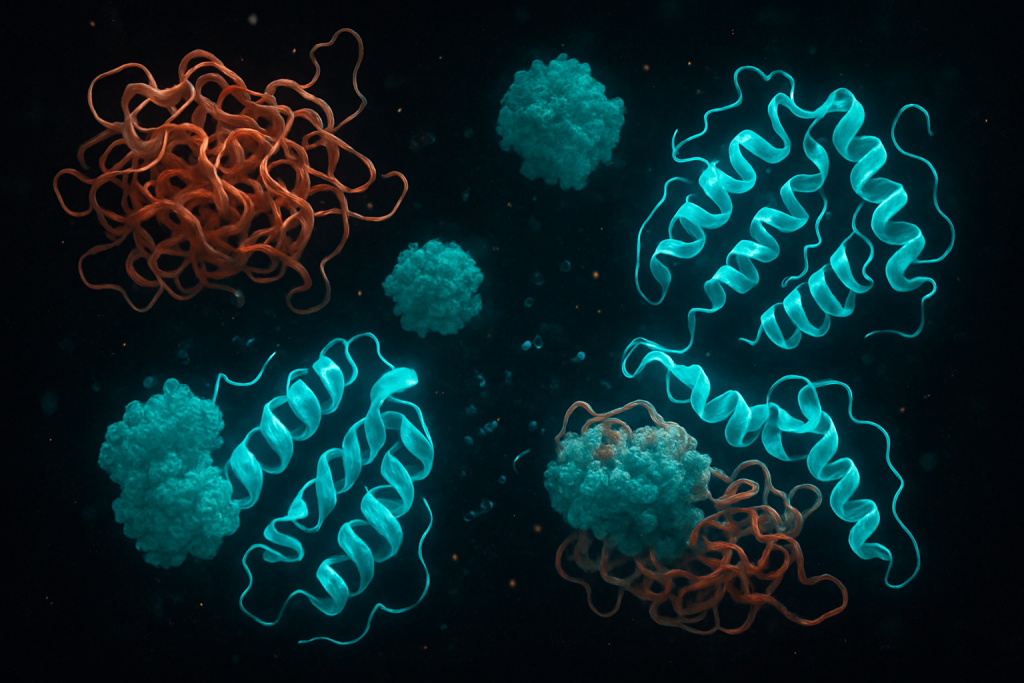
Image generated by AI
Inside every living cell, proteins are constantly being manufactured, but many of them fail to fold into their correct three-dimensional shapes. This cellular catastrophe—where a protein twists into the wrong configuration—might sound like a minor manufacturing defect, but it is actually a linchpin problem that underpins some of humanity’s most devastating diseases. From Alzheimer’s to Parkinson’s, cystic fibrosis to Creutzfeldt-Jakob disease, misfolded proteins are central culprits in conditions that steal memories, devastate motor control, and accumulate silently in the brain until collapse arrives.
Yet cells are not defenseless against this chaos. Over billions of years, evolution has equipped every living organism with an elaborate quality control system—a cellular inspection line so sophisticated that it makes modern manufacturing look primitive. This system, driven by specialized proteins called chaperones and degradation machines called proteasomes, constantly monitors the proteome, rescuing proteins that can still be salvaged and demolishing those beyond repair. Understanding how this system works, and what happens when it fails, has become one of the most urgent priorities in modern biology, with implications reaching far beyond disease into aging, medicine, and our fundamental understanding of what keeps life organized and functioning.
What Is Protein Misfolding and Quality Control?
Proteins are the molecular machines that perform nearly every task inside cells—they serve as enzymes that catalyze chemical reactions, as receptors that receive signals, as structural supports, and as components of the immune system. But a protein cannot do its job unless it folds into precisely the right three-dimensional shape, a process that happens spontaneously as the protein chain emerges from the ribosome where it is synthesized. Protein misfolding occurs when this folding process goes awry, creating a protein with a scrambled architecture that cannot perform its intended function and, worse, often becomes sticky and toxic. Protein quality control refers to the cellular systems that monitor folding, rescue proteins that are merely misfolded but still salvageable, and eliminate those that are irredeemably damaged.
The discovery of protein misfolding’s role in disease emerged gradually through the latter half of the twentieth century. In the 1980s, Stanley Prusiner’s work on prions—infectious agents composed entirely of misfolded proteins—earned him the Nobel Prize and revealed that misfolded proteins could be genuinely dangerous, spreading their corrupted shape to healthy proteins like a chain reaction. Meanwhile, researchers studying Alzheimer’s disease noticed accumulations of tangled protein aggregates in the brains of patients, particularly a protein called tau and the amyloid-beta peptide. By the 1990s, it became clear that protein misfolding was not merely a symptom of disease but often a primary cause, launching a revolution in how we understand age-related neurological disorders.
How It Works in Nature
The journey from a newly synthesized protein chain to a properly folded, functional molecule is fraught with danger. As the protein emerges from the ribosome, it is a long, unfolded strand of amino acids vulnerable to aggregating with other unfolded proteins or prematurely collapsing into incorrect configurations. This is where molecular chaperones enter the scene—proteins that have evolved specifically to guide other proteins toward their correct fold. The most studied chaperones, including the heat shock proteins (HSPs) like Hsp70 and Hsp90, work by binding to hydrophobic regions on nascent or damaged proteins, preventing them from sticking to one another while giving them repeated opportunities to fold correctly. When a protein does manage to achieve its proper conformation, the chaperone releases it, freeing the chaperone to assist another struggling protein. This process consumes energy in the form of ATP, reflecting the enormous metabolic investment cells make in maintaining proteostasis—the cellular balance of protein synthesis, folding, and degradation.
Consider a parallel from the human world: imagine a vast construction site where workers must assemble complex machines. Each machine, once finished correctly, functions perfectly. But some workers, tired or careless, assemble machines with critical flaws—gears misaligned, components inverted. A foreman with an inspection checklist walks through, identifying flawed machines. Some can be disassembled and reassembled correctly; these are like proteins that chaperones can rescue. Others are so thoroughly broken that they must be destroyed before they jam up the entire assembly line; these are removed by the proteasome, a barrel-shaped protein complex that unfolds damaged proteins and shreds them into amino acid building blocks. When this quality control system is working properly, the assembly line hums along smoothly. But when chaperones become overwhelmed or proteasomes become clogged, defective machines accumulate, gum up the works, and eventually force a shutdown—a cellular scenario that mirrors what happens in neurodegenerative diseases.
Medical and Scientific Relevance
Protein misfolding is implicated in at least two hundred human diseases, making it one of the most consequential biological problems in medicine. The most prominent are the neurodegenerative diseases, where misfolded proteins accumulate into aggregates in the brain: Alzheimer’s disease features amyloid-beta plaques and tau tangles; Parkinson’s involves alpha-synuclein aggregates; Huntington’s disease results from a mutated huntingtin protein with expanded repeats that inevitably misfold and clump. Beyond neurodegeneration, cystic fibrosis involves misfolding of the CFTR ion channel protein, which causes it to be prematurely degraded rather than reaching the cell surface where it normally functions. Type II diabetes involves misfolding of proinsulin, and certain cancers involve misfolding of p53, a critical tumor suppressor. The fundamental problem in all these diseases is the same: misfolded proteins escape quality control, accumulate, and damage cells.
Current therapeutic approaches are beginning to target this problem from multiple angles. Pharmaceutical companies are developing proteasome inhibitors that prevent the degradation of misfolded proteins temporarily, giving chaperones more time to rescue them—a strategy already approved for certain blood cancers. Researchers are also engineering new chaperones or chaperone-like molecules that specifically target disease-associated proteins; for instance, compounds that enhance the folding of CFTR in cystic fibrosis patients have shown remarkable clinical benefit. Additionally, scientists are investigating ways to stimulate autophagy, an alternative cellular degradation pathway that can clear protein aggregates when the proteasome becomes overwhelmed. These approaches represent a fundamental shift: rather than merely treating symptoms, modern medicine is beginning to address protein misfolding at its root.
Recent Breakthroughs in Protein Misfolding and Quality Control
The past two to three years have witnessed extraordinary advances powered partly by artificial intelligence and cryo-electron microscopy. In 2023, researchers published detailed structural analyses of the proteasome in action, revealing with atomic precision how this molecular shredder unfolds and demolishes proteins—work that was impossible before recent technological advances. Simultaneously, AI systems trained on vast databases of protein structures have begun predicting how mutations might cause misfolding, enabling researchers to identify disease-causing variants with unprecedented accuracy. Perhaps most dramatically, several biotech companies reported early-stage success in clinical trials of compounds designed to prevent the aggregation of amyloid-beta and tau, offering the first genuine hope in decades that Alzheimer’s disease might be slowed, if not halted.
The frontier of current research encompasses several tantalizing questions. Can we develop drugs that specifically enhance the activity of chaperones for disease-relevant proteins without side effects? How might we design synthetic proteins that act as more powerful, targeted quality control agents? Can we harness the immune system to clear protein aggregates before they cause damage? And crucially, how do aging and stress compromise the quality control system itself, potentially explaining why neurodegenerative diseases emerge primarily in older age? These open questions are attracting intense research effort from academia and industry alike, with funding and scientific attention growing exponentially.
Why Protein Misfolding and Quality Control Matters for the Future
As populations age globally, the importance of understanding and controlling protein misfolding will only intensify. Neurodegenerative diseases are projected to become one of the leading causes of disability by 2050, creating enormous human suffering and economic burden. Simultaneously, emerging evidence suggests that protein misfolding and quality control are fundamental to aging itself—the progressive deterioration of cellular organization that eventually limits all our lives. If we can understand how to maintain cellular proteostasis into advanced age, we might not merely treat individual diseases but address aging as a biological process. This prospect has attracted venture capital and biotech investment on an unprecedented scale, making protein quality control one of the hottest frontiers in modern biology. Furthermore, understanding these systems illuminates fundamental principles of life organization applicable across diverse organisms, from bacteria to plants to humans, potentially revealing universal principles of biological engineering.
However, significant obstacles remain. Many neurodegenerative diseases are heterogeneous—different patients may have different underlying causes that converge on similar symptoms—making therapeutic strategies that work perfectly in cell culture frustratingly ineffective in human brains. The blood-brain barrier, which protects the brain from toxins, also prevents many therapeutic molecules from reaching misfolded proteins where they accumulate. Additionally, protein aggregation often spreads between cells in ways we do not yet fully understand, potentially through mechanisms reminiscent of prion diseases, making it unclear whether removing aggregates from one cell truly solves the problem. These challenges ensure that despite rapid progress, protein misfolding diseases will remain formidable opponents for years to come.
Key Takeaways
- Protein misfolding—the failure of proteins to fold into correct three-dimensional shapes—is a central cause of at least two hundred human diseases, including Alzheimer’s, Parkinson’s, and cystic fibrosis.
- Cells maintain protein quality through molecular chaperones that guide proper folding and through the proteasome, which degrades irredeemably damaged proteins, consuming enormous amounts of cellular energy.
- The most promising therapeutic approaches target protein misfolding directly by enhancing chaperone function, inhibiting aggregation, or stimulating clearance of accumulated misfolded proteins.
- Recent breakthroughs in cryo-electron microscopy and artificial intelligence have revealed atomic-level details of quality control systems and enabled prediction of disease-causing mutations with unprecedented accuracy.
- As aging populations face mounting neurodegenerative disease burden, understanding protein quality control has become crucial not only for treating disease but potentially for extending healthy human lifespan.
Explore TED Talks on Protein Misfolding and Quality Control:
TED content is used under CC BY-NC-ND 4.0. © TED Conferences, LLC.
Frequently Asked Questions
What is the difference between chaperone proteins and proteasomes in the quality control system?
Chaperone proteins attempt to rescue misfolded proteins by helping them refold into correct configurations, while proteasomes are degradation machines that break down proteins that cannot be salvaged beyond repair. Together, they form a two-pronged defense system where chaperones provide a second chance and proteasomes provide a final solution.
Why do misfolded proteins cause diseases like Alzheimer's and Parkinson's?
Misfolded proteins accumulate in cells and tissues, forming toxic aggregates that disrupt normal cellular function and can trigger neurodegeneration in the brain. These protein clumps interfere with cellular machinery and trigger inflammatory responses that progressively damage or kill neurons.
How does a cell determine whether a misfolded protein should be refolded or destroyed?
Cells use quality control systems that assess whether a misfolded protein can be successfully refolded by chaperones; if the protein remains misfolded after multiple rescue attempts or shows signs of irreversible damage, it is tagged for degradation by proteasomes. The decision involves recognition of specific molecular patterns and damage signals on the protein surface.
What happens when the protein quality control system fails in cells?
When quality control fails, misfolded proteins accumulate unchecked and form aggregates that poison the cell, leading to cell dysfunction and death. This accumulation is the underlying mechanism of numerous neurodegenerative diseases and contributes to aging-related cellular decline.