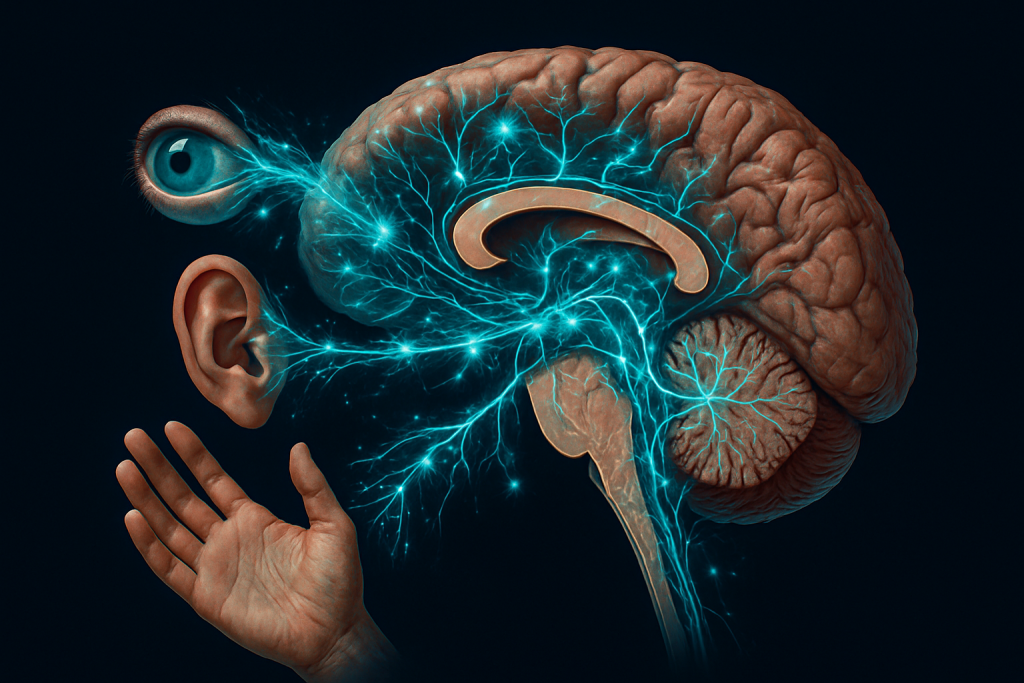
Image generated by AI
Every second, your brain receives roughly 11 million bits of sensory information—light bouncing off objects, vibrations traveling through air, chemicals dissolving on your tongue, and countless other signals. Yet you consciously perceive only about 40 to 50 bits of that deluge. The gap between what arrives at your senses and what you actually experience is the domain of sensory processing and perception, a biological marvel so fundamental that we barely notice it works. This gap is not a flaw in our design; it is perhaps the most elegant feature of our nervous system.
Understanding sensory processing and perception has become increasingly urgent as we face challenges from neurodevelopmental conditions like autism and sensory processing disorder, to age-related decline in our ability to navigate the world, to the design of artificial intelligence systems that must learn to interpret the world as we do. From diagnosing why some people are overwhelmed by everyday stimuli to building robots that can perceive their environment with human-like flexibility, the science of how we sense and perceive has moved to the center of modern biology and technology. The answers matter not only for human health but for how we design our cities, schools, and digital tools.
What Is Sensory Processing and Perception?
Sensory processing is the biological mechanism by which the nervous system detects, filters, and transforms raw sensory information from the environment into electrical and chemical signals that the brain can use. Perception, by contrast, is the brain’s interpretation of those signals—the construction of meaningful experience from the noise. Together, they form a two-stage process: sensory organs capture energy from the world, specialized neurons encode that energy into neural signals, and the brain integrates, compares, and interprets those signals in light of memory, attention, and context. Unlike a camera passively recording an image, perception is active and reconstructive, shaped as much by what you expect to see as by what is actually there.
The distinction between sensation and perception dates back centuries, but the modern study of sensory processing began in earnest during the 19th century with Johannes Müller, a German physiologist who discovered that the brain’s interpretation of sensory signals depends not on the stimulus itself but on which nerves are stimulated. In the 20th century, researchers like David Hubel and Torsten Wiesel revolutionized our understanding by showing how the visual cortex extracts simple features—edges, orientations, movements—from the barrage of information arriving from the eyes, building up increasingly complex representations layer by layer. This hierarchical model of sensory processing, refined through decades of neuroscience research, remains central to how we understand perception today.
How It Works in Nature
Sensory processing begins at the periphery, where specialized receptor cells respond to specific forms of energy. Photoreceptors in the retina absorb photons and convert them to electrical signals; hair cells in the cochlea vibrate in response to sound waves and fire neurons proportional to the frequency of vibration; chemoreceptors in the nose bind odorant molecules and trigger cascades of neural activity. This process, called transduction, converts environmental energy into the currency of the nervous system—action potentials. But sensory receptors are exquisitely tuned; they respond most strongly to their preferred stimulus and change their sensitivity based on recent experience, a process called adaptation. This is why you stop noticing the weight of your clothes or the hum of a refrigerator moments after you become aware of them.
Consider vision, the sense that dominates human perception. Light enters the eye, passes through the lens, and strikes the retina, where about 130 million photoreceptors convert photons into neural signals. Those signals flow through several layers of interconnected neurons in the retina itself, where the first stages of processing occur—contrast enhancement, motion detection, and spatial filtering. The optic nerve carries this processed information to the thalamus, a relay station in the brain, which then sends signals to the primary visual cortex at the back of the brain. From there, two major pathways diverge: one stream processes “what” something is (shape, color, identity), flowing toward the temporal lobe, while another processes “where” it is (location, motion, depth), flowing toward the parietal lobe. The brain is not passively receiving a picture; it is actively constructing a coherent scene from distributed, fragmentary information.
Medical and Scientific Relevance
Disruptions in sensory processing have profound medical consequences. Sensory processing disorder, recognized increasingly in children and adults, involves atypical responses to sensory input—some people are hypersensitive, overwhelmed by ordinary stimuli, while others are hyposensitive and crave intense input. Autism spectrum disorder frequently involves altered sensory processing, with many autistic individuals experiencing heightened sensitivity to light, sound, or touch. Beyond neurodevelopmental conditions, age-related changes in sensory processing contribute to the increased falls, balance problems, and spatial disorientation that older adults experience. Even common conditions like chronic pain involve maladaptive sensory processing, where the nervous system becomes hypersensitive to normally innocuous stimuli. Understanding the neural basis of these conditions opens pathways to therapeutic intervention, from behavioral therapies that retrain sensory responses to pharmacological approaches targeting the neurotransmitter systems underlying sensory gating.
In clinical settings, researchers are developing new tools to assess and treat sensory processing disorders. Virtual reality environments allow clinicians to present controlled sensory stimuli and measure how patients respond, while neuroimaging studies reveal differences in brain activation patterns between people with typical and atypical sensory processing. The hearing aid and cochlear implant industries, worth billions of dollars, depend on understanding how the auditory system processes sound and how electronic devices can best replace or augment that processing. Similarly, companies developing augmented reality interfaces must understand human perception to create experiences that feel natural rather than jarring, ensuring that virtual overlays integrate seamlessly with how the brain perceives real-world stimuli.
Recent Breakthroughs in Sensory Processing and Perception
In recent years, neuroscientists have made striking discoveries about the active, predictive nature of perception. Rather than the brain passively waiting for sensory input, research suggests that the brain constantly generates predictions about what it expects to encounter, and sensory signals serve primarily to correct those predictions when reality diverges from expectation. This predictive processing framework, championed by researchers like Karl Friston, fundamentally shifts how we understand perception—the brain is less like a camera and more like a hypothesis-testing machine. In 2023 and 2024, studies have shown that this predictive machinery operates across all sensory modalities, from vision to touch to interoception (the sense of the body’s internal state), suggesting a unifying principle of brain organization. Advanced neuroimaging techniques, including two-photon microscopy and optogenetics, have allowed researchers to observe how individual neurons contribute to these predictive processes in real time, revealing circuits of surprising elegance and efficiency.
Researchers are currently investigating how the brain’s predictions are learned and updated, how they interact with attention and emotion, and how they go awry in psychiatric and neurological conditions. One frontier involves understanding how sensory processing changes across the lifespan—how infants learn to parse the sensory world, how aging alters sensory integration, and how experience shapes the neural circuits underlying perception. Another active area concerns the integration of multiple senses: the brain does not process vision, hearing, and touch in isolation but constantly integrates signals across modalities, and understanding this multisensory binding is crucial for designing technologies that feel natural to users and for treating patients with disrupted sensory integration.
Why Sensory Processing and Perception Matters for the Future
As artificial intelligence systems become increasingly sophisticated, understanding human sensory processing becomes essential for bridging the gap between human and machine perception. Current AI systems excel at pattern recognition but often fail in ways that reveal how different their processing is from ours; they can be fooled by imperceptible changes that humans easily ignore, or miss obvious features that humans instantly detect. By studying how the human brain achieves robust, flexible, and efficient perception, AI researchers can design systems that perceive more like we do. Additionally, as virtual and augmented reality technologies proliferate, understanding sensory processing is crucial for creating immersive experiences that don’t trigger motion sickness or disorientation. In healthcare, the ability to diagnose and treat sensory processing disorders could dramatically improve quality of life for millions of people with autism, ADHD, sensory processing disorder, and other conditions.
The challenges remain substantial. The brain contains roughly 86 billion neurons, each connected to thousands of others, arranged in circuits of bewildering complexity. Even with modern tools like connectomics—the effort to map every neural connection—we are only beginning to understand how specific circuit motifs give rise to perception. Questions about consciousness itself remain tantalizingly open: why some sensory information reaches conscious awareness while most is filtered out, and how the brain constructs the unified sense of self that perceives the world, remain among neuroscience’s deepest mysteries. Furthermore, the diversity of human sensory experience—shaped by genetics, development, culture, and individual history—means that no single model of perception will capture the full richness of how different people experience the world.
Key Takeaways
- Sensory processing is the nervous system’s conversion of environmental energy into neural signals, while perception is the brain’s interpretation of those signals—a distinction that reveals perception as an active, constructive process rather than passive reception.
- The brain constantly generates predictions about what it expects to sense, using actual sensory input primarily to correct those predictions—a framework that explains both the efficiency and the potential failures of perception.
- Disruptions in sensory processing are implicated in autism spectrum disorder, sensory processing disorder, chronic pain, and age-related balance problems, opening new therapeutic targets and treatment strategies.
- Recent advances in neuroimaging and computational neuroscience have revealed the predictive, multisensory, and context-dependent nature of perception, suggesting unifying principles of brain organization across sensory modalities.
- Understanding human sensory processing is critical for designing artificial intelligence systems that perceive robustly, creating immersive technologies that feel natural, and improving diagnosis and treatment of sensory and neurological conditions.
Explore TED Talks on Sensory Processing and Perception:
TED content is used under CC BY-NC-ND 4.0. © TED Conferences, LLC.
Frequently Asked Questions
Why does your brain only consciously perceive 40-50 bits of the 11 million bits of sensory information it receives each second?
Your brain filters incoming sensory data to focus only on the most relevant and important signals for survival and task performance, preventing cognitive overload. This selective attention mechanism allows you to function effectively in complex environments without being overwhelmed by every stimulus.
How does sensory processing differ from sensory perception?
Sensory processing is the biological mechanism by which the nervous system detects, filters, and transmits raw sensory signals, while perception is the conscious experience and interpretation of those processed signals. Together, they create the gap between what physically arrives at your senses and what you actually experience.
What is sensory processing disorder and how does it affect how people perceive everyday stimuli?
Sensory processing disorder is a neurodevelopmental condition where the nervous system has difficulty filtering and organizing sensory information, causing individuals to become overwhelmed by everyday stimuli like sounds, lights, or textures. People with this condition may experience heightened sensitivity or difficulty distinguishing relevant signals from background noise.
Why is understanding sensory processing and perception important for designing artificial intelligence systems?
AI systems must learn to interpret and filter sensory data from their environment similarly to how human brains do, prioritizing relevant information and ignoring irrelevant noise. By understanding the biological principles of human sensory processing, scientists can create AI that perceives and responds to the world with human-like flexibility and efficiency.