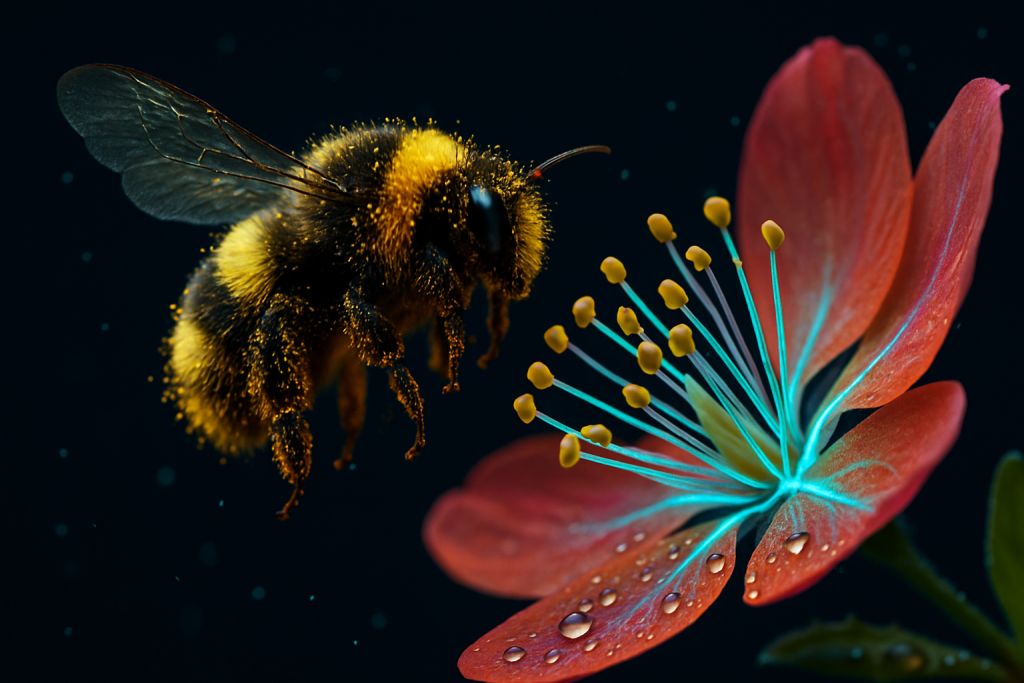
Image generated by AI
Every third bite of food you consume exists because of an animal you’ve probably never noticed. Bees, butterflies, hummingbirds, bats, and thousands of other creatures form an intricate web of relationships with flowering plants, a partnership so fundamental that roughly 75 percent of the world’s flowering plants depend on animal pollinators to reproduce. Yet this invisible architecture of life is unraveling at an alarming pace, with pollinator populations declining globally by an average of 25 percent over the past few decades. What we’re witnessing is not merely the loss of pretty insects, but a potential collapse of the ecological machinery that sustains human civilization.
In the shadow of climate change and habitat destruction, scientists are racing to understand pollinator ecology—the study of how pollinators interact with plants and their broader ecosystems—with unprecedented urgency. The stakes could not be higher: crop failures, ecosystem collapse, and cascading effects on human nutrition and economies hinge on the survival of these relationships. Understanding pollinator ecology has become a central concern for agriculture, conservation biology, and public health, making it one of the most pressing scientific frontiers of our time.
What Is Pollinator Ecology and Plant-Pollinator Interactions?
Pollinator ecology is the scientific study of how animals and plants form mutually beneficial relationships, examining not just individual interactions but entire networks of species, their behaviors, and their ecological consequences. At its heart lies a deceptively simple transaction: a pollinator visits a flower seeking food—usually nectar or pollen—and in the process, inadvertently transfers pollen between plants, enabling sexual reproduction and seed production. But this elementary description belies the extraordinary complexity beneath the surface. Plants and pollinators have coevolved for over 150 million years, developing specialized physical features, chemical signals, and behavioral adaptations that bind them together in relationships of remarkable specificity and interdependence. Some orchids, for instance, have evolved flowers that perfectly mimic the body of a particular bee species, tricking males into pseudo-copulation—a deception so convincing that the pollinator receives no reward, yet continues returning faithfully.
The modern study of plant-pollinator interactions emerged formally in the 19th century, though Darwin’s observations of orchid pollination in 1862 laid crucial groundwork for understanding coevolution. The term “pollinator ecology” crystallized as a distinct discipline in the mid-20th century, as ecologists began mapping networks of relationships rather than studying isolated plant-pollinator pairs. Pioneers like Donna Haraway and later network ecologists recognized that understanding these interactions required thinking in terms of complex systems—webs where the removal of one species could trigger cascading failures throughout the entire network. This shift from reductionism to systems thinking fundamentally transformed how scientists approach conservation and agriculture.
How It Works in Nature
The mechanics of pollination operate through a combination of plant morphology, chemical signaling, and animal sensory perception working in concert. A flowering plant produces nectar—a sugar-rich liquid—and pollen grains containing male gametes, often accompanied by distinctive visual patterns, ultraviolet markings invisible to humans, and volatile organic compounds that advertise the flower’s location to potential pollinators from considerable distances. When a pollinator lands on the flower to harvest nectar or pollen, pollen grains adhere to its body via electrostatic forces or sticky proteins; as the pollinator moves between flowers, some of this pollen transfers to female flower structures, enabling fertilization. The specificity of these interactions can be remarkable: certain long-tongued bees can access nectar in flowers with deep tubular structures that other insects cannot reach, and some flowers bloom exclusively during the active foraging hours of their primary pollinator, creating temporal as well as spatial barriers to “cheating” by other species.
Consider the case of the fig and its pollinating wasp, one of nature’s most intricate relationships. The female wasp enters the fig’s enclosed flower cluster, lays her eggs in some flowers, and pollinates others while doing so; her offspring develop inside the fig, feeding on developing seeds. When the wasps mature and exit, they carry pollen to new figs, beginning the cycle anew. Neither partner can reproduce without the other—the fig depends entirely on the wasp for pollination, and the wasp requires the fig as a nursery for its young. This obligate mutualism, repeated across thousands of plant-pollinator pairs with infinite variations, represents one of the most successful strategies life has evolved for ensuring reproduction and genetic diversity.
Medical and Scientific Relevance
The immediate relevance of pollinator ecology to human welfare is agricultural: approximately 35 percent of global food production by volume depends on animal pollination, valued at roughly $200 billion annually in ecosystem services. Crops ranging from almonds and apples to cucumbers and coffee cannot exist at commercial scale without sufficient pollinator populations. Beyond agriculture, pollinator ecology informs medical and pharmaceutical research, as many plant species that produce compounds used in modern medicine—from the Madagascar periwinkle producing anti-cancer alkaloids to willow bark containing salicylic acid—require pollination for reproduction and propagation. Understanding and maintaining healthy pollinator populations thus becomes a question of human health security and economic resilience.
The honeybee pollination crisis of the 2000s, when colony collapse disorder devastated managed hives across North America and Europe, catalyzed urgent research into pollinator health and plant-pollinator network dynamics. Agricultural scientists have responded by developing targeted pollinator conservation strategies, including hedgerow restoration, pesticide reduction programs, and habitat corridors that maintain genetic connectivity between wild pollinator populations. Meanwhile, researchers are employing advanced molecular techniques to map plant-pollinator networks at unprecedented resolution, identifying which species are most critical to ecosystem stability and which networks are most vulnerable to collapse—information essential for prioritizing conservation efforts.
Recent Breakthroughs in Pollinator Ecology and Plant-Pollinator Interactions
The past three years have witnessed transformative advances in our understanding of pollinator ecology, driven largely by computational approaches and large-scale monitoring networks. Researchers utilizing environmental DNA analysis can now detect pollen loads in pollinators with remarkable accuracy, revealing which plants individual insects have visited and revealing previously unknown plant-pollinator partnerships. Machine learning algorithms trained on millions of flower images have begun predicting which plants will attract which pollinators based on visual features alone, offering a tool for designing more effective pollinator-friendly gardens and agricultural landscapes. Simultaneously, long-term ecological studies tracking the same plant and pollinator communities across decades have revealed that climate change is increasingly creating temporal mismatches—where plants flower earlier due to warming, but pollinators emerge on their ancestral schedules, leading to critical gaps in food availability.
Among the most intriguing recent discoveries is evidence that plant-pollinator networks exhibit surprising structural properties that make them simultaneously robust to some disturbances yet fragile to others. Research published in 2023 demonstrated that networks with many generalist species are more resistant to the extinction of individual pollinators, but more susceptible to cascading collapse when generalists themselves face pressure. Other teams are investigating how pollinator learning and behavior—previously thought to be fixed—adaptively changes in response to shifting plant phenologies and climate conditions, suggesting that at least some pollinator populations possess greater evolutionary plasticity than previously appreciated. Yet critical questions remain: Can urban pollinator populations serve as meaningful refugia for wild populations? How do microplastics and novel pesticides interact to affect pollinator cognition and navigation? What roles do “forgotten” pollinators—flies, beetles, and other insects less charismatic than bees—play in maintaining ecosystem functions?
Why Pollinator Ecology and Plant-Pollinator Interactions Matters for the Future
As human societies face mounting environmental crises, pollinator ecology provides a lens through which to understand and address the interconnectedness of ecological systems and human survival. The pollinator crisis is not an isolated problem but a symptom of broader environmental degradation—habitat loss, chemical contamination, monoculture agriculture, and climate disruption all converge on pollinator populations. By prioritizing pollinator conservation and restoring the plant-pollinator networks upon which ecosystems depend, we simultaneously address these root causes, creating conservation strategies that generate co-benefits across multiple environmental domains. Food security, biodiversity preservation, economic stability, and climate resilience all hang together in the network of flowering plants and their animal partners.
The greatest challenge facing pollinator ecology is the tension between the scale of the problem and the scale of current solutions. While individual conservation projects demonstrate clear benefits—restoring native plant habitat, creating wildlife corridors, reducing pesticide use—the global agricultural system remains largely oriented toward practices that damage pollinator populations. Scaling up effective solutions requires fundamental shifts in how societies value ecosystem services, redesign agricultural landscapes, and regulate chemical inputs. Additionally, the geographic heterogeneity of pollinator communities means that universal solutions are inadequate; conservation strategies must be tailored to regional species assemblages and ecological contexts, requiring expensive, place-based research and implementation across the globe.
Key Takeaways
- Pollinator ecology studies how animals and plants form mutually beneficial reproductive relationships, with 75 percent of flowering plants depending on animal pollination.
- Pollinators transfer pollen between plants through specialized coevolved relationships involving visual signals, chemical attractants, and behavioral adaptations that can exhibit remarkable species-specificity.
- The most promising applications involve using network science to identify critical species and vulnerabilities in ecosystems, enabling targeted conservation strategies that maximize ecological resilience.
- Current research is leveraging environmental DNA, machine learning, and long-term monitoring to reveal previously unknown pollinator behaviors, climate mismatches, and structural properties of pollinator networks.
- Protecting pollinators is essential for food security, human health, and economic stability, making pollinator ecology central to addressing climate change and biodiversity loss in coming decades.
Explore TED Talks on Pollinator Ecology and Plant-Pollinator Interactions:
TED content is used under CC BY-NC-ND 4.0. © TED Conferences, LLC.
Frequently Asked Questions
What percentage of flowering plants depend on animal pollinators for reproduction?
Approximately 75 percent of the world's flowering plants depend on animal pollinators to reproduce. This demonstrates how central pollinator-plant relationships are to global plant biodiversity and ecosystem function.
How much have pollinator populations declined globally in recent decades?
Pollinator populations have declined globally by an average of 25 percent over the past few decades. This decline represents a significant threat to the pollination services that ecosystems and agriculture depend upon.
Why is understanding pollinator ecology important for human food security?
Understanding pollinator ecology is critical because roughly one-third of human food depends on animal pollinators, making pollinator decline a direct threat to crop production, nutrition, and economic stability. The loss of pollinator-plant interactions could trigger cascading ecosystem collapse with severe consequences for human civilization.
What major factors are currently threatening the stability of plant-pollinator relationships?
Climate change and habitat destruction are identified as primary drivers eroding pollinator populations and their interactions with flowering plants. These environmental pressures are causing the decline of pollinator ecology on a global scale.