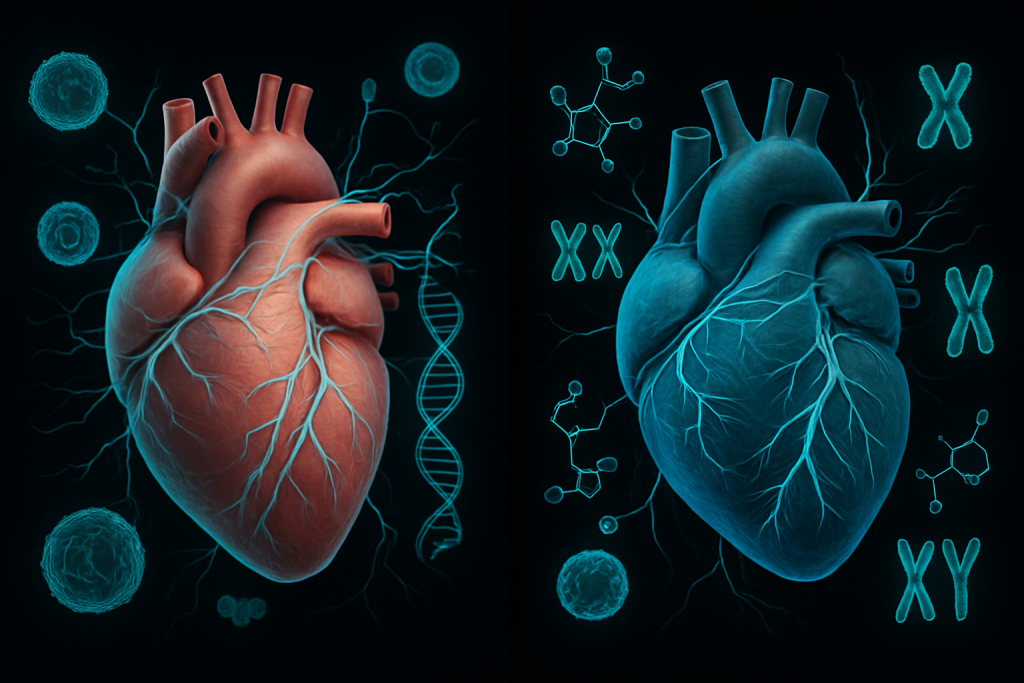
Image generated by AI
Women are more likely to survive sepsis, but men recover faster from surgery. Female brains process pain differently than male brains, yet men die of heart disease at younger ages. These contradictions hint at something profound: biological sex shapes human health in ways that medicine has largely ignored, leading to treatments optimized for one sex that fail for the other. For decades, medical science treated these differences as footnotes to human biology, but they may be central to why the same disease kills different people in different ways.
Today, sex-based medicine is experiencing a renaissance. The National Institutes of Health now mandates that federally funded research include female animals and cells, a policy that barely existed two decades ago. Clinicians are recognizing that women experience heart attacks differently, that autoimmune diseases strike women far more often, and that psychiatric medications work at different doses depending on sex. Understanding these differences isn’t about identity politics—it’s about survival, efficacy, and the future of personalized medicine.
What Is Sex Differences in Physiology and Health Outcomes?
Sex differences in physiology and health outcomes refer to the systematic biological variations between males and females that influence how their bodies function, respond to disease, and benefit from treatment. These differences span multiple levels: genetic, hormonal, cellular, and systemic. While many people conflate sex with gender, biological sex encompasses chromosomal differences (XX versus XY), reproductive anatomy, and crucially, the hormonal and biochemical environments that develop during fetal life and puberty. The result is that two people with the same disease may experience different symptoms, progress at different rates, and respond differently to identical medications.
The scientific recognition of sex differences is surprisingly recent. Until the 1990s, most medical research was conducted primarily on male subjects—both in animal models and in human trials. This wasn’t necessarily intentional exclusion; researchers often viewed female biology as too “noisy” due to menstrual cycle fluctuations and were concerned about harming fetuses in undiagnosed pregnancies. The turning point came in 1993 when the U.S. Food and Drug Administration mandated the inclusion of women in drug trials, followed by growing evidence that excluding half the population was creating medicine that worked suboptimally for that half. Since then, researchers have discovered that sex differences aren’t peripheral—they’re woven through virtually every system in the body.
How It Works in Nature
The roots of sex differences run deep, beginning with the presence or absence of the Y chromosome and its master regulator, the sex-determining region Y (SRY) gene. This single gene triggers a developmental cascade that shapes not just reproductive anatomy but the entire organism. During fetal development, the SRY gene activates the formation of testes, which produce testosterone and anti-Müllerian hormone. In the absence of SRY, the default developmental pathway produces ovaries and a female reproductive system. But these early hormonal differences don’t disappear after birth—they permanently alter brain structure, immune function, and metabolic rates.
Consider the immune system as an example. Female immune cells carry two X chromosomes, while male cells carry only one. This matters because the X chromosome contains hundreds of genes involved in immune regulation, some of which escape the process of X-inactivation (where one X chromosome is randomly silenced in each cell). As a result, women typically mount stronger antibody responses to vaccines and infections—which is protective against many pathogens but also explains why autoimmune diseases like lupus and rheumatoid arthritis are two to three times more common in women. Men, conversely, have higher baseline inflammation but less robust adaptive immune responses, making them more vulnerable to certain infections while paradoxically protecting them from some autoimmune conditions. Evolution hasn’t optimized one immune system; rather, it has optimized different strategies suited to different reproductive investments.
Medical and Scientific Relevance
The clinical implications of sex differences are staggering in scope. Women experience myocardial infarction (heart attack) with different symptoms—often presenting with fatigue, nausea, or jaw pain rather than classic chest pressure—and their coronary arteries show different patterns of disease. They’re also more likely to experience spontaneous coronary artery dissection, a rare condition that is often missed in women because it doesn’t fit traditional risk profiles. Men, meanwhile, show earlier onset of atherosclerotic disease and have higher rates of sudden cardiac death. Cancer outcomes differ by sex too: women with lung cancer who have never smoked respond better to certain targeted therapies, while men show different patterns of metastasis in colorectal cancer. Psychiatric medications require different dosing strategies—women typically require lower doses of antipsychotics and show different side effect profiles, yet clinical guidelines have historically been written around male physiology.
The pharmaceutical industry is beginning to integrate sex-based medicine into drug development. Researchers now study how menstrual cycle hormones affect drug metabolism, recognizing that medications taken during the follicular phase (estrogen-dominant) may behave differently than those taken during the luteal phase (progesterone-dominant). Clinical trial designs are shifting to ensure adequate female representation and to analyze results by sex from the outset. In precision oncology, tumor profiling now includes sex-specific biomarkers, as tumors in female patients often harbor different mutations and show different immunological landscapes. This represents a fundamental shift: medicine moving from a one-size-fits-all model toward recognition that therapeutic efficacy must be evaluated separately for different populations.
Recent Breakthroughs in Sex Differences in Physiology and Health Outcomes
Over the past three years, several landmark discoveries have accelerated understanding of sex-based biology. Research published in leading journals has revealed that the mitochondria—the cellular powerhouses—function differently in male versus female cells, with implications for how cells generate energy and respond to stress. A major 2023 study found that female-derived immune cells mount more vigorous responses to vaccine antigens, explaining partly why women generate better antibody responses to COVID-19 vaccines. Concurrently, neuroscience research has shown that female brains have higher density of certain neurotransmitter receptors, which helps explain why women are more susceptible to anxiety disorders but also why they respond differently to anxiolytic medications. These discoveries aren’t merely academic—they’re reshaping how researchers design experiments and interpret results.
Currently, the field is grappling with fundamental questions about sex differences that remain incompletely answered. How much of the variation in disease outcomes is due to chromosomal differences versus hormonal environment versus social and behavioral factors? Do sex differences vary across populations with different ancestral backgrounds, and if so, why? How can personalized medicine integrate sex-specific insights without reinforcing stereotypes or limiting care? Researchers are also investigating whether the developmental window of vulnerability differs between sexes—for instance, whether prenatal hormone exposure has different lasting effects on male versus female neurodevelopment. These questions require longitudinal studies, diverse populations, and interdisciplinary collaboration spanning molecular biology, epidemiology, and medicine.
Why Sex Differences in Physiology and Health Outcomes Matters for the Future
The integration of sex-based medicine into clinical practice could save thousands of lives annually and prevent countless unnecessary side effects. If drug doses are tailored to sex, if diagnostic criteria account for how diseases present differently, and if treatment protocols are optimized for different physiologies, the efficacy of healthcare could improve dramatically. This matters not only for individual patient outcomes but for public health strategy. Understanding that women and men experience depression, autoimmunity, and cardiovascular disease differently allows health systems to allocate resources more effectively and to design prevention programs that actually work for the intended population. Moreover, as medicine moves toward precision health, incorporating sex as a fundamental variable—alongside genetics, environment, and lifestyle—is essential for algorithms and AI systems to make accurate predictions.
Yet significant challenges remain. Much of what we know about sex differences comes from studies in wealthy nations with predominantly European ancestry; whether findings generalize across populations remains poorly understood. There’s also a risk that emphasizing biological sex differences could be misused to reinforce unfounded stereotypes or to limit care options. Researchers must carefully distinguish between physiological differences that are scientifically robust and social narratives that have no biological basis. Additionally, the vast majority of sex difference research has focused on cisgender people; how sex-based medicine should adapt for transgender and intersex individuals remains an evolving conversation that requires both scientific rigor and ethical sensitivity.
Key Takeaways
- Sex differences in physiology are rooted in chromosomal, hormonal, and developmental factors that influence everything from immune function to drug metabolism to disease presentation.
- Female biology typically involves stronger adaptive immunity but higher autoimmune risk, while male biology shows earlier cardiovascular disease onset and different cancer susceptibilities.
- Integrating sex-based medicine into clinical practice could improve drug efficacy, reduce adverse effects, and enhance diagnostic accuracy across multiple disease categories.
- The field has advanced rapidly in recent years with discoveries about mitochondrial function, immune responses, and neurobiology, yet major questions about population variation and mechanisms remain open.
- Sex-informed medicine represents the future of precision healthcare, but requires careful integration with other biological variables and ethical attention to avoid misuse of biological findings.
Explore TED Talks on Sex Differences in Physiology and Health Outcomes:
TED content is used under CC BY-NC-ND 4.0. © TED Conferences, LLC.
Frequently Asked Questions
Why do female and male brains process pain differently, and what are the physiological mechanisms behind this difference?
Sex hormones like estrogen and progesterone influence pain perception pathways in the nervous system, and differences in neurotransmitter sensitivity between males and females alter how pain signals are processed and modulated. Additionally, structural differences in pain-processing brain regions and variations in immune cell activation contribute to these distinct pain responses.
How do sex differences in the immune system explain why women are more likely to survive sepsis while men recover faster from surgery?
Women's immune systems, particularly their adaptive immune response driven by higher baseline immune activation, provide better protection against severe infections like sepsis, but this heightened response can also increase inflammation and slow surgical recovery. Men's more moderate immune response allows faster post-operative healing but leaves them more vulnerable to overwhelming septic shock.
Why do men die of heart disease at younger ages than women, and what biological role does sex play in this difference?
Estrogen provides cardioprotective effects by improving endothelial function and reducing arterial inflammation, delaying atherosclerosis in women until after menopause when estrogen levels decline sharply. Men lack these hormonal protections throughout life and also have higher baseline testosterone, which can promote atherosclerosis development, leading to earlier cardiovascular disease onset.
Why do autoimmune diseases strike women far more often than men, and what is the biological basis for this sex difference?
Women have stronger adaptive immune responses due to higher baseline immune cell activation and the immunological effects of estrogen, which enhances B and T cell function, making them more prone to autoimmune activation. The X chromosome, of which women have two copies, also carries genes involved in immune regulation, potentially increasing autoimmune disease susceptibility when these regulatory mechanisms malfunction.