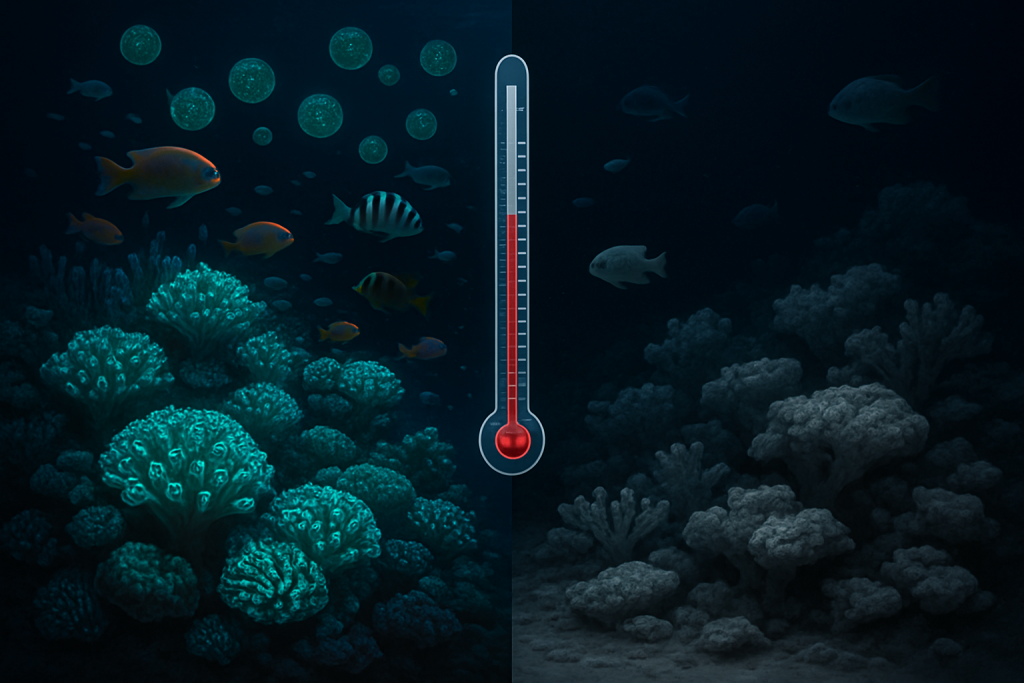
Image generated by AI
Imagine an underwater city where millions of organisms depend on the structural integrity of their shared home—and that home is dying. Coral reefs, often called the rainforests of the sea, cover less than one-tenth of one percent of the ocean floor, yet they support nearly a quarter of all marine species. But these ancient ecosystems are vanishing at an alarming rate, with roughly half of the world’s coral reefs already degraded or destroyed. The question that now captivates marine biologists isn’t whether coral reefs can survive climate change—it’s whether they can adapt quickly enough, and what that adaptation actually looks like at the molecular and ecological level.
The stakes are extraordinary. More than 500 million people worldwide depend on coral reefs for food, coastal protection, and economic survival through tourism and fisheries. When a reef dies, entire food webs collapse, fisheries fail, and coastal communities lose their primary buffer against storms and rising seas. Yet in recent years, scientists have discovered something unexpected: some corals are adapting to warming oceans faster than anyone predicted, raising profound questions about evolution, resilience, and whether human intervention can nudge nature in the right direction. Understanding coral reef health and climate adaptation has become one of the most urgent challenges in marine biology—a frontier where molecular biology, ecology, and climate science converge.
What Is Coral Reef Health and Climate Adaptation?
Coral reef health refers to the biological capacity of a reef ecosystem to maintain its structural complexity, species diversity, and ecological functions despite environmental stress. This encompasses everything from the survival of individual coral polyps—the tiny animals that build the reef—to the presence of fish populations, algae communities, and the countless microorganisms that bind these systems together. Climate adaptation in corals involves both immediate physiological responses to temperature and pH changes, and longer-term evolutionary shifts in coral populations that favor heat-tolerant traits. A healthy reef is essentially one where corals can reproduce, resist disease, and maintain their symbiotic relationships with zooxanthellae—the photosynthetic algae that live inside coral tissues and provide up to 90 percent of their energy through photosynthesis. When reefs fall into poor health, they lose this balance: corals bleach (expel their algae), stop growing, become susceptible to disease, and eventually die, leaving behind a skeletal structure colonized by algae and devoid of fish.
The concept of coral reef health as a measurable scientific metric emerged in the 1980s, when researchers first quantified the devastating impacts of the 1982-1983 El Niño event on reefs across the Pacific. Scientists like Walter Adey and Karen Fabricius developed frameworks for assessing reef condition based on coral cover, species composition, and structural complexity. The idea of adaptation—that corals might evolve heat tolerance—gained serious scientific attention only in the 2000s, after researchers documented “super corals” in the Persian Gulf and Great Barrier Reef that survived temperatures that killed their cousins. This reframed the conversation from inevitable decline to a more nuanced question: under what circumstances can corals adapt, and at what pace can evolutionary processes operate given the speed of climate change?
How It Works in Nature
At the most fundamental level, coral reef health depends on a delicate equilibrium between three players: the coral animal itself, its zooxanthellae symbionts, and the broader reef community. Corals are tiny polyps—related to sea anemones—that secrete calcium carbonate skeletons and cluster together to form colonies. Each polyp hosts thousands of zooxanthellae cells in its tissues, a partnership refined over millions of years. The algae photosynthesize and transfer sugars to the coral, while the coral provides the algae with protection and access to nitrogen and phosphorus from its waste products. When ocean temperatures rise even slightly—as little as 1-2 degrees Celsius above the coral’s historical summer maximum—this relationship fractures. The zooxanthellae become stressed and begin producing reactive oxygen species, toxic byproducts that damage both the algae and the coral host. The coral responds by expelling the algae, a process called bleaching because the algae’s pigments are now gone, revealing the white skeleton beneath. Without their algal energy source, corals can survive for a few weeks, but if the stress persists beyond about four weeks, they starve and die.
Think of this relationship like a carefully calibrated human immune system. Normally, your immune cells and beneficial bacteria coexist in harmony, each supporting the other’s survival. But if your body temperature rises too high due to fever, your immune system malfunctions—it begins attacking cells it should protect. The zooxanthellae-coral partnership works the same way: temperature stress is like a fever that throws the system into chaos. What makes some corals different is their internal thermostat setpoint. Scientists have found that certain coral species, or populations within species, have zooxanthellae or possess coral tissues more resistant to oxidative stress. These “thermally tolerant” corals might maintain their partnership even when temperatures rise by 1.5 degrees instead of only 0.5 degrees. This margin might sound trivial, but in a world where we’re racing against tenths of a degree of warming, every fraction matters.
Climate adaptation happens through multiple mechanisms. First, there’s acclimatization—reversible physiological adjustments within a single organism’s lifetime. A coral exposed to gradually warming temperatures can harden its tissues, increase antioxidant production, and adjust its photosynthetic machinery to handle stress. Second, there’s symbiont shuffling, where corals either switch to different zooxanthellae strains better suited to warmer conditions, or their existing zooxanthellae evolve more heat-tolerant traits over a few coral reproductive cycles. Third, there’s true genetic evolution, where heat-tolerant genes spread through a coral population because individuals carrying those genes survive and reproduce better than their neighbors. This can happen surprisingly quickly—researchers have documented measurable changes in allele frequencies over just 20-30 years in some populations.
Medical and Scientific Relevance
While coral reefs don’t directly treat human disease the way some organisms do, the biomolecules they produce have profound medical and biotechnological value. Corals and their associated microorganisms synthesize compounds used in cancer research, anti-inflammatory treatments, and novel antibiotics. The green fluorescent protein (GFP), which earned the 2008 Nobel Prize in Chemistry and revolutionized molecular biology imaging, was first isolated from a reef-dwelling jellyfish relative. Additionally, understanding how corals resist stress at the molecular level—their heat-shock proteins, antioxidant systems, and gene regulation pathways—provides crucial insights into cellular resilience that applies across biology. Researchers are studying coral stress-response genes to understand how organisms can adapt to rapid environmental change, knowledge with implications for agriculture, medicine, and conservation breeding programs.
Current applications range from reef restoration to biotechnology development. Marine scientists are working with assisted evolution techniques—selectively breeding corals for heat tolerance, cryopreserving coral sperm and larvae, and even using probiotics to enhance coral health. Companies are exploring coral-derived compounds for cosmetics and pharmaceuticals. Most importantly, studying coral adaptation mechanisms provides a real-world laboratory for evolutionary biology, offering insights into whether and how fast organisms can evolve under human-induced stress. The Great Barrier Reef Breeding Initiative, for instance, is collecting and propagating heat-tolerant corals, while labs worldwide are genome-sequencing corals to identify specific genes conferring thermal tolerance—knowledge that could inform future conservation strategies.
Recent Breakthroughs in Coral Reef Health and Climate Adaptation
Between 2021 and 2024, several transformative discoveries have reshaped our understanding of coral adaptability. Researchers at the University of Miami and other institutions sequenced the genomes of heat-tolerant coral populations from the Persian Gulf and discovered that these corals possess genetic variants in heat-shock protein genes and oxidative stress pathways that appear selected for by decades of exposure to extreme temperatures. A landmark 2023 study published in Nature Climate Change documented that some Great Barrier Reef corals have shifted their thermal tolerance by up to 0.5 degrees Celsius over just one decade—a faster rate of evolution than previously thought possible. Simultaneously, researchers in Hawaii and Australia have successfully identified and propagated “super corals” in laboratory conditions, developing protocols for maintaining their heat tolerance across generations. These breakthroughs suggest that adaptation is occurring, though still racing against the pace of warming.
Current frontier research focuses on several crucial questions. How heritable are heat-tolerance traits, and will they persist across multiple generations in wild populations? Can we accelerate coral evolution through selective breeding without reducing genetic diversity and creating inbred populations vulnerable to disease? What role do coral microbiomes—the bacterial communities living within coral tissue—play in thermal tolerance, and can we engineer beneficial microbial communities to boost coral health? Scientists are also investigating whether “coral probiotics”—beneficial bacterial supplements—can enhance a reef’s resistance to warming, drawing parallels from human microbiome research. The race is on to determine whether these adaptations can outpace global warming, or whether they represent only a temporary reprieve.
Why Coral Reef Health and Climate Adaptation Matters for the Future
The implications of coral reef research extend far beyond marine biology. Coral reefs serve as an early warning system for ocean health—they’re like the proverbial canary in the coal mine, responding to warming, acidification, and pollution before most other ecosystems. By studying how (or whether) corals adapt, we’re essentially asking: can ecosystems evolve fast enough to survive human-induced climate change? The answer will shape conservation strategies globally. If corals can adapt, it suggests that protecting the most resilient populations and facilitating assisted evolution might be viable long-term solutions. If they cannot, it signals that only dramatic emissions reductions can save them, reframing climate change from a distant threat to an immediate extinction crisis. Additionally, coral research informs our understanding of evolution itself: traditionally, scientists thought evolution required thousands or millions of years, but corals are challenging that assumption, showing that strong selection pressures can drive measurable change in decades.
However, significant challenges remain. Even heat-tolerant corals are not immune to other stressors—overfishing, pollution, disease, and ocean acidification continue degrading reef health independently of temperature. A coral that survives warming might still suffer from crown-of-thorns starfish outbreaks or skeletal disease. Furthermore, adaptation doesn’t mean corals thrive; it means they might persist. A thermally adapted coral growing slowly in a degraded reef is not equivalent to a healthy, thriving reef ecosystem. There’s also the ethical question of whether assisted evolution—essentially managing coral evolution through human intervention—represents conservation or hubris. And perhaps most critically, coral adaptation cannot happen fast enough if warming continues at current rates; even optimistic projections suggest that without substantial emissions reductions, most coral reefs will become functionally extinct by 2100, regardless of adaptive capacity.
Key Takeaways
- Coral reef health depends on the symbiotic relationship between corals and zooxanthellae, a partnership disrupted when ocean temperatures rise beyond each population’s thermal tolerance threshold.
- Corals adapt to warming through multiple mechanisms: acclimatization (reversible physiological adjustment), symbiont shuffling (switching to heat-tolerant algae strains), and genetic evolution (spread of heat-tolerance genes through populations).
- Recent research has documented “super corals” with measurable thermal tolerance increases and identified specific genes conferring heat resistance, opening possibilities for selective breeding and assisted evolution programs.
- Current science reveals that some coral populations can evolve heat tolerance faster than previously thought—potentially 0.5 degrees Celsius per decade—but this pace still lags behind projected warming scenarios.
- Understanding coral adaptation has profound implications for conservation strategy, evolutionary biology, and whether ecosystems can evolve fast enough to survive human-induced climate change, with consequences affecting over 500 million people dependent on reef ecosystems.
Explore TED Talks on Coral Reef Health and Climate Adaptation:
TED content is used under CC BY-NC-ND 4.0. © TED Conferences, LLC.
Frequently Asked Questions
What molecular mechanisms allow some corals to adapt to warming ocean temperatures faster than expected?
Corals can rapidly adapt through changes in their symbiotic algae (zooxanthellae) composition, heat-shock protein expression, and gene regulation that enhance thermal tolerance without requiring genetic mutations across generations. Some populations also show epigenetic modifications—chemical changes to DNA that don't alter the underlying genetic code—that can be inherited and help offspring survive warmer conditions more quickly than traditional evolution would predict.
How does coral bleaching relate to reef health, and what causes it at the physiological level?
Coral bleaching occurs when heat stress causes corals to expel their symbiotic zooxanthellae algae, which provide the coral with essential nutrients and pigmentation; without these algae, the coral turns white and loses its primary food source. If water temperatures remain elevated for extended periods, the coral starves and dies, devastating the entire reef ecosystem that depends on the living coral structure.
Why do more than 500 million people depend on coral reefs, and what ecosystem services do they provide?
Coral reefs support critical ecosystem services including food security through fisheries that feed millions, coastal protection by breaking wave energy and preventing erosion, and economic revenue through tourism and pharmaceutical discoveries. Additionally, reef-associated organisms and plants provide livelihoods for fishing communities and serve as natural barriers that reduce storm surge and flood damage for coastal populations.
Can human intervention help corals adapt to climate change, and what approaches show scientific promise?
Yes, assisted adaptation strategies such as selective breeding of heat-tolerant coral strains, coral restoration programs, and creating artificial reef structures show promise in laboratory and field trials. However, these interventions work best alongside climate mitigation efforts to reduce ocean warming, as adaptation alone cannot sustain reefs if global temperatures continue rising unchecked.