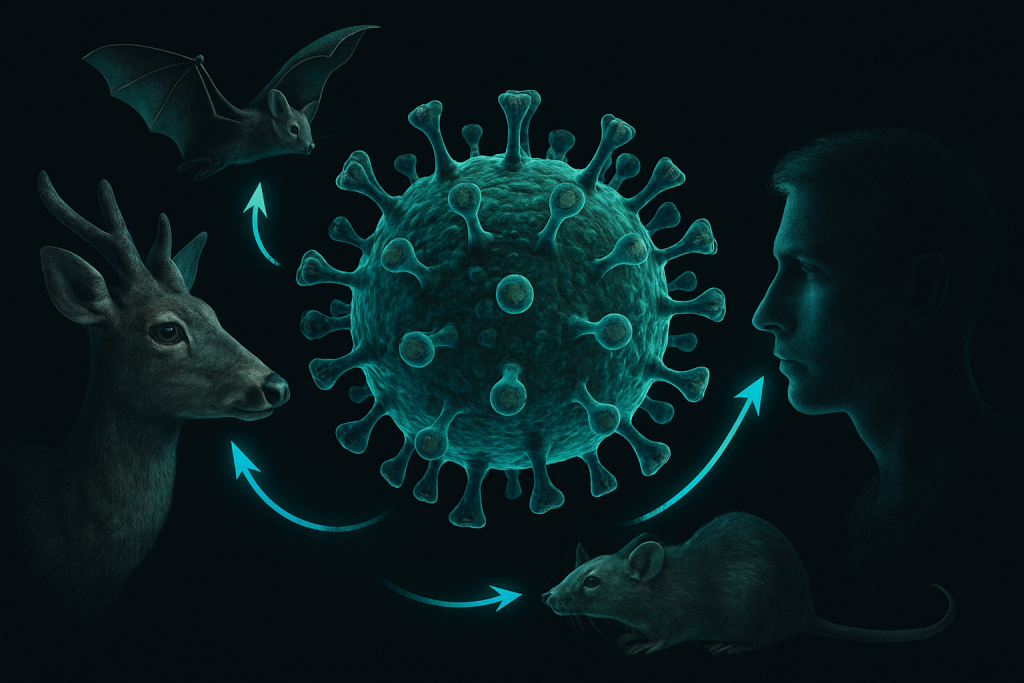
Image generated by AI
In 2019, a novel coronavirus emerged in Wuhan, China, jumping from bats or pangolins to humans and triggering a global pandemic that would reshape civilization for years to come. Yet this catastrophic event was not an anomaly—it was a manifestation of a fundamental biological process that occurs constantly in nature, largely invisible until it becomes catastrophic. The question that scientists have grappled with since long before COVID-19 is deceptively simple: why can some viruses infect only a single species while others can jump between dozens?
This question sits at the intersection of evolutionary biology, molecular virology, and public health—three fields that have become increasingly urgent to understand in an era of climate change, urbanization, and intensive animal agriculture. Viral spillover events, where pathogens leap from their natural animal hosts into human populations, have sparked nearly every major pandemic in modern history, from influenza to Ebola to SARS-CoV-2. Understanding the rules that govern which viruses can infect which hosts has become not merely an academic exercise, but a matter of human survival and global security.
What Is Viral Host Range and Zoonotic Spillover?
Viral host range refers to the spectrum of animal species that a particular virus can infect and replicate within. Some viruses are extraordinarily narrow in their preferences—the measles virus, for instance, has evolved to infect only humans and primates, and even among primates, its ability to establish sustained transmission remains limited. Other viruses are promiscuous generalists, capable of infecting dozens of species across different taxonomic groups. This variation is not random; it reflects millions of years of coevolution between viruses and their hosts, written into the very structure of viral proteins and the cellular machinery they exploit.
Zoonotic spillover—or zoonosis—describes the moment when a virus escapes the ecological niche of its natural animal reservoir and establishes itself in a new host species, particularly humans. The term comes from the Greek “zoon” (animal) and “nosos” (disease), capturing the essential biology: these are diseases that spring from animals. What makes spillover events so consequential is their unpredictability and explosive potential. A virus that has circulated harmlessly in bat populations for millennia can suddenly acquire the capacity to bind human cells, transmit between people, and spread globally within weeks.
The concept of zoonotic disease is ancient—Hippocrates noted that herds and humans sometimes shared illnesses—but the modern scientific understanding of host range and spillover mechanisms emerged in the mid-20th century as molecular virology developed. The breakthrough came with electron microscopy and later DNA sequencing, which allowed researchers to see that viruses were not monolithic entities but intricate molecular machines, each one precisely engineered through evolutionary selection to exploit specific cellular vulnerabilities. By the 1970s and 1980s, scientists began to understand that host range was determined by a handful of critical viral proteins and the cellular receptors they recognized, much like a key fitting into a lock.
How It Works in Nature
At its most fundamental level, viral host range is determined by the collision of molecular compatibility. A virus cannot infect a cell it cannot enter, and entry depends on proteins on the virus’s outer surface—called spike proteins, envelope proteins, or attachment proteins—finding and binding to specific receptors on the target cell’s surface. The coronavirus spike protein, for instance, binds to the ACE2 receptor, which exists on cells lining the lungs, intestines, and heart. When the spike and ACE2 find each other, a molecular embrace begins that leads to membrane fusion and viral entry. If a species lacks sufficient ACE2 receptors, or if the receptors have slightly different shapes, the virus cannot efficiently enter cells and establish infection.
But molecular lock-and-key fitting is only the beginning. Once inside a cell, the virus faces a gauntlet of additional barriers. The cell’s cytoplasm contains antiviral defense mechanisms—proteins called interferons that activate immune responses before the virus can replicate. The viral genome must be processed by the host’s cellular machinery in ways compatible with viral replication. The newly replicated virus must navigate the cell’s secretory pathways to escape and infect neighboring cells. Finally, if the virus is to maintain transmission between individuals, it must avoid killing its host too quickly, or triggering such an intense immune response that transmission is blocked. Think of it as a series of locks, each requiring its own key, and a virus must have keys that fit the locks of its new host—or it must rapidly evolve them.
Consider the jump of influenza virus from birds to humans. Avian influenza viruses circulate in water fowl globally, shedding in feces with relatively little consequence to the birds themselves. These viruses have evolved spike proteins optimized to bind to sialic acid receptors abundant in duck intestinal cells. Human influenza viruses, by contrast, have evolved spike proteins that preferentially bind to sialic acid receptors found in human respiratory cells. When an intermediate host—pigs are frequent culprits—becomes infected with both avian and human influenza simultaneously, the viral genes can shuffle and recombine, creating pandemic strains that combine the novelty of avian viruses with the human-adaptation of circulating strains. This is not random mutation; it is a reassortment of pre-existing solutions, a genomic rearrangement that sometimes—rarely, but consequentially—creates a virus that can spread efficiently in humans.
Medical and Scientific Relevance
Understanding viral host range has become foundational to both pandemic preparedness and infectious disease surveillance. Public health agencies worldwide now monitor wildlife populations for novel viruses, attempting to predict which zoonotic pathogens pose the greatest spillover risk. The logic is straightforward: if we can identify viruses circulating in animal reservoirs before they adapt to humans, we can develop vaccines, therapeutics, and surveillance systems in advance of crisis. The NIH-funded PREDICT program, which operated from 2009 to 2020, trained virology teams across Africa, Southeast Asia, and the Americas to identify novel viruses in wildlife before they spilled over into human populations. Similar programs operate in China, India, and other regions with high spillover risk.
This surveillance has yielded remarkable discoveries. Researchers have identified thousands of previously unknown viruses in bats, rodents, primates, and other animals. The findings have revealed that bats, in particular, harbor an extraordinary diversity of coronaviruses and other RNA viruses—likely because their unique physiology, with extremely high metabolic rates and body temperatures approaching 40°C, creates an environment where viruses evolve rapidly. Studies of SARS-like coronaviruses in Chinese bat populations have identified dozens of viruses more closely related to SARS-CoV-2 than to the original SARS virus, suggesting that the pandemic coronavirus was not a singular anomaly but one realization among many possible spillover events waiting to happen.
Beyond surveillance, understanding host range informs the development of next-generation vaccines and antivirals. Researchers now use structural biology to design vaccines that present viral proteins in configurations that trigger robust immune responses in humans. The mRNA vaccines developed for COVID-19 used knowledge of the spike protein’s structure and how it binds to human ACE2 receptors to engineer precise immunogens. Similarly, broad-spectrum antivirals—drugs that can inhibit multiple related viruses—rely on identifying common targets across viral families. If researchers understand that all paramyxoviruses, for instance, share certain essential polymerase proteins, they can design drugs targeting those conserved regions, potentially providing coverage against both known and unknown future spillover events.
Recent Breakthroughs in Viral Host Range and Zoonotic Spillover
The last three years have witnessed remarkable advances in our capacity to predict spillover risk. In 2022, researchers at UC Davis published a comprehensive model predicting which mammalian species are most likely to host human-transmissible viruses, and which existing animal viruses pose the greatest pandemic threat. Using machine learning algorithms trained on known zoonotic pathogens, they identified characteristics shared by high-risk viruses: those infecting multiple mammalian orders, those with RNA genomes (which mutate faster than DNA), and those naturally harboring high genetic diversity. The model flagged several hundred viruses currently circulating in wildlife as posing measurable pandemic risk, allowing public health resources to be targeted toward surveillance and vaccine development for the most dangerous candidates.
Additionally, single-cell sequencing and functional genomics have revolutionized our ability to identify which cells within a host organ a virus can actually infect. Researchers can now map the distribution of ACE2 receptors or other viral entry factors cell-by-cell across tissues, revealing that viral tropism—the cell types a virus infects—is far more heterogeneous than previously recognized. This has profound implications for understanding pathogenesis: the severity of COVID-19, for instance, appears partly determined by which cell types are infected and how strongly they express ACE2. Some individuals have high ACE2 expression in lung epithelial cells, leading to severe respiratory disease, while others have predominantly intestinal infection, causing gastrointestinal symptoms.
Current research frontiers include synthesizing this cellular data with evolutionary modeling to predict not just whether spillover will occur, but when and where. Scientists are investigating whether certain environmental or climatic conditions trigger spillover events with greater frequency. Preliminary evidence suggests that habitat disruption, which brings wildlife into closer contact with humans and livestock, is a major risk factor. Armed with this knowledge, researchers are collaborating with conservation biologists and epidemiologists to identify geographic hotspots where spillover risk is highest—the “viral dark matter” regions where surveillance and outbreak response systems remain weakest, even though spillover risk is greatest.
Why Viral Host Range and Zoonotic Spillover Matters for the Future
The relevance of viral host range and zoonotic spillover extends far beyond laboratory curiosity into the fundamental architecture of our civilization in the 21st century. Climate change is reshaping where animals live and how they interact, bringing species into novel contact and creating conditions where viruses previously confined to tropical regions may spread to temperate zones. Simultaneously, human population growth and agricultural expansion are encroaching on wildlife habitats at unprecedented rates, fragmenting ecosystems and increasing the probability of spill-over events. Some virologists estimate that of the roughly 1.7 million viruses thought to exist in mammalian and avian hosts, fewer than 10,000 have been characterized. The implication is sobering: we have likely identified only a small fraction of the zoonotic threats we will face.
Yet there is reason for measured optimism. The technological infrastructure for responding to novel spillover events is more sophisticated than ever. Metagenomic sequencing—the ability to sequence all genetic material in a sample regardless of whether we’ve encountered it before—means that novel viruses can be identified and characterized within days rather than months. mRNA vaccine platforms proved capable of generating effective vaccines against SARS-CoV-2 within a year of the virus’s genome sequence being published. There is serious momentum toward developing platform vaccines—single inoculations that provide broad protection against entire viral families—which could transform pandemic response from crisis management to routine medical practice.
The remaining challenges are formidable. Surveillance systems remain vastly unequal across the globe, with wealthy nations capable of detecting novel viruses far more readily than middle-income or low-income countries, where spillover risk is often highest. Vaccine distribution inequities mean that even effective pandemic countermeasures may not reach vulnerable populations quickly enough. Political will to curtail activities that increase spillover risk—particularly industrial animal agriculture and habitat destruction—remains tentative. And perhaps most fundamentally, the evolutionary process that generates novel viruses capable of spillover is not something humans can stop; it is the background radiation of biology itself, occurring whether we wish it or not.
Key Takeaways
- Viral host range describes which animal species a virus can infect, determined by molecular compatibility between viral proteins and cellular receptors, along with compatibility with intracellular replication machinery.
- Zoonotic spillover occurs when a virus adapted to animal populations acquires the capacity to infect and transmit between humans, often through intermediary hosts or through direct mutation and selection.
- The most promising applications of host range research include predictive modeling to identify high-risk viruses before spillover, surveillance in wildlife populations at spillover hotspots, and platform vaccine development for viral families.
- Recent breakthroughs include machine learning models predicting spillover risk, single-cell mapping of viral receptor distribution, and integration of epidemiological and ecological data to identify spillover triggers.
- Understanding viral host range and preventing catastrophic spillover events will define global health security for coming decades, particularly as climate change and habitat destruction reshape human-wildlife contact patterns.
Explore TED Talks on Viral Host Range and Zoonotic Spillover:
TED content is used under CC BY-NC-ND 4.0. © TED Conferences, LLC.
Frequently Asked Questions
What molecular mechanisms allow a virus to cross species barriers and infect a new host?
A virus must be able to recognize and bind to specific receptor proteins on the surface of a new host's cells, and its genetic material must be compatible with that host's cellular machinery for replication. Mutations in viral genes encoding surface proteins or internal replication machinery can enable recognition of novel receptors, facilitating spillover to new species.
Why do some viruses have narrow host ranges while others can infect multiple species?
Viruses with narrow host ranges typically depend on highly specific receptor-ligand interactions or have evolved specialized replication strategies tied to particular host cell biology, creating biological barriers to infection in other species. Conversely, viruses with broad host ranges possess genetic flexibility and can recognize conserved receptor molecules present across multiple species or tolerate variation in host cellular environments.
How does environmental stress like climate change increase the likelihood of zoonotic spillover events?
Climate change drives wildlife species into closer contact with humans and livestock as habitats shift and fragment, increasing the frequency of virus exposure opportunities between species. Environmental stress also weakens animal immune systems and increases viral shedding, creating conditions that make spillover events more probable when contact occurs.
Can scientists predict which viruses are most likely to cause the next pandemic based on their host range characteristics?
Scientists can identify high-risk viruses by analyzing their genetic capacity for adaptation, their current presence in animal populations near human settlements, and their demonstrated ability to replicate across multiple species, though perfect prediction remains impossible due to the complexity of evolutionary processes. Studies of viral receptor compatibility across species and surveillance of spillover events in wildlife provide probabilistic frameworks for assessing pandemic risk.