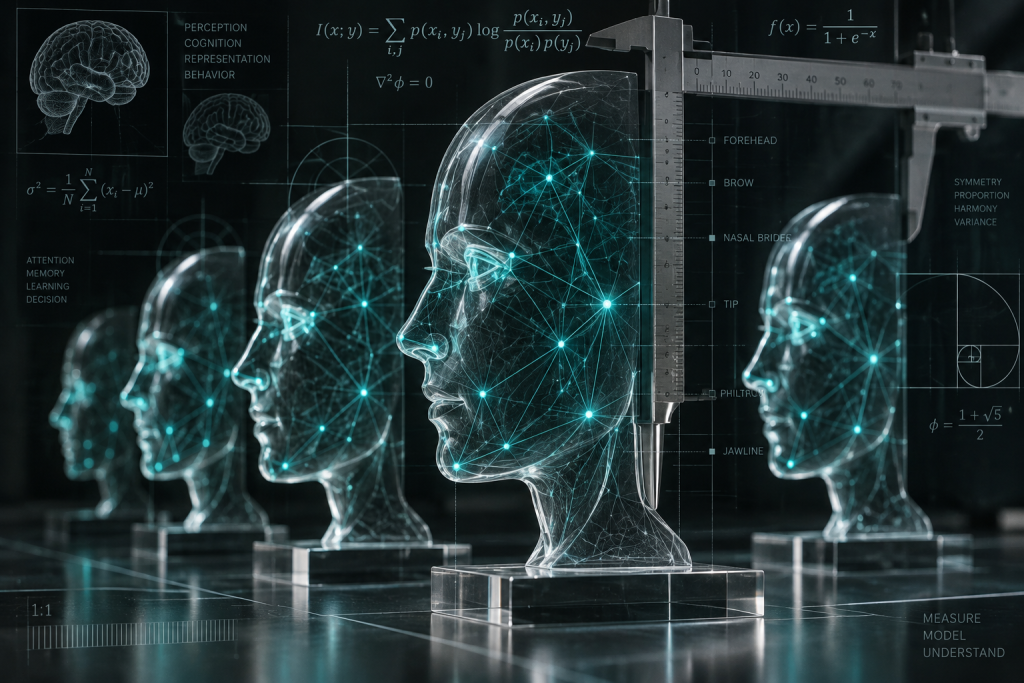
Image generated by AI
Within milliseconds of seeing a stranger’s face, your brain has already made dozens of judgments about them—whether they’re trustworthy, competent, attractive, or threatening. You haven’t heard them speak, learned their name, or discovered anything about their character, yet your mind has constructed an elaborate psychological profile based entirely on the arrangement of their facial features. This lightning-fast evaluation happens so automatically that we rarely notice it occurring, yet it shapes everything from job interviews to romantic relationships to how we navigate social hierarchies.
These snap judgments reveal something profound about human cognition: our brains are fundamentally prediction machines, constantly generating expectations about the people around us based on incomplete visual information. The science of first impressions has exploded over the past two decades, transforming from a curiosity of social psychology into a field that touches neurobiology, evolutionary biology, artificial intelligence, and even law and ethics. Understanding why we make these judgments—and how often they mislead us—has become increasingly urgent in an age where algorithms trained on facial recognition are making consequential decisions about hiring, lending, and criminal justice.
What Is First Impressions and Facial Features Influencing Expectations?
First impressions based on facial features represent the rapid cognitive process by which humans form judgments, attributions, and expectations about others based primarily on the appearance of their face. Within just 100 to 500 milliseconds—faster than conscious awareness—the human brain extracts information from facial geometry, skin tone, expression, and other visual markers to generate inferences about personality, intelligence, trustworthiness, dominance, and social status. These initial judgments then function as anchors that influence how we subsequently interpret that person’s behavior, words, and intentions, often persisting even when contradicted by direct evidence about their actual character or capabilities.
The scientific study of first impressions dates back to the 1940s when psychologist Solomon Asch conducted groundbreaking experiments showing that people form coherent impressions of others remarkably quickly. However, the field accelerated dramatically in the 1990s and 2000s following work by Janine Willis and Alexander Todorov at Princeton University, who demonstrated that facial judgments of trustworthiness and competence could be reliably measured and predicted. Their research revealed that even when people were given longer exposure to faces—several seconds instead of milliseconds—their judgments didn’t fundamentally change, suggesting that first impressions are remarkably stable and resistant to revision. This counterintuitive finding launched hundreds of subsequent studies investigating what facial features drive these judgments and why our brains are so committed to snap evaluations.
What the Science Says
The mechanism underlying facial first impressions involves multiple neural systems working in concert. The amygdala, a brain region crucial for detecting threat and evaluating emotional significance, activates very rapidly when processing faces—sometimes before information even reaches conscious awareness. Simultaneously, regions of the prefrontal cortex associated with social reasoning and theory of mind begin attributing mental states and personality traits to the face. The fusiform face area, a specialized region in the visual cortex dedicated to face recognition, extracts detailed geometric information about facial structure. Together, these systems generate rapid inferences by matching the observed facial features against accumulated patterns learned from a lifetime of social experience. Importantly, this process is not deliberative or conscious; it happens automatically, almost inevitably, even when we consciously distrust our own judgments.
Think of facial perception like a sophisticated prediction algorithm that your brain has been training since infancy. When you see a baby’s round face with large eyes and a small chin, something in your brain responds with a sense of cuteness and protectiveness—features that Konrad Lorenz termed “baby schema” that trigger caregiving instincts across mammalian species. Similarly, faces with wider cheekbones and more angular jaws trigger associations with testosterone and dominance, while faces with softer features and higher voices activate associations with femininity and agreeableness. These connections aren’t arbitrary; they emerge from both statistical patterns in the real world and deep evolutionary pressures that made rapid social assessments survival-relevant. Your brain isn’t making logical deductions; it’s activating learned associations between facial geometry and social categories at speeds that outpace conscious reasoning.
How This Affects Everyday Life
The real-world consequences of facial first impressions are profound and pervasive. Research consistently demonstrates that facial features influence hiring decisions—a 2019 study found that job candidates with “baby-faced” features receive fewer callbacks for leadership positions despite equivalent qualifications, while another study showed that perceived facial competence significantly predicts election outcomes for political candidates. Physical attractiveness, driven largely by averageness, symmetry, and specific geometric ratios, influences earnings, sentencing lengths in criminal courts, and access to educational opportunities. Perhaps most troublingly, faces perceived as more “criminal” or “threatening”—characteristics that correlate with race and other demographic factors—influence both law enforcement stop-and-search decisions and jury verdicts, contributing to systemic inequities in criminal justice. These effects persist even among experts; judges, teachers, and doctors all show evidence of facial biases in their professional judgments, suggesting that expertise and training don’t automatically override these automatic evaluative processes.
The influence extends into domains we often don’t recognize. Dating apps and online platforms have amplified the importance of facial features by making them the primary decision criterion for initial matches. Employers using video interviews increasingly rely on facial analysis software that claims to predict candidate performance based on subtle facial features—a practice that many organizations have begun backing away from following concerns about bias and the scientific unreliability of such inferences. Meanwhile, artificial intelligence systems trained to recognize faces and infer attributes have inherited and sometimes amplified these human biases, creating a feedback loop where algorithmic discrimination reinforces existing social inequities. Even in medicine, physicians’ snap judgments about patient faces influence diagnostic decisions and treatment recommendations, sometimes for better (enabling rapid threat assessment) but often for worse (contributing to health disparities for patients perceived as less trustworthy).
Recent Breakthroughs in First Impressions and Facial Features Influencing Expectations
Recent research has revealed surprising complexity in how facial features influence expectations, challenging earlier assumptions that judgments are purely automatic and immutable. A 2023 study published in Nature Human Behaviour found that while initial facial judgments do form very rapidly, they’re more malleable than previously thought when people encounter contradictory behavioral information. Researchers from multiple institutions have begun mapping the specific neural circuits that underlie facial evaluations with unprecedented precision using fMRI and other neuroimaging techniques. Additionally, new machine learning approaches have identified which facial features most strongly predict judgment outcomes—moving beyond vague references to “trustworthiness” toward concrete measurements of facial width-to-height ratios, eye position, brow angle, and other measurable geometric properties. This work has revealed that many face-based judgments correlate more strongly with specific demographic categories (age, sex, race) than with actual personality traits, suggesting that facial stereotypes may drive much of what we interpret as genuine personality inference.
The frontier of current research involves understanding individual differences in how people make facial judgments and investigating whether these biases can be reduced through training or awareness. Scientists are also investigating how facial judgments interact with other forms of nonverbal communication—how does a trustworthy-looking face change our impression when paired with a threatening tone of voice or aggressive posture? Neuroscientists are exploring whether the rapid facial judgments made by the amygdala can be overridden by slower, more deliberative prefrontal processes, and what conditions facilitate such cognitive control. Another active area involves understanding how cultural factors shape facial stereotypes—the “baby schema” may be universal, but judgments about dominance, health, and intelligence from facial features vary significantly across cultures, suggesting that much of face-based impression formation is learned rather than innate.
Why First Impressions and Facial Features Influencing Expectations Matters for the Future
As artificial intelligence systems increasingly mediate human social and economic interactions, understanding facial first impressions becomes a matter of urgent practical and ethical significance. Facial recognition technology is now deployed in hiring, lending, criminal justice, and countless other domains where decisions carry significant consequences for people’s lives. If these systems incorporate or amplify the biases inherent in human facial judgment—and evidence strongly suggests they do—they risk automating and legitimizing existing discrimination at scale. Conversely, understanding the mechanisms of facial judgment could enable us to build better safeguards into AI systems, design interventions that reduce facial bias in human decision-making, and create more equitable hiring, lending, and criminal justice processes. The future of fairness in algorithmic decision-making may depend on how well we understand the cognitive foundations of facial bias.
Several significant challenges remain to be overcome. First, while we understand that facial features influence judgments, we still struggle to predict with precision which features matter most and why—different studies sometimes reach conflicting conclusions about whether particular face-based judgments reflect real patterns or pure stereotyping. Second, the relationship between facial appearance and actual personality traits remains deeply contentious; many studies purporting to show that faces reveal personality have been criticized for circularity or methodological flaws. Third, developing effective interventions to reduce facial bias has proven difficult; awareness of bias often fails to eliminate it, and some debiasing interventions can backfire by triggering reactance. Finally, there’s the philosophical question of whether and how we should incorporate facial information into consequential decisions—even if faces do carry some valid information about personality or capability, the marginal predictive value may not justify the discrimination costs.
Key Takeaways
- Humans form judgments about others’ trustworthiness, competence, and personality from facial features in milliseconds—faster than conscious awareness—based on patterns learned throughout life and shaped by evolutionary pressures.
- The mechanism involves multiple brain regions including the amygdala, prefrontal cortex, and fusiform face area working automatically to match observed facial geometry against learned social associations.
- Facial first impressions influence consequential real-world outcomes including hiring decisions, criminal sentencing, medical treatment, and educational opportunities across all professional domains.
- Recent research reveals that while facial judgments form rapidly, they may be more malleable than previously believed and often reflect demographic stereotyping more than genuine personality inference.
- As AI systems increasingly automate decision-making based on facial analysis, understanding and mitigating facial bias has become critical to building equitable institutions and preventing algorithmic discrimination at scale.
Explore TED Talks on First Impressions and Facial Features Influencing Expectations:
TED content is used under CC BY-NC-ND 4.0. © TED Conferences, LLC.
Frequently Asked Questions
Why does the human brain form facial judgments within milliseconds?
The brain is a prediction machine that rapidly generates expectations based on visual cues to quickly assess social threats and opportunities for survival. This automatic process evolved because speed of social assessment provided adaptive advantages in ancestral environments where rapid threat detection was critical.
What is the connection between facial feature analysis and expectation formation in first impressions?
The brain extracts information from facial proportions, symmetry, and other morphological features to construct psychological profiles and behavioral predictions about strangers before any actual interaction occurs. These visual-to-psychological inferences happen largely outside conscious awareness and shape subsequent social expectations and behaviors.
How accurate are snap judgments based solely on facial features?
The article indicates that first impressions based on facial features often mislead us, suggesting these rapid judgments frequently diverge from actual personality, competence, or trustworthiness. The accuracy varies by trait, but the evidence demonstrates that facial appearance is a poor predictor of actual character or capabilities.
Are there real-world consequences when facial feature judgments influence consequential decisions?
Yes, facial-based snap judgments demonstrably affect outcomes in hiring, lending, and criminal justice, and this problem is magnified when algorithms trained on facial recognition automate these biased assessments. These applications show that first impression mechanisms can produce systematic discrimination with measurable harm in high-stakes contexts.