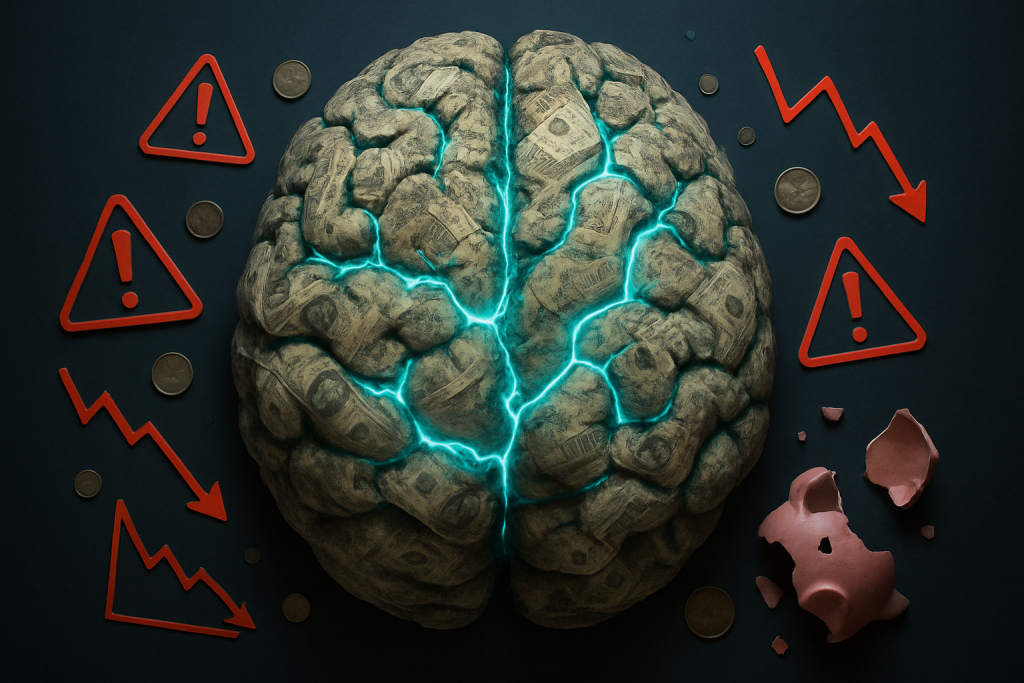
Image generated by AI
When your rent is due in three days and your bank account balance reads $847, your brain enters a peculiar state. Studies show that financial stress doesn’t just make you anxious—it fundamentally rewires how you think, plan, and decide. Researchers have discovered that scarcity of money triggers the same cognitive patterns as scarcity of time, activating ancient survival mechanisms that were never designed for modern financial complexity. What emerges is a paradox: the moment when you most need to think clearly about money is precisely when your brain is least equipped to do so.
This phenomenon has become increasingly urgent in contemporary life. With economic volatility, rising costs of living, and wealth inequality affecting billions of people worldwide, understanding how financial stress distorts decision-making has moved from academic curiosity to pressing public health concern. Poor financial decisions made under stress compound over time—missed payments lead to debt spirals, impulsive spending undermines long-term goals, and the cognitive burden of financial worry depletes mental resources needed for work, relationships, and health. For policymakers, employers, and individuals alike, understanding the psychology of financial stress offers a pathway to better outcomes.
What Is Financial Stress and Decision-Making?
Financial stress refers to the psychological and physiological strain that arises when individuals face actual or perceived scarcity of money, combined with uncertainty about meeting financial obligations. Decision-making under financial stress is the cognitive process by which people choose financial actions—whether to spend or save, borrow or invest, pay bills or delay them—while experiencing this strain. The crucial insight from behavioral science is that financial stress doesn’t simply make decisions harder; it changes the very machinery of cognition itself. When you’re financially stressed, your working memory capacity shrinks, your time horizon shortens, and your brain’s reward system becomes hypersensitive to immediate gains. This isn’t a character flaw or a sign of poor discipline—it’s a predictable output of neurobiology under specific conditions.
The scientific study of financial stress and decision-making emerged prominently in the early 2000s, though its roots stretch back to Herbert Simon’s concept of “bounded rationality” in the 1950s. The breakthrough moment came with economist Sendhil Mullainathan and psychologist Eldar Shafir’s 2013 book “Scarcity: Why Having Too Little Means So Much,” which synthesized research across behavioral economics, psychology, and neuroscience. Their work revealed that financial scarcity operates like a form of cognitive tax—it consumes mental resources the same way solving a difficult math problem does. This reframed financial stress not as a moral failing but as an engineering problem: the human brain wasn’t designed to operate efficiently under conditions of monetary scarcity combined with modern financial complexity.
What the Science Says
The mechanism underlying poor financial decisions under stress involves several interacting neural and cognitive systems. The prefrontal cortex, responsible for long-term planning, impulse control, and complex reasoning, becomes less active when financial stress triggers the amygdala and other threat-detection systems in the limbic brain. This is an evolutionary inheritance—when your ancestors faced resource scarcity, the optimal strategy was often to consume immediately rather than save for an uncertain future. Simultaneously, financial stress activates what researchers call “scarcity psychology,” a tunnel vision effect where the mind becomes preoccupied with the immediate problem. You can’t stop thinking about your depleted bank account, which consumes working memory that would otherwise be available for rational deliberation. Studies using fMRI brain imaging have shown that individuals under financial stress show reduced activation in areas associated with complex decision-making and increased activation in areas associated with emotional processing and threat detection.
Consider an analogy: imagine you’re trying to solve a complex puzzle while holding your breath. The effort of breath-holding consumes cognitive resources, leaving fewer mental cycles available for puzzle-solving. Your mistakes multiply not because you’re incapable of solving puzzles, but because your brain is divided. Financial stress works similarly. A person earning $20,000 annually who faces an unexpected $500 car repair isn’t just dealing with the repair itself—they’re simultaneously managing the cognitive load of financial threat assessment, emotional regulation, and competing priorities. Research from Princeton and Harvard found that people in financial scarcity showed a 13-point drop in IQ performance equivalent to losing one night of sleep. This wasn’t permanent cognitive damage; it was the temporary rent paid by the brain for managing scarcity.
How This Affects Everyday Life
The real-world consequences of financial stress and decision-making appear across every domain of life. People under financial stress are more likely to make payday loans at interest rates of 400% or higher, not because they’re mathematically illiterate, but because the immediate relief of cash overwhelms consideration of future consequences. They’re more likely to overdraft bank accounts, incurring fees that deepen financial distress. They’re more likely to delay medical care, miss doses of medication, or avoid preventive health measures—not from recklessness, but from the cognitive overwhelm that makes future-oriented decisions nearly impossible. Stress hormones like cortisol and adrenaline, elevated chronically in financially stressed individuals, directly impair the prefrontal cortex’s executive function while strengthening the amygdala’s emotional reactivity. Over time, this rewiring can lead to anxiety disorders, depression, and cognitive decline. A meta-analysis of longitudinal studies found that individuals experiencing financial stress showed a 35% increased risk of major depression within two years.
In practical domains, this psychology shapes behavior across industries and sectors. The financial services industry has recognized this pattern—predatory lending practices deliberately exploit the cognitive vulnerabilities of financially stressed individuals, offering immediate relief while concealing long-term consequences. Credit card companies design interfaces to encourage minimum payments, which feel manageable in the moment but extend debt indefinitely. Conversely, companies developing financial inclusion technologies for low-income populations increasingly incorporate insights from this research: apps that automate savings, remove the decision burden, or provide small cognitive nudges toward better choices. Healthcare systems serving low-income populations have found that addressing financial stress alongside medical treatment improves health outcomes more effectively than medical intervention alone. Workplace financial wellness programs, now adopted by 68% of large U.S. employers according to the Society for Human Resource Management, explicitly target financial stress reduction as a means of improving employee productivity and mental health.
Recent Breakthroughs in Financial Stress and Decision-Making
Over the past three years, research has revealed increasingly specific mechanisms linking financial stress to decision-making errors. A 2022 study in the journal Social Cognitive and Affective Neuroscience found that financial stress specifically impairs the brain’s ability to discount future outcomes—meaning stressed individuals become unable to properly weigh future consequences against present desires. Another breakthrough, published in 2023 in Psychological Science, demonstrated that financial stress doesn’t uniformly impair all decisions; rather, it creates a specific pattern where immediate, concrete choices are made reasonably well, but abstract, future-oriented decisions deteriorate sharply. This explains why a financially stressed person might negotiate effectively on a current bill but fail to plan for retirement. Researchers also discovered that the effect is bidirectional: experiencing financial stress reduces decision-making capacity, which leads to worse financial decisions, which increases financial stress—a vicious cycle that can trap individuals for years.
Current research frontiers are exploring interventions with neuroscientific precision. Cognitive behavioral therapy adapted specifically for financial stress has shown promise in clinical trials, helping individuals develop decision-making strategies that bypass cognitive weaknesses under stress. Behavioral economists are investigating “choice architecture”—how the structure of financial decisions can be redesigned to make good choices easier automatically. For instance, changing default settings so that raises automatically increase retirement contributions rather than requiring active enrollment dramatically improves long-term financial outcomes. Neuroscientists are examining whether specific meditation practices can strengthen prefrontal control under stress, with preliminary results suggesting even brief mindfulness training can partially protect decision-making capacity during financial threat. An open question remains whether the relationship between financial stress and cognitive impairment varies across populations—early evidence suggests that cultural background, prior economic stress, and social support networks all modulate the effect, but the specifics remain unclear.
Why Financial Stress and Decision-Making Matters for the Future
Understanding financial stress and decision-making has implications that extend far beyond personal finance. Climate change represents perhaps the ultimate test of humanity’s ability to make long-term financial decisions in the face of existential stress and uncertainty. If financial stress impairs our ability to think beyond the immediate term, what happens when the stress is climate anxiety? Public health crises, as demonstrated during the COVID-19 pandemic, often force financially stressed populations into decisions with massive long-term consequences—whether to work in person despite contagion risk, whether to delay medical care, whether to access emergency savings. At a societal level, understanding this psychology is essential for designing more effective social safety nets, tax policies, and economic institutions. Policymakers are increasingly recognizing that traditional economic models that assume rational actors making optimal decisions describe almost no one under actual financial stress. This realization is driving a redesign of how social programs are structured, moving toward approaches that work with human psychology rather than against it.
Significant challenges remain in translating this research into effective interventions at scale. One limitation is that most research has been conducted in controlled settings or with relatively small populations; large-scale randomized trials of behavioral interventions for financial stress remain rare and expensive. Another challenge is that financial stress intersects with other forms of adversity—food insecurity, housing instability, health conditions—in ways that complicate both research and intervention. Additionally, as we develop technologies to help individuals under financial stress make better decisions, questions arise about autonomy, paternalism, and whose interests the choice architecture serves. And finally, the cognitive mechanisms underlying financial stress appear partly culturally contingent; interventions developed in wealthy nations may not transfer directly to contexts with different economic systems, social safety nets, or cultural relationships with money.
Key Takeaways
- Financial stress activates ancient threat-detection systems in the brain while impairing the prefrontal cortex responsible for long-term planning, creating a cognitive state optimized for immediate survival but poorly suited to modern financial decision-making.
- Scarcity psychology creates a “tunnel vision” effect where preoccupation with immediate financial problems consumes working memory, reducing cognitive capacity for complex reasoning by measurable amounts equivalent to a full night of sleep deprivation.
- The most promising intervention approach involves changing the structure of financial choices—using defaults, automation, and cognitive nudges—rather than relying on willpower or education alone.
- Current research is rapidly advancing toward understanding both the neural mechanisms (which brain regions are affected and how) and the boundary conditions (what factors make some people more or less vulnerable to financial stress effects).
- As societies face growing economic uncertainty and inequality, understanding how financial stress distorts decision-making is increasingly critical for designing public health policy, workplace interventions, and financial systems that work with human psychology rather than against it.
Explore TED Talks on Financial Stress and Decision-Making:
TED content is used under CC BY-NC-ND 4.0. © TED Conferences, LLC.
Frequently Asked Questions
How does financial scarcity trigger the same cognitive patterns as time scarcity?
Both financial and time scarcity activate ancient survival mechanisms in the brain that evolved to handle immediate resource constraints, causing the same cognitive load and decision-making impairment. This is because the brain processes both forms of scarcity through similar neural pathways related to threat detection and resource allocation.
Why is the brain least equipped to make financial decisions during the moments of greatest financial stress?
Financial stress activates survival-mode thinking that prioritizes immediate threats over long-term planning, reducing the brain's capacity for complex decision-making and strategic thinking. This cognitive narrowing was adaptive for ancestral environments but maladapts to modern financial complexity requiring sustained attention and delayed gratification.
What is the mechanism by which financial worry depletes mental resources needed for other life domains?
The cognitive burden of financial stress consumes working memory and executive function resources that would otherwise be allocated to work performance, relationship management, and health decisions. This mental resource depletion is a documented phenomenon where preoccupation with financial problems creates a finite-capacity bottleneck in overall cognitive functioning.
How do poor financial decisions made under stress create compounding negative outcomes over time?
Stress-induced poor decisions—such as missed payments or impulsive spending—trigger cascading consequences like debt accumulation and credit damage that intensify financial stress in future periods. This creates a reinforcing cycle where stress impairs judgment, worsening financial conditions, which further impairs future decision-making capacity.