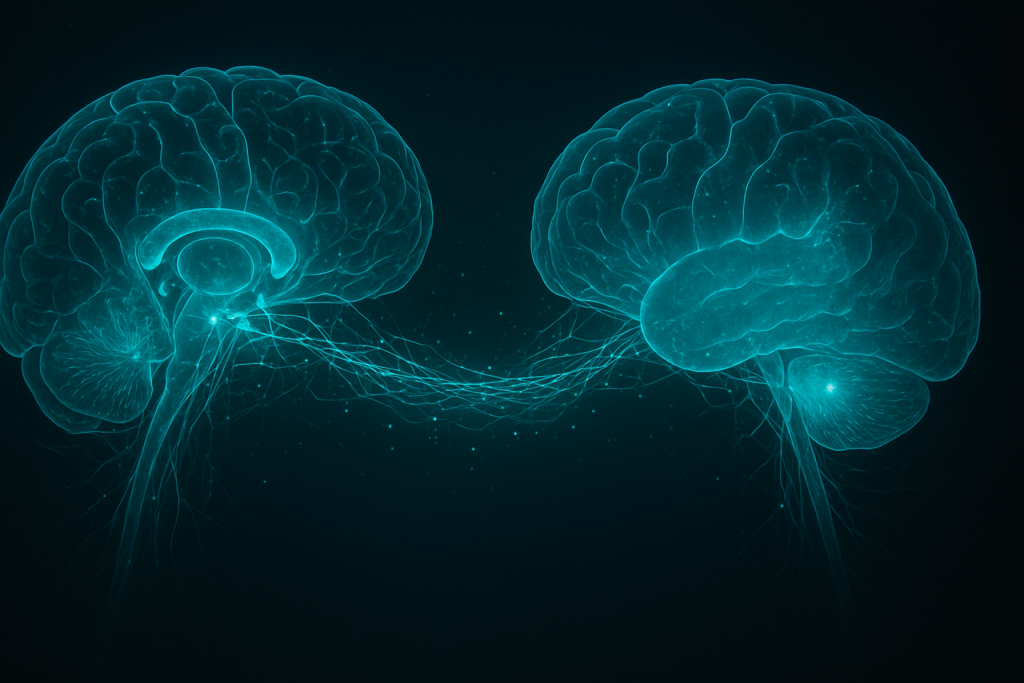
Image generated by AI
When Buddhist monks meditate on loving-kindness for several hours each day, something remarkable happens to their brains: the regions associated with emotional processing light up with an intensity rarely seen in ordinary people. Yet most of us never develop this capacity intentionally, leaving our natural empathetic abilities underdeveloped and our compassionate responses inconsistent. The question isn’t whether humans can cultivate compassion—neuroscience now confirms we can—but rather why we need structured training to access what should be an inherent part of our nature.
In an era of deepening political polarization, epidemic loneliness, and widespread mental health crises, the ability to genuinely understand and care about others has never felt more urgent. Schools face crises of bullying and mental health, workplaces struggle with toxic cultures, and social media fragments our capacity to see humanity in those who disagree with us. Yet evidence from cognitive neuroscience suggests that compassion and empathy aren’t fixed traits—they’re trainable skills that can be systematically developed, measured, and strengthened through specific mental exercises.
What Is Compassion and Empathy Training?
Compassion and empathy training refers to structured practices designed to develop and strengthen our ability to understand others’ emotions and respond with genuine care. While the terms are often used interchangeably in casual conversation, neuroscientists distinguish between them: empathy is the cognitive and emotional capacity to understand what someone else is feeling, while compassion adds a motivational layer—the desire to alleviate their suffering. Training in these capacities typically involves meditation practices, mindfulness exercises, perspective-taking activities, and deliberate cognitive practices that rewire neural circuits responsible for social understanding and emotional regulation. These interventions are grounded in the principle that repeated mental practice produces lasting changes in brain structure and function, much like physical exercise reshapes muscle tissue.
The scientific study of compassion training gained significant momentum following the work of neuroscientist Richard Davidson at the University of Wisconsin-Madison in the early 2000s. Davidson’s groundbreaking brain imaging studies of Tibetan Buddhist monks revealed that intensive meditation practice produces measurable changes in neural activity and structure. This work shifted compassion from the realm of philosophy and spirituality into empirical neuroscience, enabling researchers worldwide to investigate whether ordinary people without monastic training could achieve similar results through shorter, more accessible interventions. Since then, compassion training has evolved into a legitimate scientific field with rigorous protocols, randomized controlled trials, and validated measurement instruments.
What the Science Says
At its neurological core, compassion training works by strengthening and coordinating brain networks involved in emotional processing, perspective-taking, and reward. The anterior insula, a region crucial for processing physical and emotional pain, becomes more active when we’re trained to recognize suffering. Simultaneously, the prefrontal cortex—associated with rational decision-making and self-control—strengthens its connections to emotional centers, allowing us to regulate reactive responses and choose compassion even in challenging situations. The ventral striatum, part of the brain’s reward system, also activates more robustly when compassion-trained individuals encounter others in need, suggesting that their brains literally find helping others more rewarding than untrained brains do. This retraining essentially creates new neural pathways that make compassionate responses more automatic and less effortful.
Consider the analogy of learning a musical instrument. Initially, every finger movement requires conscious attention, and the performance sounds halting and mechanical. With repeated practice, the neural circuits governing those movements become refined; playing becomes fluid and intuitive. Compassion training works similarly: early practice requires deliberate effort and conscious attention, but over time, recognizing another’s pain and feeling motivated to help becomes more natural and automatic. A person trained in loving-kindness meditation might naturally notice a stranger’s distress faster and feel a genuine pull to help, rather than consciously reminding themselves that they “should” care.
How This Affects Everyday Life
Compassion training demonstrably impacts how people behave in real-world situations. In one landmark study published in Psychological Science in 2013, researchers found that people who completed an eight-week compassion training program were significantly more likely to give their own money to help someone in distress, compared to a control group. Healthcare workers trained in compassion demonstrate lower burnout rates and provide higher-quality patient care. Parents who practice mindfulness and empathy-building exercises report better relationships with their children and less reactive parenting. These aren’t marginal effects—studies show reductions in anxiety and depression symptoms, improved relationship satisfaction, and measurable increases in prosocial behavior in populations ranging from teenagers to elderly adults.
The applications extend across professional sectors. Hospitals now integrate compassion training into medical education, recognizing that physician empathy directly improves patient outcomes and compliance. Schools implement social-emotional learning programs that teach empathy and perspective-taking, with research showing reductions in bullying and improvements in academic performance. Corporate leaders attend training programs designed to increase empathic leadership, recognizing that empathetic managers create less toxic workplaces. Even law enforcement and military organizations have begun exploring compassion training as a tool for reducing excessive force and improving decision-making under stress. Technology companies developing AI systems are now studying compassion training as a model for how to engineer more ethical artificial intelligence systems.
Recent Breakthroughs in Compassion and Empathy Training
Recent years have brought striking refinements to our understanding of how compassion training works at the neurochemical level. A 2023 study from Stanford University discovered that compassion training increases oxytocin signaling in the brain, the neurochemical associated with social bonding and trust. Researchers at the Max Planck Institute found that even brief compassion training—as little as 30 minutes daily over two weeks—produces measurable changes in brain connectivity visible on functional MRI scans. Most intriguingly, a 2024 meta-analysis published in Nature Mental Health synthesized data from over 200 randomized controlled trials, demonstrating that compassion-based interventions are as effective as cognitive-behavioral therapy for treating anxiety and depression in certain populations. This represents a paradigm shift: compassion training is no longer merely a wellness enhancement but a legitimate clinical intervention.
Current research frontiers are exploring whether compassion training can be personalized based on individual neural patterns, whether virtual reality experiences can enhance training outcomes, and how to optimize training for different age groups and personality types. Scientists are also investigating whether compassion training can counteract tribal thinking and political polarization—early evidence suggests it may help people extend empathy across ideological divides. A critical open question remains: why does compassion training produce lasting changes in some people but not others, and can we predict who will benefit most?
Why Compassion and Empathy Training Matters for the Future
As artificial intelligence increasingly mediates human relationships and decisions, understanding how to cultivate genuine empathy becomes perhaps more urgent than ever. Unlike AI systems that can simulate empathetic responses, human empathy involves felt experience—an actual resonance with another’s emotional state. This distinction matters profoundly as we navigate technologies that may eventually replace human decision-makers in contexts ranging from medical diagnosis to criminal justice. Societies that cultivate empathy and compassion in their populations may build more resilient institutions, less prone to systemic cruelty and more capable of wise collective decision-making. Conversely, societies that neglect empathy training may find themselves increasingly fragmented, with polarized groups unable to understand one another’s legitimate concerns.
Several significant challenges remain before compassion training becomes universally accessible and integrated into institutions. Efficacy varies substantially across individuals, populations, and contexts—what works powerfully for one person may prove ineffective for another, and we lack robust predictive models for matching people to optimal interventions. Cultural factors shape whether compassion training translates across different societies and value systems. The mechanisms by which temporary neural changes from training sessions produce lasting behavioral change remain incompletely understood. Additionally, there’s a risk that compassion training, if implemented poorly or coercively, could become a tool for manipulating people into accepting unjust systems rather than inspiring genuine moral transformation.
Key Takeaways
- Compassion and empathy are trainable cognitive and emotional capacities, not fixed personality traits—brain imaging confirms that structured practice produces measurable neural changes.
- Compassion training works by strengthening neural circuits connecting emotional centers with the prefrontal cortex, making empathetic responses more automatic and less effortful over time.
- The most promising real-world application is in healthcare, where compassion training reduces physician burnout while improving patient outcomes and satisfaction.
- Recent research demonstrates that compassion-based interventions rival cognitive-behavioral therapy in treating anxiety and depression, elevating compassion from wellness concept to clinical intervention.
- As technology increasingly mediates human connection, cultivating genuine human empathy becomes essential for building resilient societies and institutions capable of ethical decision-making.
Explore TED Talks on Compassion and Empathy Training:
TED content is used under CC BY-NC-ND 4.0. © TED Conferences, LLC.
Frequently Asked Questions
What specific brain regions show increased activity during compassion and empathy training?
The article identifies emotional processing regions in the brain as primary areas that activate intensely during practices like loving-kindness meditation, as observed in Buddhist monks. These regions demonstrate measurable neuroplastic changes in response to structured compassion training.
Is compassion a fixed trait or can it actually be developed through training?
According to cognitive neuroscience evidence cited in the article, compassion and empathy are trainable skills rather than fixed traits, meaning they can be systematically developed, measured, and strengthened through specific mental exercises. This contradicts the assumption that empathetic ability is inherent and unchangeable.
How does structured compassion training differ from naturally occurring empathy in untrained individuals?
The article indicates that without intentional training, most people leave their natural empathetic abilities underdeveloped and experience inconsistent compassionate responses. Structured training programs systematize the mental exercises needed to activate emotional processing regions at the intensity observed in highly practiced individuals like Buddhist monks.
What measurable outcomes does the research suggest compassion training can produce?
The article states that compassion and empathy can be systematically measured and strengthened, with neuroimaging studies showing increased intensity of activity in emotional processing brain regions as a direct result of training. This provides quantifiable evidence that training produces observable changes in brain function.