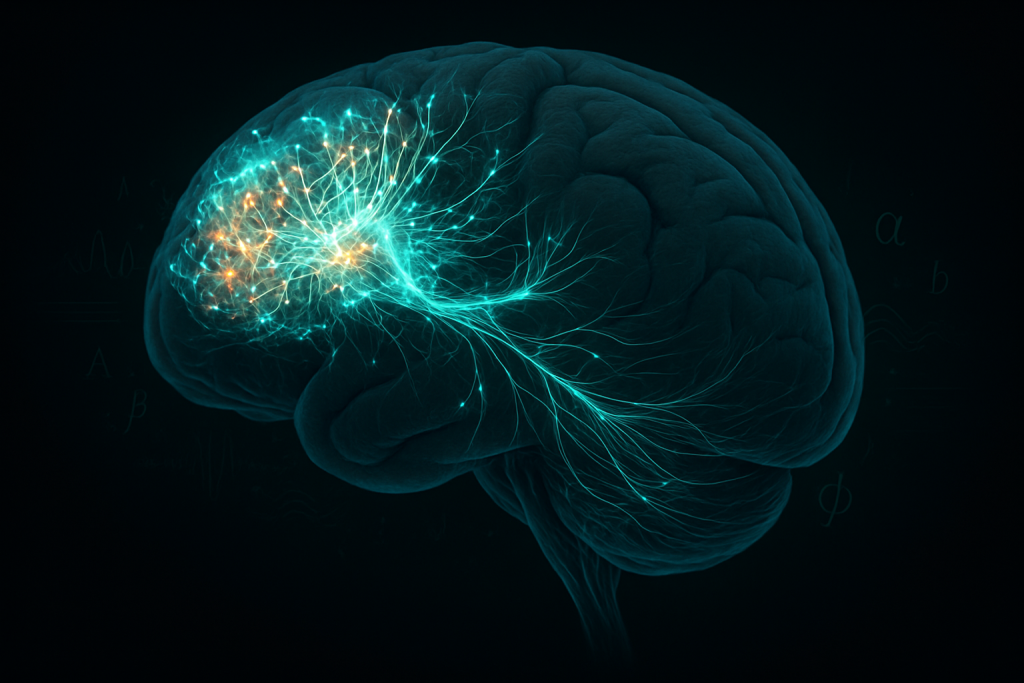
Image generated by AI
Here’s a puzzle that has long intrigued cognitive scientists: some of the most brilliant minds in history—including Leonardo da Vinci, Albert Einstein, and Temple Grandin—struggled with reading, writing, or basic arithmetic. Yet many of these individuals displayed extraordinary language abilities, creative thinking, and pattern recognition. This paradox raises a fundamental question about how the human brain works: How can learning difficulties coexist with pronounced language processing strengths?
The answer lies not in the absence of difficulty, but in the architecture of neurodiversity itself. Recent advances in neuroscience and psychology have revealed that learning differences like dyslexia, dyscalculia, and dysgraphia often come packaged with unexpected cognitive advantages. Understanding these strengths isn’t merely an academic curiosity—it has profound implications for how we educate, diagnose, and support individuals with learning differences, potentially unlocking billions of dollars in untapped human potential.
What Is Language Processing Strengths in Learning Difficulties?
Language processing strengths in learning difficulties refers to the phenomenon where individuals diagnosed with specific learning disorders—such as dyslexia, dysgraphia, or language-based learning disabilities—often demonstrate exceptional abilities in certain linguistic and cognitive domains. This might manifest as superior verbal reasoning, exceptional listening comprehension, remarkable storytelling ability, rich vocabulary development, or sophisticated pragmatic language skills. The term challenges the deficit-based model that has dominated special education for decades, proposing instead that learning differences represent a different cognitive profile rather than a uniformly disadvantaged one. These strengths exist alongside and sometimes precisely because of the neurological differences that create processing challenges in other areas.
The modern scientific understanding of learning disabilities as neurodevelopmental differences rather than fixed deficits began crystallizing in the 1970s and 1980s. Pioneering researchers like Norman Geschwind noticed patterns suggesting that individuals with dyslexia showed unusual brain asymmetries and often possessed distinctive cognitive profiles. His work laid the groundwork for the “neurodiversity” framework, which gained traction through the efforts of advocacy groups and researchers including Donna Williams and, later, Temple Grandin. By the 1990s and 2000s, neuroimaging studies began to document the specific neural correlates of these differences, revealing not damage or deficiency, but reorganization—alternative wiring that created both challenges and advantages.
What the Science Says
The neuroscience of learning difficulties and associated strengths hinges on understanding how the brain’s neural networks develop and organize during critical periods. In individuals with dyslexia, for instance, the left hemisphere’s language regions develop differently, with reduced specialization for phonological processing but often enhanced visual-spatial abilities. A landmark 2009 study by researchers at the University of California using functional magnetic resonance imaging (fMRI) demonstrated that dyslexic individuals showed different patterns of brain activation during reading, with greater engagement of right-hemisphere regions involved in visual processing and spatial reasoning. Importantly, these reorganized networks don’t simply compensate for phonological weakness—they appear to create genuine cognitive advantages in domains requiring holistic pattern recognition, three-dimensional thinking, and creative problem-solving. The brain, in essence, redistributes its computational resources, trading facility with some skills for excellence in others.
Consider an analogy from computer architecture: imagine two systems with identical processing power but different configurations. One is optimized for sequential, linear operations—breaking problems into steps and solving them one by one. The other distributes its resources toward parallel processing, simultaneously handling multiple information streams. Neither system is “better” in absolute terms; each excels at different types of problems. The dyslexic brain appears to operate more like the parallel-processing system, which explains both why sequential decoding of written symbols presents difficulty and why these individuals often excel at grasping complex systems, seeing multiple perspectives simultaneously, and generating creative solutions that require synthesizing disparate information.
How This Affects Everyday Life
The practical implications of language processing strengths in learning difficulties have begun reshaping educational policy, workplace accommodations, and clinical practice. Modern inclusive education frameworks now emphasize identifying and nurturing these strengths rather than exclusively remediating deficits. Research conducted at the Yale Center for Dyslexia and Creativity has found that students with dyslexia who receive strengths-based education—instruction that explicitly builds on their superior oral language, conceptual reasoning, and creative thinking abilities—show improved academic outcomes and substantially higher self-esteem compared to deficit-focused approaches. Beyond academics, the American Psychological Association and various vocational rehabilitation agencies now recommend career counseling that matches learning-different individuals with roles leveraging their distinctive cognitive profiles. This shift represents a fundamental reconception of learning disabilities, from a pathology to manage to a neurodevelopmental variation to understand and accommodate strategically.
In contemporary industries, these strengths have become increasingly valuable. Graphic design and architectural firms actively recruit individuals with dyslexia for their superior spatial reasoning and innovative visual thinking. Technology companies have discovered that neurodiverse hiring practices—explicitly welcoming applications from people with learning differences—expand their talent pools for roles requiring creative problem-solving and unconventional thinking. Legal practices have found that individuals with dysgraphia but exceptional verbal reasoning often become outstanding litigators and case strategists. Microsoft, EY, and Specialisterne have launched major neurodiversity hiring initiatives recognizing that learning-different employees bring distinctive cognitive assets. Medical education increasingly acknowledges that certain learning differences need not preclude excellence in diagnosis and clinical reasoning—domains where integrative thinking and pattern recognition from multiple domains prove essential.
Recent Breakthroughs in Language Processing Strengths in Learning Difficulties
Over the past three years, neuroscience has made remarkable strides in mapping the specific advantages associated with learning differences. A 2023 study published in Neuropsychology by researchers at the University of Melbourne analyzed nearly 300 individuals with dyslexia and found that they significantly outperformed controls on tests of fluid reasoning, creative thinking, and what researchers term “conceptual integration”—the ability to combine ideas from disparate domains into novel syntheses. Simultaneously, advances in machine learning have enabled researchers to identify biomarkers and neural signatures that predict both reading difficulties and enhanced creative problem-solving capabilities, suggesting these traits emerge from common underlying neurological architecture. Most provocatively, a 2024 investigation using diffusion tensor imaging—which maps white matter connections in the brain—found that dyslexic individuals showed enhanced neural connectivity between regions involved in language processing and regions associated with imagery and spatial reasoning. This finding elegantly explains why dyslexic individuals often excel at thinking in images and conceptual frameworks while struggling with sequential symbol manipulation.
Current research frontiers are investigating whether similar trade-offs exist for other learning differences, including dyscalculia and dysgraphia, and whether certain combinations of learning differences and associated strengths might be particularly advantageous in specific cognitive domains. Researchers at Oxford University are exploring whether the social communication challenges sometimes associated with language-based learning differences might correlate with enhanced capacity for logical reasoning or systematic analysis. Another emerging line of inquiry examines whether educational interventions can be designed to enhance the development of associated strengths during the critical windows when neural plasticity is greatest—essentially asking whether we can deliberately cultivate the cognitive advantages that often emerge alongside learning differences.
Why Language Processing Strengths in Learning Difficulties Matters for the Future
As cognitive science deepens our understanding of neural diversity, the implications ripple outward into education policy, workforce development, and clinical practice. The conventional educational paradigm—designed for and optimized around neurotypical learners—has historically treated learning differences as obstacles to overcome rather than cognitive variations to understand. Yet the emerging evidence suggests that this deficit-focused approach leaves vast reservoirs of human potential underdeveloped. If we reconceive education not as standardized instruction but as individualized cultivation of cognitive strengths—providing the targeted support for areas of difficulty while simultaneously nurturing distinctive abilities—we might unlock substantially greater human flourishing and societal benefit. This represents not merely a humanitarian concern but an economic imperative; estimates suggest that optimizing human capital by better matching individuals to roles aligned with their cognitive profiles could generate trillions of dollars in additional economic value globally.
Yet significant challenges remain in translating scientific understanding into practical implementation. Many schools and workplaces still operate within outdated deficit-based frameworks, lacking training or resources to identify and nurture learning-related strengths. The neuroscience community continues grappling with fundamental questions: Are the strengths we observe merely statistical correlations that emerge from larger samples, or do they reflect genuine causal mechanisms? Do all learning differences confer associated strengths, or are there specific neurodevelopmental profiles where this trade-off occurs? How can we design educational and vocational systems flexible enough to accommodate genuine individual variation while maintaining shared standards and expectations? These questions will occupy researchers and policymakers for years to come.
Key Takeaways
- Individuals with learning difficulties like dyslexia often display exceptional strengths in language processing, creative thinking, pattern recognition, and spatial reasoning—strengths that emerge from the same neural reorganization creating their processing challenges.
- The brain of a learning-different individual represents a reorganized rather than damaged system, with neural resources distributed differently across cognitive domains, creating distinctive profiles of strength and challenge.
- Strengths-based education and career matching strategies that build on learning-related cognitive advantages have demonstrated measurable improvements in academic outcomes, professional success, and psychological wellbeing.
- Recent neuroimaging and cognitive research has begun mapping the specific neural mechanisms underlying language processing strengths in learning difficulties, with emerging evidence suggesting enhanced connectivity between language and imagery/spatial regions in the brain.
- Recognizing and cultivating learning-related strengths represents both a humanitarian imperative and an economic opportunity, with potential implications for education reform, workforce development, and our fundamental understanding of human cognition.
Explore TED Talks on Language Processing Strengths in Learning Difficulties:
TED content is used under CC BY-NC-ND 4.0. © TED Conferences, LLC.
Frequently Asked Questions
What neurobiological mechanisms explain why individuals with dyslexia can have strong language processing abilities in other domains?
Dyslexia involves differences in phonological processing pathways, but the brain often compensates by developing enhanced strengths in semantic processing, oral language comprehension, and verbal reasoning through alternative neural networks. This neurodiversity reflects how the brain can reorganize and develop specialized capabilities in response to processing differences in specific areas.
How do cognitive scientists measure language processing strengths in individuals with learning difficulties?
Researchers use specialized neuropsychological assessments including verbal IQ tests, semantic fluency tasks, narrative comprehension evaluations, and functional neuroimaging (fMRI) to isolate language processing abilities while controlling for reading or writing deficits. These tools reveal that strengths in oral language, vocabulary, and conceptual thinking often remain intact despite difficulties in decoding or encoding written language.
Why does the architecture of neurodiversity create a pattern where learning difficulties and language strengths coexist rather than occur independently?
Learning difficulties and language strengths often coexist because they may result from the same underlying neurological differences—such as enhanced visual-spatial processing or atypical neural connectivity patterns—that create obstacles in one cognitive domain while facilitating advantages in another. The brain's compensatory mechanisms and alternative processing routes can amplify certain linguistic abilities as neural resources are allocated differently.
Can language processing strengths in individuals with learning difficulties be reliably predicted during early childhood assessment?
Early identification is challenging because language processing strengths may not fully emerge until cognitive compensation mechanisms develop, typically occurring over years of development. However, certain markers—such as advanced oral vocabulary, strong listening comprehension, or exceptional storytelling ability—can suggest potential strengths even when writing or reading difficulties are apparent.