AI Insight
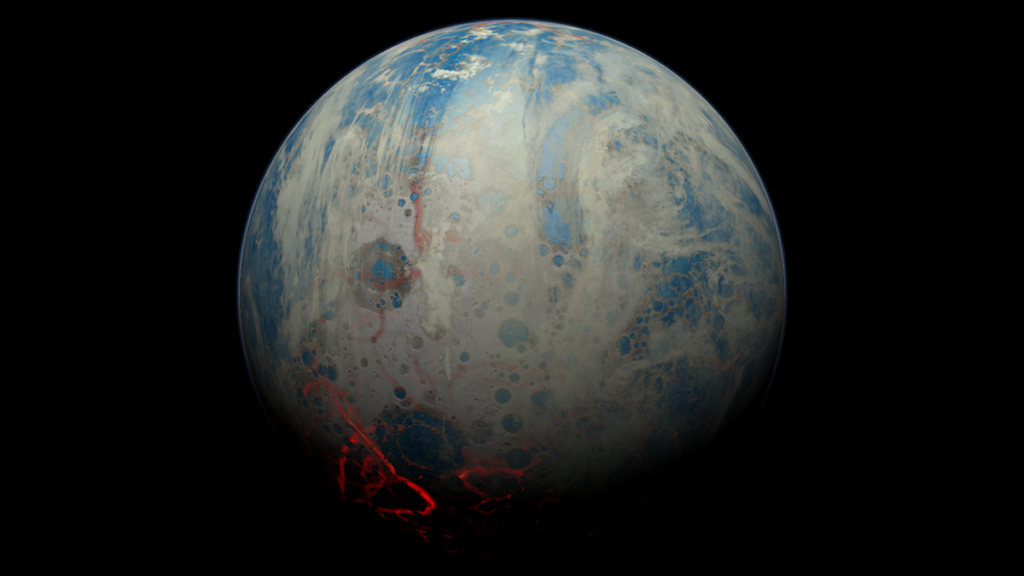
During the Hadean and Archean eons (4.6 to 3.5 billion years ago), frequent asteroid and planetesimal impacts fractured Earth's basaltic crust, significantly increasing its permeability. Alexander et al. used iSALE impact physics simulations to demonstrate that around 4.3 billion years ago, impacts enhanced crustal permeability especially within 8 kilometers of the surface, creating porous zones where fluids and gases could circulate. These permeable regions likely provided suitable environments for hydrothermal systems that facilitated prebiotic chemical reactions necessary for the origin and evolution of early life.
Why it matters
This research provides the first comprehensive analysis of impact-induced permeability in early Earth's crust, offering a new framework for understanding how asteroid bombardment created the hydrothermal conditions that may have been essential for life's emergence on our planet.
Understand the Science
Source: AGU Advances
This is an authorized translation of an Eos article. 本文是Eos文章的授权翻译。
在大约46亿至35亿年前的冥古宙(Hadean eon)和太古宙(Archean eon)期间,小行星和微行星频繁轰击地球。由于如今保存下来的岩石中,年代超过40亿年的寥寥无几,我们对当时地球环境的了解十分有限。然而,来自月球的样本及其布满陨石坑的表面,为我们了解该时期的宇宙撞击频率提供了线索。
早期的小行星撞击导致了地球地壳的显著变化,而当时的地壳主要由玄武岩质岩石构成。撞击产生的冲击波使地壳破裂并增加了孔隙率,从而使流体和气体能够在岩石中穿行。既往研究表明,由此产生的热液系统——例如黄石国家公园周边的间歇泉群——为地球早期生命的起源与演化提供了适宜的环境。
Alexander等人研究了冥古宙和太古宙时期的地表撞击如何促使流体和气体在地壳环境中流动。研究人员利用iSALE冲击物理模拟程序构建了一系列撞击模拟,并调整了诸如玄武岩地壳厚度、地温梯度以及是否存在深达5公里海洋等参数。这些模拟详细展示了地表撞击如何影响地壳的渗透性。随后,他们结合关于古代撞击数据的模型,分析随着时间推移,反复撞击所产生的累积效应。
结果显示,在43亿年前,撞击可能极大地提高了地壳的渗透性,尤其是在地表以下8公里的范围内。通过模拟,研究人员推断,高渗透性区域的规模取决于撞击能量,而地温梯度和地壳岩石成分则影响了撞击后的破碎程度。这些多孔区域为早期地壳内的前生物化学反应提供了潜在的场所。
这项研究是对早期地球最外层因撞击而产生的渗透性的首次全面研究。其结果为评估撞击如何影响冥古宙和太古宙时期的热液循环及地球化学变化提供了新的框架,对理解地球早期生命起源与演化具有重要意义。
—科学撰稿人Aaron Sidder
This translation was made by Wiley. 本文翻译由Wiley提供。
Read this article on WeChat. 在微信上分享本文。

Text © 2026. AGU. CC BY-NC-ND 3.0
Except where otherwise noted, images are subject to copyright. Any reuse without express permission from the copyright owner is prohibited.
Source: 宇宙轰击为前生物化学反应创造了条件