AI Insight
This Astronomy Picture of the Day documents a major fireball meteor photographed on November 14, 2017, from a mountain pass in Italy's Dolomite Alps. The meteor streaked east to west across the northern horizon beneath the Big Dipper constellation and became one of the most widely reported fireball events to the American Meteor Society and International Meteor Organization. Analysis of the meteor's trajectory over Germany indicated it originated from the Northern Taurid Meteor Shower radiant, which is associated with debris from Comet Encke.
Why it matters
This documentation demonstrates the value of citizen science and widespread meteor reporting in tracking potentially hazardous near-Earth objects. The connection to Comet Encke's debris stream helps scientists better understand the distribution and behavior of meteoroid streams that regularly intersect Earth's orbit.
Understand the Science
APOD
Astronomy Picture of the Day
Discover the cosmos! Each day a different image or photograph of our fascinating universe is featured, along with a brief explanation written by a professional astronomer.
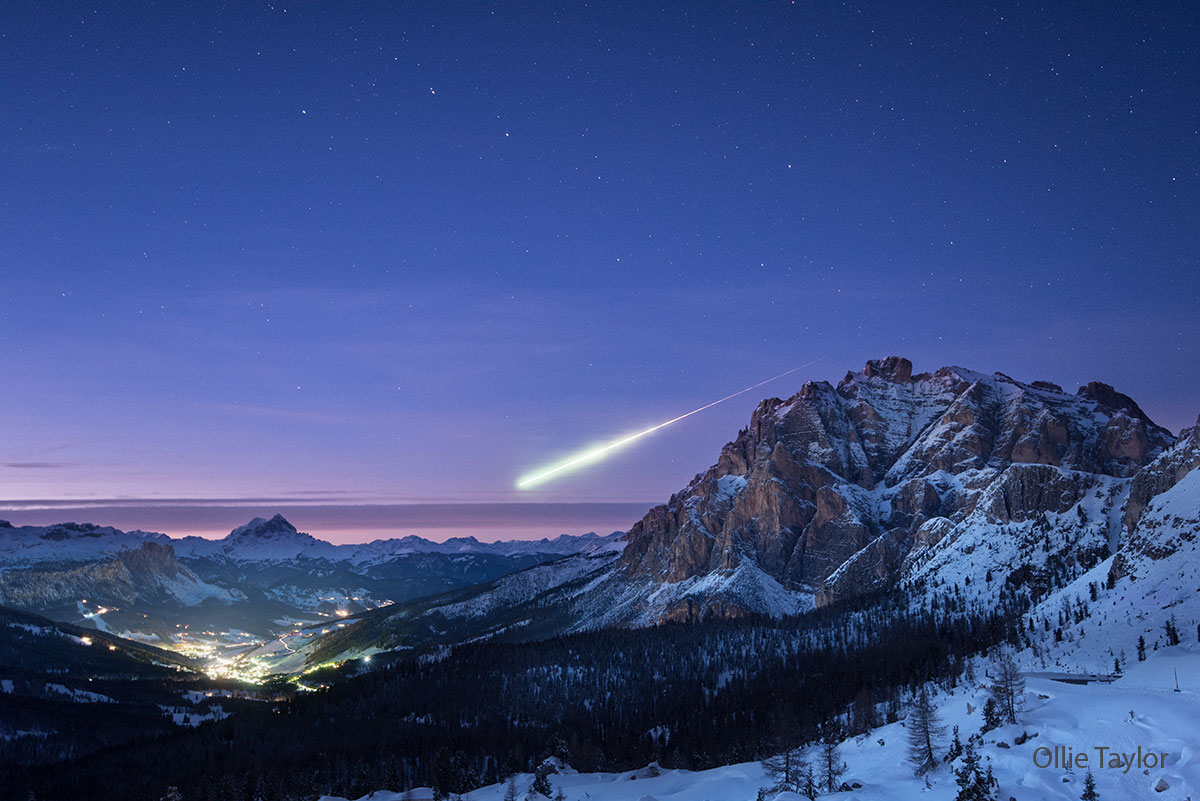
Major Fireball Meteor
Explanation: The sky glows with soft pinkish colors of fading twilight in this serendipitous mountaintop vista. Taken in subfreezing temperatures, the thoughtfully composed photo shows snowy, rugged peaks seen from a mountain pass on 2017 November 14. Below lies the village of La Villa, Alta Badia in Italy‘s Dolomite Alps. Above the nestled village lights, the constellation Ursa Major hangs over the northern horizon. But most stunning is the intense fireball meteor. It was captured during the camera’s exposure by chance as it flashed east to west across the northern horizon, under Ursa Major’s familiar Big Dipper asterism. Sightings of this major fireball meteor were widely reported in European skies, making it one of the most reported fireball events ever for planet Earth’s American Meteor Society and the International Meteor Organization. The meteor’s measured track over Germany is consistent with its origin near the active radiant of November’s Northern Taurid Meteor Shower, a shower associated with dust from Encke’s comet.
Tomorrow’s picture: witch sky?
| Date: | November 8, 2026 |
|---|---|
| Credit & Copyright: | Ollie Taylor |
| Authors & editors: | Robert Nemiroff, Jerry Bonnell, Cecilia Chirenti, Keighley Rockcliffe |
| A service of: |
ASD at NASA / GSFC, NASA Science Activation & Michigan Tech. U. |