AI Insight
On August 25, the sun released an M6.9-class solar flare from sunspot region 4513, accompanied by a coronal mass ejection (CME) directed toward Earth. The eruption caused moderate radio blackouts across Africa, Europe, and the Arctic, and models predict the CME may deliver a glancing blow to Earth on August 28. The potential impact could be enhanced by a concurrent high-speed solar wind stream from a coronal hole, which may amplify geomagnetic activity and northern lights visibility.
Why it matters
The combined effect of the CME and solar wind stream could produce enhanced auroral displays at lower latitudes than normal and may affect satellite operations, power grids, and communications systems. The timing and magnetic field orientation of the CME will determine whether significant geomagnetic storming occurs.
Understand the Science
Today (Aug. 25), the sun unleashed a powerful M6.9 solar flare from a restless Earth-facing sunspot, hurling a coronal mass ejection (CME) into space — and Earth could potentially be in the firing line.
The M6.98 solar flare erupted from the active sunspot region 4513 and peaked at 6 a.m. EDT (1000 GMT), according to SpaceWeatherLive. 4513 has been particularly active over the last 24 hours, firing off a barrage of solar flares including five powerful M-class eruptions.
Solar flares are ranked by strength into five classes — A, B, C, M and X — with each class 10 times more powerful than the one before it. M-class flares are the second-strongest category, sitting just below the most powerful X-class eruptions.
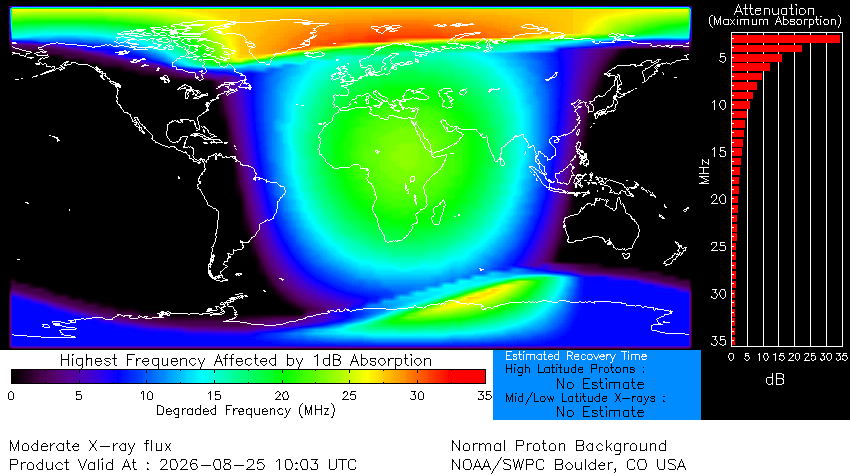
The eruption also triggered a moderate (R2) radio blackout across the sunlit side of Earth, affecting high-frequency radio communications over parts of Africa, Europe and the Arctic.
CME incoming
Now, all eyes are on the CME launched during today’s M6.9 eruption.
Early modelling suggests Earth could receive a glancing blow from the CME on Friday (Aug. 28). According to aurora chaser Jure Atanackov, NASA’s model predicts the CME could reach Earth at around 6-7 a.m. EDT (1000-1100 GMT), with an uncertainty of around seven hours.
Here we go. This is the NASA M2M WSA-ENLIL+Cone model prediction for the CME. A glancing blow, as indicated by lopsided EUV dimming. The arrival is expected on August 28th (Friday) around 10-11h UTC (+/-7h). Slow, not expecting much from this one. https://t.co/GmyhSbxTGn pic.twitter.com/EkoZBmyKYKAugust 25, 2026
Though Atanackov described the CME as slow-moving and said he isn’t expecting much from the glancing encounter, there’s another piece of the space weather puzzle that could make things interesting for aurora chasers.
According to the Solar Influences Data Analysis Center (SIDC), a high-speed stream of solar wind from a positive-polarity coronal hole is expected to begin influencing Earth from Aug. 27. SIDC forecasts unsettled to active geomagnetic conditions, with a chance of minor storm levels as the fast solar wind arrives.
If the glancing CME arrival coincides with the high-speed solar wind stream, the two influences could work together to ramp up geomagnetic activity and potentially enhance aurora activity.
How much of an impact the CME ultimately has will depend on its exact arrival time and, crucially, the orientation of its magnetic field when it reaches Earth. A strong southward magnetic field would interact more effectively with Earth’s magnetic field, increasing the chances of stronger geomagnetic activity.
We’ll be keeping a close eye on the latest models and space weather forecasts as Friday approaches and will update this story as more information becomes available.