AI Insight
Supernumerary rainbows are additional faint rainbow bands that appear inside the main rainbow arc, caused by light interference rather than simple reflection. These phenomena only form when water droplets are uniformly sized (typically less than one millimeter in diameter), allowing sunlight waves to interfere with each other similar to ripples on water. The photograph captured at least five distinct supernumerary bands following Hurricane Florence's passage over New Jersey in 2018.
Why it matters
The existence of supernumerary rainbows provided crucial early evidence for the wave nature of light in the 1800s, as they cannot be explained by particle theory alone. This optical phenomenon demonstrates fundamental principles of wave interference that apply across physics, from quantum mechanics to electromagnetic radiation.
Understand the Science
APOD
Astronomy Picture of the Day
Discover the cosmos! Each day a different image or photograph of our fascinating universe is featured, along with a brief explanation written by a professional astronomer.
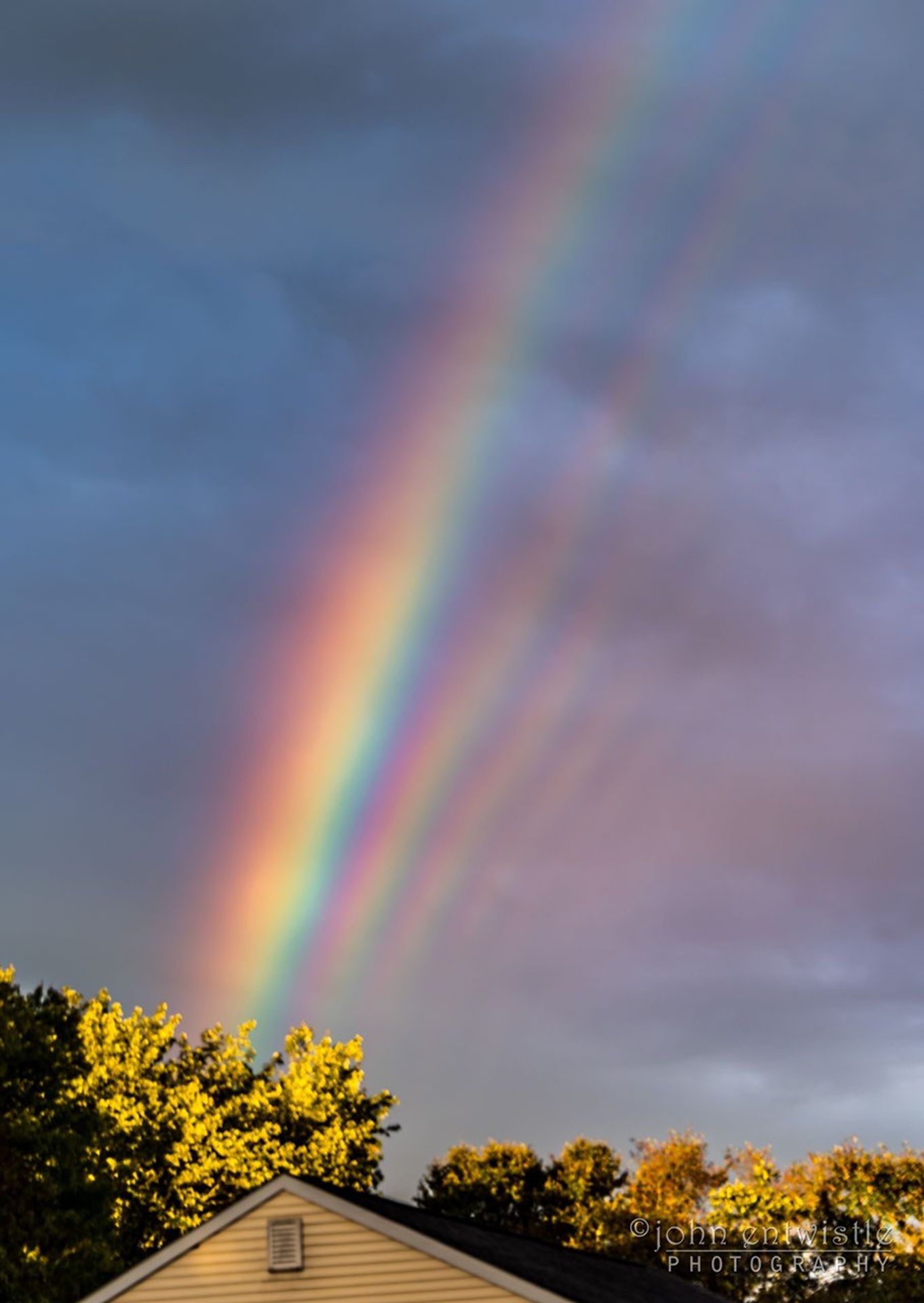
Supernumerary Rainbows over New Jersey
Explanation: Yes, but can your rainbow do this? After the remnants of Hurricane Florence passed over the Jersey Shore, New Jersey, USA in 2018, the Sun came out in one direction but something quite unusual appeared in the opposite direction: a hall of rainbows. Over the course of the next half hour, to the delight of the photographer and his daughter, vibrant supernumerary rainbows faded in and out, with at least five captured in this featured single shot. Supernumerary rainbows only form when falling water droplets are all nearly the same size and typically less than a millimeter across. Then, sunlight will not only reflect from inside the raindrops, but interfere, a wave phenomenon similar to ripples on a pond when a stone is thrown in. In fact, supernumerary rainbows can only be explained with waves, and their noted existence in the early 1800s was considered early evidence of light’s wave nature.

Your Sky Surprise: What picture did APOD feature on your birthday? (post 1995)
Tomorrow’s picture: open space
| Date | October 4, 2026 |
|---|---|
| Credit & Copyright | John Entwistle |
| Authors & editors: | Robert Nemiroff, Jerry Bonnell, Cecilia Chirenti, Keighley Rockcliffe |
| A service of: |
ASD at NASA / GSFC, NASA Science Activation & Michigan Tech. U. |
Source: APOD: 2026 October 4 – Supernumerary Rainbows over New Jersey