AI Insight
Three NASA astronauts currently aboard the International Space Station—Anil Menon, Luke Delaney, and Jessica Watkins—successfully cast their votes in the U.S. midterm elections using encrypted electronic ballots. The voting process involves filling out digital forms that are transmitted securely through NASA's Tracking and Data Relay Satellite System to ground stations in New Mexico, then to Mission Control in Houston, before reaching county election officials. Americans have been able to vote from space since 1997, when Texas passed legislation enabling this capability, with NASA astronaut David Wolf being the first to vote from orbit aboard Russia's Mir space station.
Why it matters
This demonstrates that democratic participation can be maintained even in extreme remote environments, ensuring that astronauts on extended space missions do not lose their fundamental civic rights. The secure transmission infrastructure developed for space voting also showcases advanced encryption and communication technologies that could have applications in other secure remote voting scenarios.
Understand the Science
The three Americans currently living off Earth just made sure their electoral voices were heard.
Anil Menon told us today (Nov. 3) that he and fellow NASA astronauts Luke Delaney and Jessica Watkins voted in the U.S. midterm elections from the International Space Station (ISS).
“Yes, you can even vote from space! All three U.S. crew members had the privilege of voting from space station. We filled out an electronic ballot and sent it securely to the election officials,” Menon wrote in an X post this morning.
Yes, you can even vote from space! All three US crew members had the privilege of voting from space station. We filled out an electronic ballot and sent it securely to the election officials. https://t.co/hJCExQ2nKrNovember 3, 2026
That post included a 29-second video, in which Menon — wearing, like many of us today, an “I voted” sticker — shows us his “voting booth.”
It’s actually his room on the ISS, Menon explained. “Inside of it is my computer, where I was able to fill out an electronic form and send it to Harris County so I could vote today,” he said.
Most NASA astronauts register to vote in Texas’ Harris County; it’s home to Johnson Space Center in Houston, the agency’s human spaceflight hub.
Americans have been able to vote from space since 1997, when Texas passed a law allowing this to happen. The first person to take advantage of the legislation was NASA astronaut David Wolf, who cast his ballot from Russia’s Mir space station that same year. (The ISS didn’t welcome its first crew until November 2000.)
“Just like any other American away from home, astronauts may fill out a Federal Post Card Application to request an absentee ballot,” NASA officials wrote in an astronaut-voting explainer.
The process is somewhat involved, however.
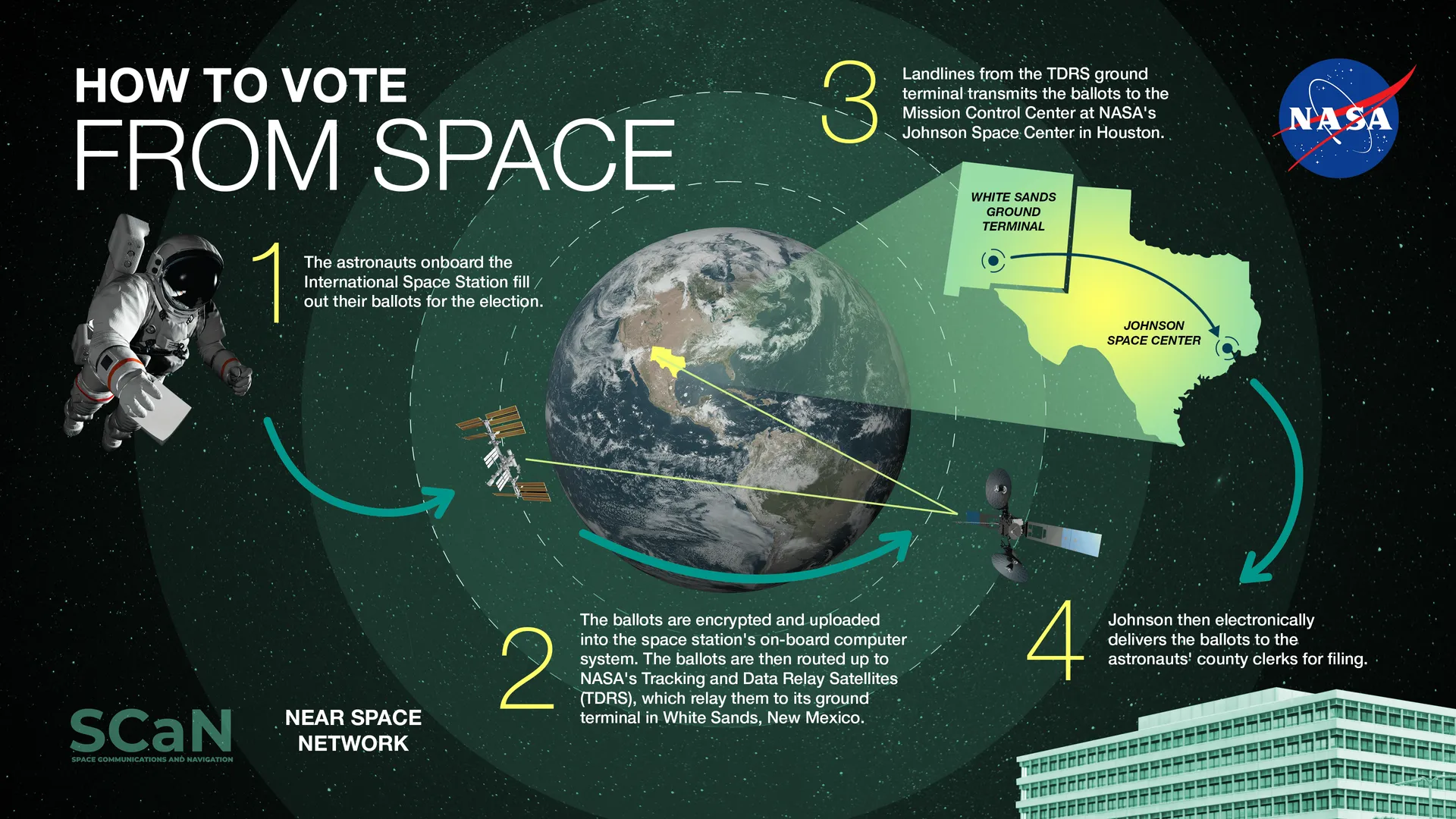
“After an astronaut fills out an electronic ballot aboard the orbiting laboratory, the document flows through NASA’s Tracking and Data Relay Satellite System to a ground antenna at the agency’s White Sands Test Facility in Las Cruces, New Mexico,” they added. “From New Mexico, NASA transfers the ballot to the Mission Control Center at NASA Johnson and then on to the county clerk responsible for casting the ballot. To preserve the vote’s integrity, the ballot is encrypted and accessible only by the astronaut and the clerk.”
Delaney and Watkins launched to the ISS on Oct. 1 on SpaceX’s Crew-13 mission. Menon has been there since mid-July, arriving aboard a Russian Soyuz spacecraft.
The trio currently share the orbiting lab with four other people — Canadian Space Agency astronaut Joshua Kutryk and cosmonauts Anna Kikina, Pyotr Dubrov and Sergey Teteryatnikov. Kutryk and Teteryatnikov are members of Crew-13, whereas Dubrov and Kikina shared the Soyuz with Menon.
Source: Voting in space: NASA astronauts cast ballots from International Space Station