AI Insight
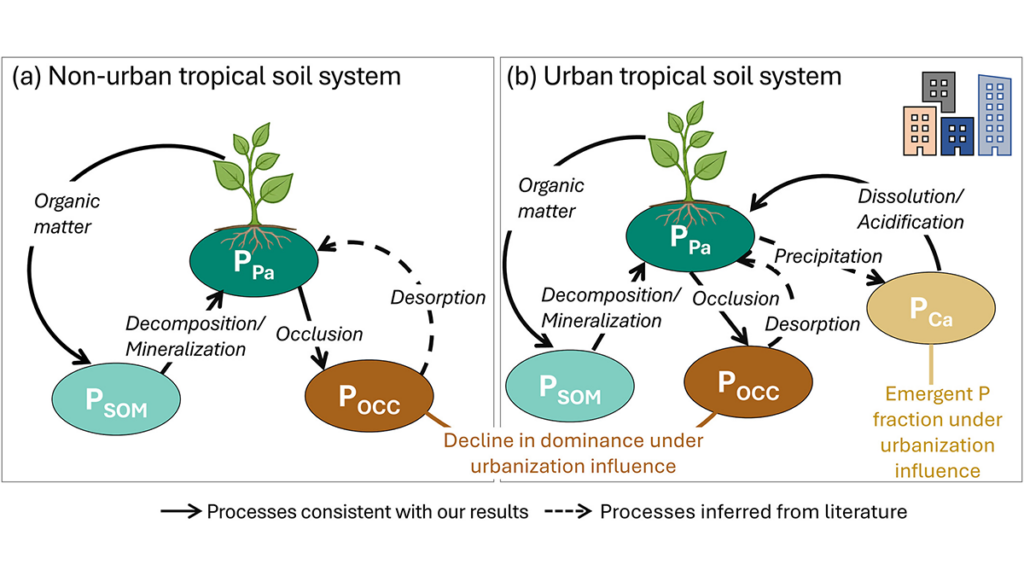
Researchers surveyed soil phosphorus levels along an urban-to-rural gradient in Kumasi, Ghana, finding that urban agricultural soils contain significantly more phosphorus than their rural counterparts. The study revealed that long-term farming in urban areas shifts phosphorus from mineral-occluded forms (difficult for plants to absorb) to calcium-bound forms (more readily available to plants). This transformation appears to result from urban waste materials such as cement fragments, charcoal, ash, and wash-water that accumulate in these soils over time.
Why it matters
This research demonstrates how urbanization can unexpectedly benefit soil fertility in tropical regions where phosphorus is typically scarce, potentially supporting food security in rapidly growing cities. The findings suggest that managed urban waste could serve as an unintentional fertilizer source for small-scale urban farms that are vital to local economies in developing regions.
Understand the Science
Editors’ Highlights are summaries of recent papers by AGU’s journal editors.
Source: Journal of Geophysical Research: Biogeosciences
Small-scale farming is an important component of local economies, globally. In rapidly growing regions, farmed plots of land remain as cities expand. To understand how urbanization impacts a critical nutrient for plant growth, phosphorus, Asabere and Sauer [2026] conducted a thorough survey of soil phosphorus pools along an urban to rural gradient surrounding Kumasi, Ghana.
Highly weathered tropical soils, such as those in Kumasi, are generally depleted in phosphorus. The authors find that soils with a long history of use in food production had higher phosphorus content overall, and a shift from phosphorus being predominantly in a difficult-to-absorb form (mineral-occluded) to a form that is more readily taken-up by plants (calcium-bound). The study proposes that urban waste in its various forms (broken bits of cement, charcoal and ash, wash-water, etc.) contribute to the accumulation of phosphorus and calcium in these soils over time. This work shines a light on understudied soils that play a critical role in regional economies and livelihoods.
Citation: Asabere, S. B., & Sauer, D. (2026). Oxide-occluded to calcium-bound: Urbanization increases soil phosphorus stocks and diversifies pools in a tropical West African agroecosystem. Journal of Geophysical Research: Biogeosciences, 131, e2026JG009815. https://doi.org/10.1029/2026JG009815
—Kendalynn Morris, Associate Editor, JGR: Biogeosciences

Text © 2026. The authors. CC BY-NC-ND 3.0
Except where otherwise noted, images are subject to copyright. Any reuse without express permission from the copyright owner is prohibited.
Source: Trash to Treasure? Increased Soil Phosphorus in Farmed Urban Soils