AI Insight
Carbon Brief has created an interactive tracking tool to monitor the negotiating texts and agreements being discussed at the COP31 UN climate summit in Antalya, Turkey. Nearly 200 countries (excluding the US) are negotiating over 100 separate agreements covering topics including the global goal on adaptation, mitigation work programmes, and a new "just transition mechanism." Turkey and Australia are jointly leading the summit, with plans to produce a cover text that may address the potential overshoot of the 1.5C warming limit and Turkey's proposed electrification target of 35% of global final energy from electricity by 2035.
Why it matters
This tracking system provides transparency into complex multilateral climate negotiations that will shape international climate policy and action. Key discussions on adaptation finance, emission reduction mechanisms, and climate-related trade tariffs could have significant implications for global climate commitments and developing country support.
Understand the Science
The centrepiece of every UN climate summit is for countries to negotiate the wording of a large number of legal agreements – and COP31 in the Turkish city of Antalya is no different.
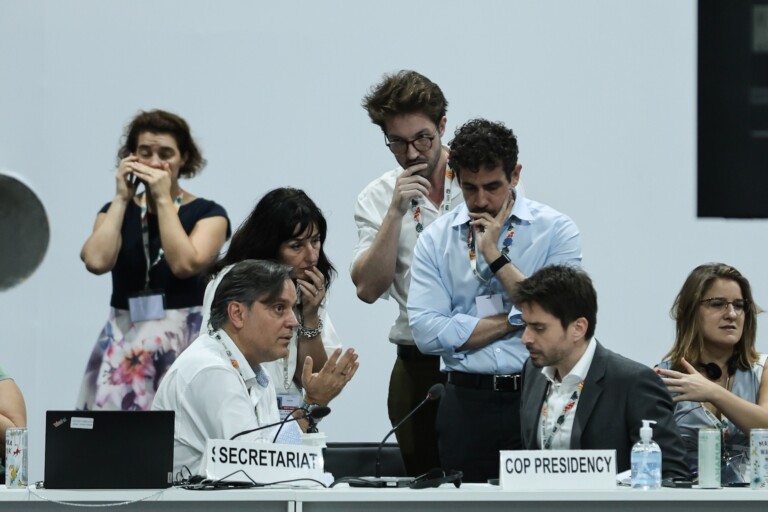
These texts are hashed out behind closed doors in the “blue zone” at the COP, where diplomats from nearly 200 nations – not including the US – will be haggling over each individual verb.
Over the course of the two-week summit, negotiators will be trying to reach consensus on more than 100 separate agreements – but, first, they must agree which issues are on the agenda.
The complexity of this process can make it challenging to keep track of what countries are fighting about and how negotiations are progressing.
Carbon Brief’s real-time text tracker, below, offers a helping hand by decoding the agenda and keeping a searchable record of every document for each part of the negotiations.
The first column of the interactive tracker lists the topic of each agenda item, with further columns including dates, page counts and links to the original PDFs.
The table is searchable via the interactive text box and can be sorted using the arrow icons.
(() => {
const iframe = document.getElementById(‘cop31-text-tracker’);
const iframeOrigin = new URL(iframe.src).origin;
window.addEventListener(‘message’, (event) => {
if (event.origin !== iframeOrigin || event.source !== iframe.contentWindow) {
return;
}
const message = event.data;
if (
!message ||
message.type !== ‘cop31-text-tracker:resize’ ||
!Number.isFinite(message.height) ||
message.height < 0
) {
return;
}
iframe.style.height = `${Math.ceil(message.height)}px`;
});
})();
This year’s talks come with a twist: Turkey holds the presidency and is hosting COP31, but Australia is jointly running the show as “president of negotiations”.
The pair have already announced their intention to produce a “cover text” – an overarching political document summarising key negotiated outcomes, along with issues not on the official agenda.
This could include a recognition that warming is set to “overshoot” the 1.5C limit and the impacts this is already causing. It may also include potential solutions, such as the Turkish presidency’s “electrification” target, for 35% of global final energy to come from electricity by 2035.
While the summit is not seen as a banner year for the negotiations, falling half-way between two “global stocktakes” of progress, there are still plenty of major topics up for discussion.
These include efforts to finalise the “global goal on adaptation” and whether to continue a contested process on how to cut emissions, known as the “mitigation work programme”.
Negotiators will also be trying to agree on the details of a new “just transition mechanism”, also referred to as the “Belém-Antalya mechanism for global just transitions” (BAM).
While most of the items on the agenda are agreed in advance, parties can suggest late additions. These must be signed off before negotiations can begin, often resulting in an “agenda fight”.
COP30 agreed to put two new items on the agenda for future summits.
These are the provision of climate finance by developed countries, under Article 9.1 of the Paris Agreement, and making global “finance flows” consistent with the treaty, under Article 2.1c.
Ahead of COP31, the African group of nations filed a request to add climate-related trade tariffs to the agenda. COP30 had agreed to annual “dialogues” on this matter at the Bonn climate talks.
The African group also wants further items added, on tripling adaptation finance and on funding for the Green Climate Fund, a flagship UN body designed to support climate action.
Ahead of the opening of the summit, Carbon Brief’s text tracker counts 104 substantive items on the agenda, not including procedural matters, such as the election of COP officials.
The figure below illustrates the status of the COP31 negotiations overall, in a traffic-light format. Each agenda item is colour-coded according to its current status.
(() => {
const iframe = document.getElementById(‘cop31-text-chart’);
const iframeOrigin = new URL(iframe.src).origin;
window.addEventListener(‘message’, (event) => {
if (event.origin !== iframeOrigin || event.source !== iframe.contentWindow) {
return;
}
const message = event.data;
if (
!message ||
message.type !== ‘cop31-text-chart:resize’ ||
!Number.isFinite(message.height) ||
message.height < 0
) {
return;
}
iframe.style.height = `${Math.ceil(message.height)}px`;
});
})();
For topics shown in red, negotiators have not yet managed to put anything down on paper, perhaps because parties have fundamentally different views on how they should proceed.
For items in orange, negotiators are working on an “informal text”, which is an early draft setting out the views of different parties, but not yet expressed in formal legal language.
Once a draft legal agreement becomes available, topics will be colour-coded yellow. At this point, areas of remaining disagreement will be denoted in the text with [square brackets] and “options”.
As such, texts with many square brackets or options tend to be an indicator of a high level of disagreement between parties. For this reason, the tracker table above counts and displays the number of outstanding brackets and options in each document.
During the course of the summit, negotiators may work through many iterations of texts on each agenda item. These documents may include “bridging text”, designed to resolve differences of opinion and to find a “landing zone” that all groups can agree on.
Agreement is reached on a given topic once all brackets and options have been resolved, at which point the item will be coloured green in Carbon Brief’s traffic-light chart.
Where agreement cannot be reached, discussions may be subject to “rule 16”, meaning negotiations are postponed until the next session. These topics are colour-coded grey.
The figure below gives an at-a-glance overview of the status of the main topics up for negotiation.
(() => {
const iframe = document.getElementById(‘cop31-agenda-status’);
const iframeOrigin = new URL(iframe.src).origin;
window.addEventListener(‘message’, (event) => {
if (event.origin !== iframeOrigin || event.source !== iframe.contentWindow) {
return;
}
const message = event.data;
if (
!message ||
message.type !== ‘cop31-agenda-status:resize’ ||
!Number.isFinite(message.height) ||
message.height < 0
) {
return;
}
iframe.style.height = `${Math.ceil(message.height)}px`;
});
})();
As parties narrow down the options and brackets towards the end of each summit, they start to generate “clean” texts, which contain no areas of disagreement and can be converted into “draft decisions” that are ready for formal adoption at the closing plenary of the meeting.
Finally, at the closing plenary, each draft decision must be gavelled through by the COP president, signifying its formal adoption as a legal agreement and outcome of the summit.
This last step is usually a formality, but dramatic exceptions are possible.
During the closing plenary at COP29, the president of the meeting failed to adopt a deal relating to the “global stocktake” from 2023, which had called for “transitioning away” from fossil fuels.
Carbon Brief also ran text trackers for COP28, COP29 and COP30.
Words by Simon Evans. Tracker maintained by Ho Woo Nam.


The post Interactive: Tracking negotiating texts at the COP31 climate summit appeared first on Carbon Brief.
Source: Interactive: Tracking negotiating texts at the COP31 climate summit