AI Insight
Research presented at AGU's Annual Meeting shows that ice caves in Lava Beds National Monument, California, are losing their perennial ice formations due to changes in their internal climate. Analysis of 20 years of temperature data from 37 caves reveals that ice caves are experiencing increased temperature variability, causing their closed thermal systems to break down and resemble regular caves. Field observations confirm complete ice loss in multiple caves, including one that previously contained ice formations 25-30 feet deep.
Why it matters
Ice caves support unique ecosystems of microbes and insects, provide water sources for desert wildlife, and hold cultural significance for Native American tribes like the Modoc. The disappearance of perennial ice threatens these specialized habitats and the organisms adapted to them, while potentially indicating broader climate impacts on underground ecosystems.
Understand the Science
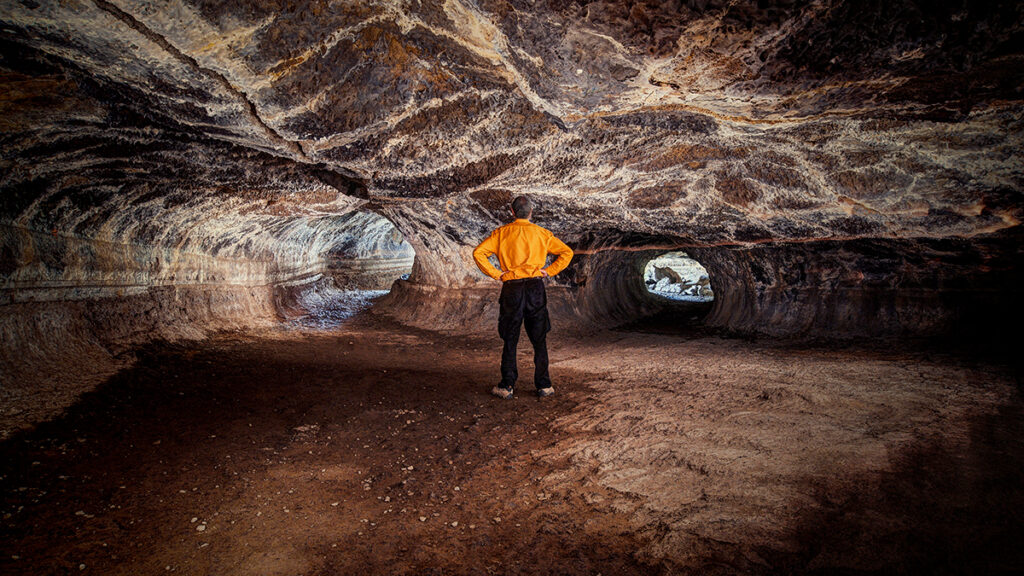

Lava Beds National Monument in northeastern California contains more than 800 caves, the most of any national park unit in the United States. Some of these bedrock caverns are considered “ice caves” (not to be confused with glacier ice caves), which retain perennial ice formations underground.
But new research set to be presented at AGU’s Annual Meeting in San Francisco on 8 December reports that the internal climate of these caves is shifting, erasing the very features that defined them in the first place.
Amelia Weiss, formerly a cave scientist at the Great Basin Institute (GBI) and now an assistant data scientist at Colorado State University, began analyzing data from a National Park Service cave monitoring system in 2024. The project left data loggers to record hourly temperature and other climatic variables in 37 ice and non-ice caves across Lava Beds, with some of the time series stretching back 20 years.
“In the process, I got really curious as to whether we could actually see anything interesting,” Weiss said. She quickly noticed a clear shift in ice cave temperatures over time.
Temperature Swings and Losing Cave Ice Formations
Ice caves are unique, frigid ecosystems that support life in and outside of the cave. On the inside, they host diverse communities of microbes and insects, and, beyond, they can provide a source of drinking water to animals in the desert environment. In addition, Weiss explained, the caves have cultural significance, once serving as both spiritual sites and water sources for Native American tribes such as the Modoc. The caves also hosted underground ice skating rinks for early European settlers.
The caves are often shaped like vertical pits, with a narrow entryway at the top. During cold snaps, frigid air descends into the cave. Because of the small cave opening and thermal physics, that cold air remains trapped underground while a warm air layer rests at the cave mouth.
The ice was completely gone in many caves—including in one that had once had an ice feature described as 25–30 feet deep.
“When it’s warm at the surface, the cave is acting as a closed system,” Weiss explained. “There are relatively little temperature fluctuations because it’s all just kind of locked down.”
Non-ice caves have more open thermal systems, with air fluctuating throughout the chamber.
By analyzing temperature variability, Weiss discovered that the “overall air circulation behavior of the ice caves is starting to resemble the non-ice caves, the regular caves in the area.”
These were just temperatures; Weiss wanted to see whether Lava Beds was actually losing ice. She ventured into several caves with anecdotal records of perennial ice formations and found that the ice was completely gone in many—including in one cave that had once had an ice feature described as 25–30 feet deep. Although not explicitly part of her research, she speculated that global warming is likely affecting these climate shifts, as warmer air temperatures weaken the ability for ice caves to retain a closed system.
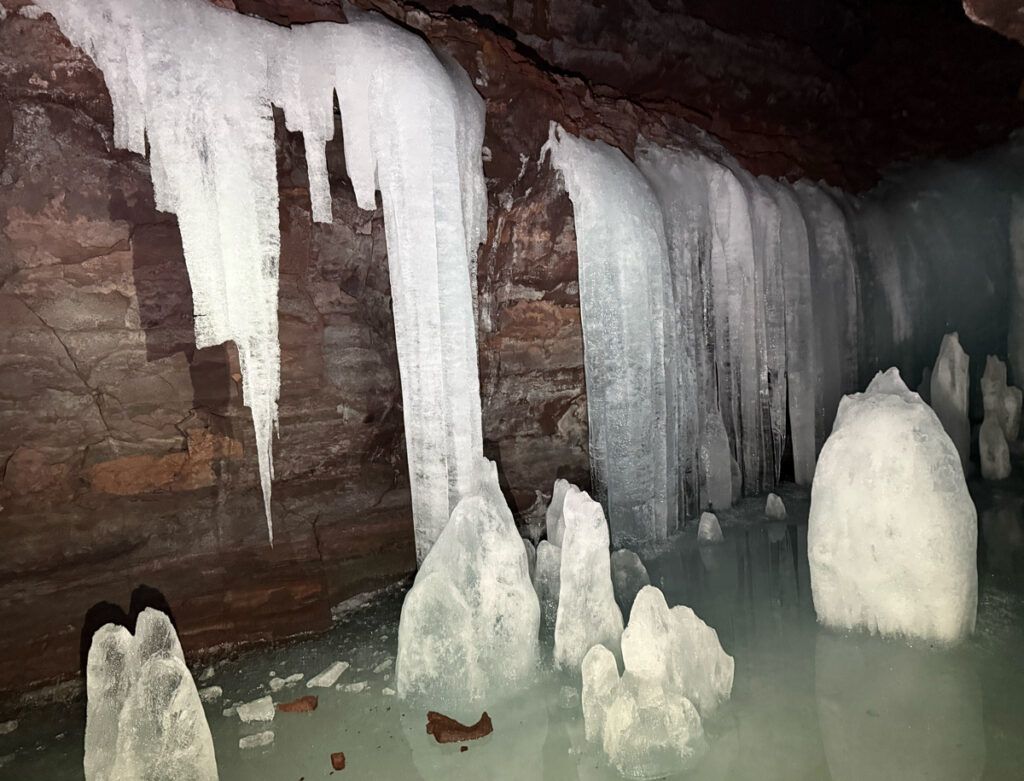
For Jeff Munroe, a cave scientist and research fellow at the University of Innsbruck, Weiss’s findings are, unfortunately, unsurprising. Although he’s worked in higher-altitude, colder caves and hasn’t seen ice completely disappear, he knows they’re changing.
“These systems are really close to the edge,” Munroe said.
The Consequences of Losing Ice Caves
“The loss of that ice is presumably going to change just about everything about the ecosystem.”
Although Weiss acknowledged that more research is needed to draw definitive conclusions, losing once-perennial ice formations is a worrying sign for these caves and the ecosystems they support. Some insects thrive on these ice features, and losing them disrupts habitat. The melting of the ice formations also changes the very structure of these caverns, opening up new passages and possibly altering airflow.
“In an ecosystem that has historically been dominated by large, perennial, and extensive ice deposits, the loss of that ice is presumably going to change just about everything about the ecosystem,” Weiss said.
Munroe and Weiss also emphasized that extensive ice deposits are important research tools. Similar to polar ice cores that reveal the atmosphere millions of years ago, ice cave samples can provide localized climate history. For example, Weiss said the stratification of ice preserves pollen and oxygen isotopes, which can tell researchers about past ecosystems and the paleoclimate.
“We’re losing these underground records of past change, and they’re irreplaceable,” Munroe said.
However, not all is lost. Weiss doesn’t yet know whether this is simply a localized problem, and she wants to compare Lava Beds’ cave monitoring data to those in nearby cave systems.
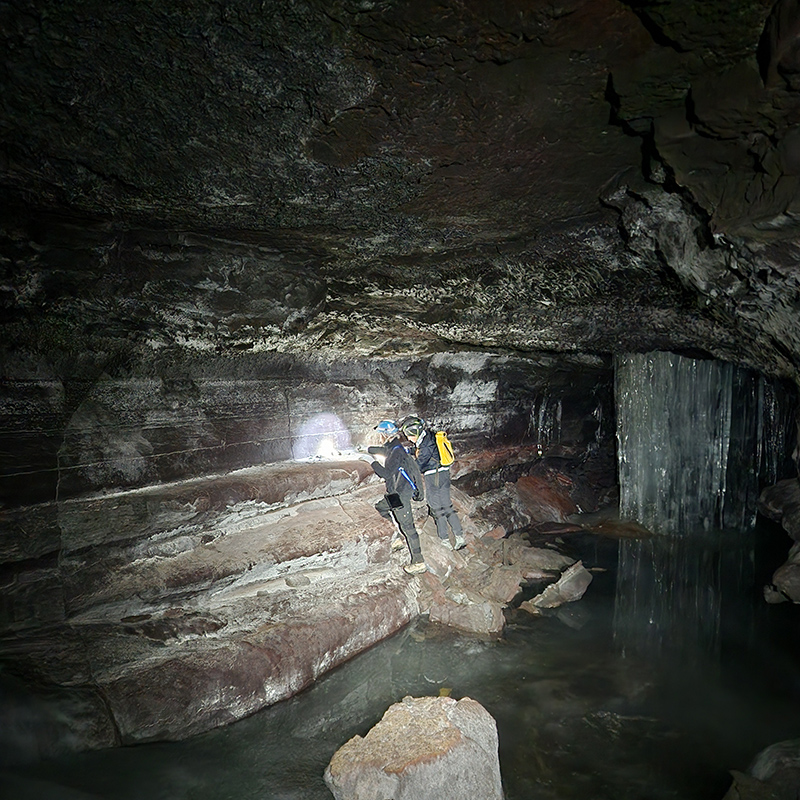
Beyond scientific value, Weiss simply hopes these ice formations stay around long enough for more people to experience.
“There are caves that have these massive, just unbelievably beautiful, giant ice waterfalls—just draw-dropping features that exist and are, in some cases, disappearing without anyone really noticing,” Weiss said. “That’s worth bearing witness to.”
—Sam Norton (@sam-norton.bsky.social), Science Writer
Citation: Norton, S. (2026), Temperature swings are melting the ice in Lava Beds National Monument’s caves, Eos, 107, https://doi.org/10.1029/2026EO260354. Published on 5 November 2026.
Text © 2026. The authors. CC BY-NC-ND 3.0
Except where otherwise noted, images are subject to copyright. Any reuse without express permission from the copyright owner is prohibited.
Source: Temperature Swings Are Melting the Ice in Lava Beds National Monument’s Caves