AI Insight
NASA's James Webb Space Telescope captured an image of galaxy cluster MACS J0454.1-0300, where gravitational lensing creates multiple warped images of distant galaxies. The orange galaxies appearing bunched together are not part of the foreground cluster but are much more distant objects whose light has been bent and magnified by the cluster's enormous mass. This gravitational lensing effect acts like a cosmic magnifying glass, allowing astronomers to observe galaxies that would otherwise be too faint or distant to detect.
Why it matters
Gravitational lensing enables scientists to study extremely distant and early galaxies that would be impossible to observe directly, providing insights into galaxy formation and the early universe. This technique essentially uses massive galaxy clusters as natural telescopes to peer deeper into space and time than would otherwise be possible.
Understand the Science
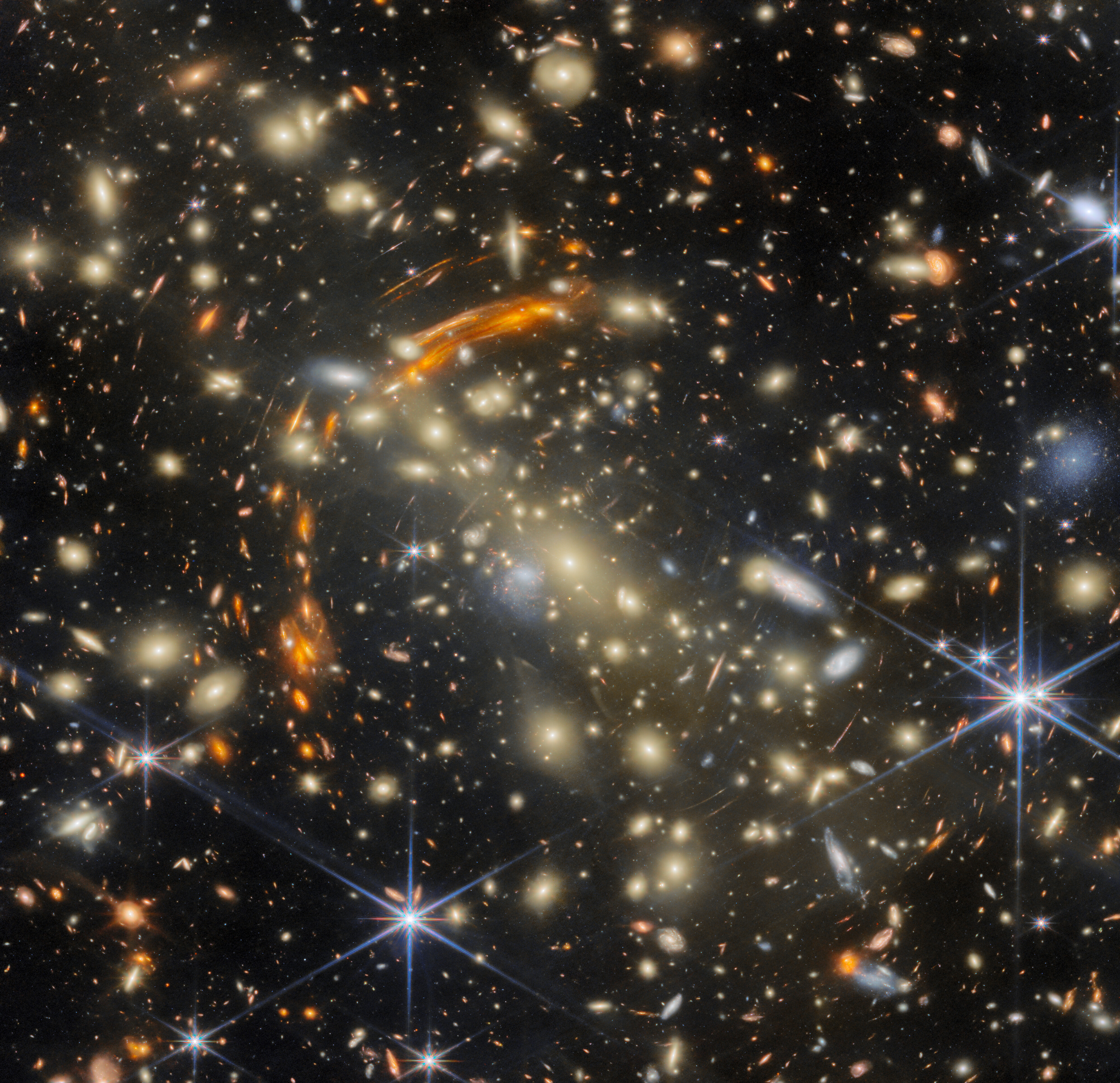
Galaxies warp and multiply as if in a house of mirrors in this image from NASA’s James Webb Space Telescope released on Sept. 29, 2026.
The brilliant golden galaxies seen here are part of a galaxy cluster called MACS J0454.1-0300. The orange galaxies bunched together on one side of the image, however, are not actually part of the cluster, but rather galaxies much farther away whose light has been bent and magnified by gravitational lensing. This phenomenon occurs when the enormous mass of a foreground object such as a galaxy cluster bends and magnifies the light from a more distant object in the background.
Learn more about this galaxy cluster.
Image credit: ESA/Webb, NASA & CSA, L. Furtak, S. Fujimoto
Source: Cosmic House of Mirrors