AI Insight
Five planets will be visible in the September 2024 night sky at different times and locations. Venus will remain visible in the early evening western sky but will set progressively earlier throughout the month, while Mercury becomes visible low on the western horizon during the final week for southern U.S. observers. Saturn appears in the eastern evening sky, Mars brightens in the predawn hours, and Jupiter shines prominently in the eastern sky before sunrise.
Why it matters
This planetary alignment provides accessible opportunities for amateur astronomers and casual observers to view multiple planets without specialized equipment, though binoculars may help locate dimmer objects. The article offers practical guidance on timing and positioning to maximize viewing success across different geographic locations.
Understand the Science
Venus, which has been such a prominent object in the western evening twilight sky since the start of spring, is now entering its final full month of visibility. With each passing day, it drops a bit lower in the southwest sky and sets a bit earlier and closer to the vicinity of the sun. By month’s end, making a Venus sighting will be rather difficult as it will be following the sun to below the horizon by only about 30 minutes.
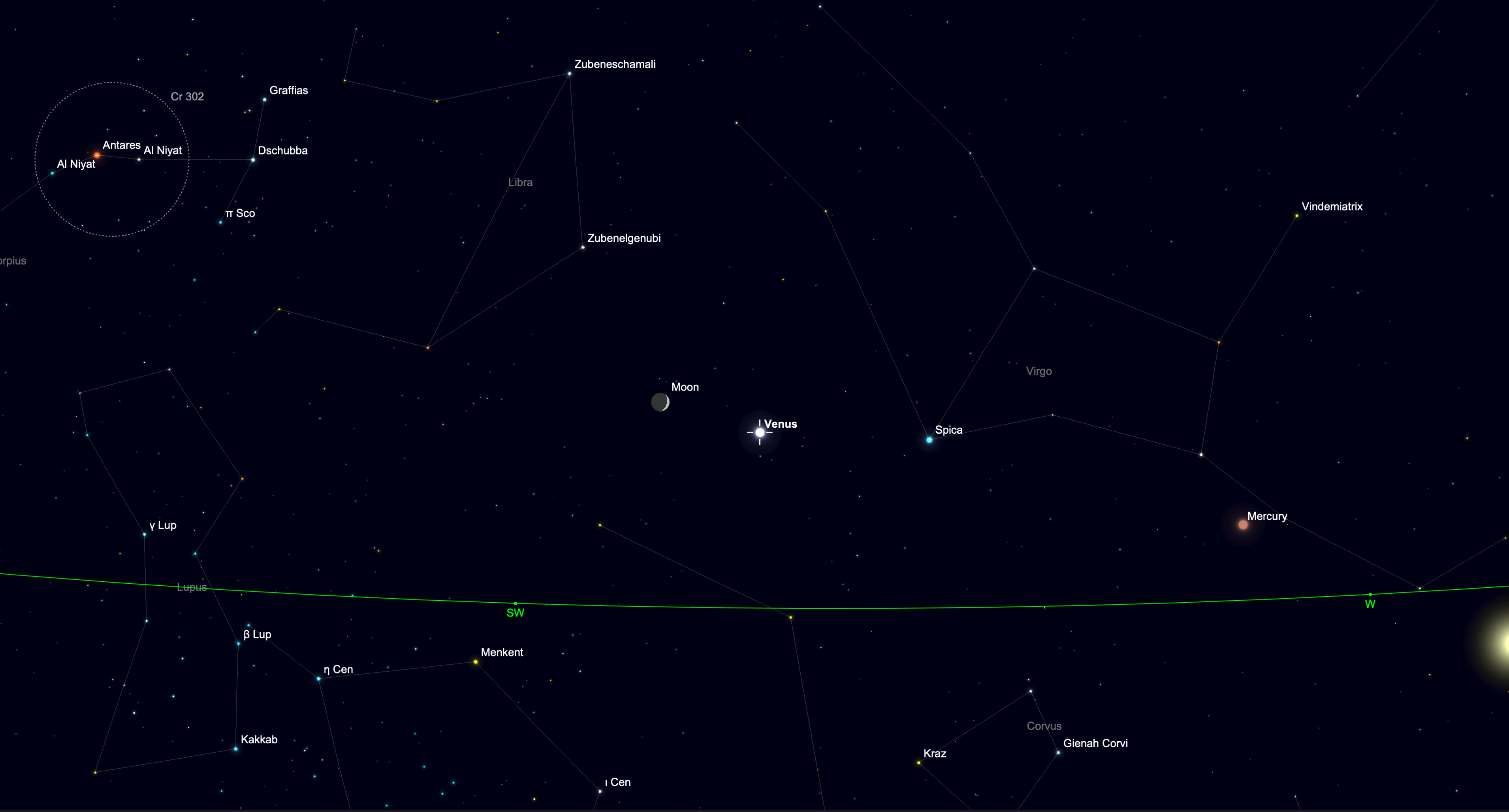
During the last week of September, Mercury pops up above the western horizon at dusk, primarily for those living in the southern half of the U.S., though you might need Venus to help direct you to this rocky little world.
Saturn is evident for much of the night, appearing low in the eastern sky as the sky darkens and reaching its highest point in the southern sky soon after midnight.
Mars is a planet that is visible during the predawn hours. While it was quite dim just a few months ago, it has been slowly approaching Earth and consequently has been slowly increasing in brightness. Now, as we move into the final quarter of this year, its brightening will become much more noticeable.
Finally, there is Jupiter, becoming increasingly obvious as a brilliant light, low in the eastern sky a few hours before sunrise.
In our schedule, remember that when measuring the angular separation between two celestial objects, your clenched fist held at arm’s length measures roughly 10 degrees. Here, we present a schedule below which provides some of the best planet viewing times as well as directing you as to where to look to see them
The sun
The sun crosses the celestial equator, heading south at 8:05 p.m. EDT on Sept. 22 (0005 GMT on Sept. 23). This equinox marks the beginning of autumn in the Northern Hemisphere and spring in the Southern.
Mercury
Mercury becomes visible during the final week of September from the southern US, low in the west-southwest in evening twilight. On the evening of Sept. 25, this planet, shining at magnitude -0.1 lies 21 degrees east of the sun and 1 degree above and to the right of the 1st magnitude star Spica. Try using Venus as a benchmark to locate them, as they will be positioned 14 degrees to Venus’ right. You’ll likely need binoculars to pick up Spica as it will shine only about ⅓ as bright as Mercury. On Oct. 9 this smallest of planets will attain greatest elongation, 25 degrees, but this is a decidedly poor apparition. For mid-northern latitudes, the planet will set only 45 minutes after sundown.
Venus
Venus will soon be relinquishing its dominance of the early evening sky.
Looking low near the southwest horizon an hour after sunset on Sept. 1, observers can enjoy spotting the 1st-magnitude star Spica only about 1.5 degrees above Venus. The gap between the two grows by 1 degree per day after that. The dazzling planet sets 1½ hours after the sun as September starts and only a little more than a half hour after as the month ends. Even worse, with respect to the sun, Venus’ path makes a very shallow angle to the horizon for those living near latitude 40 degrees north.
Sharp-eyed observers who can glimpse the planet’s pinpoint gleam around the time of sunset will find it in the west-southwest only about 14 degrees high on Sept. 1 and 5½ degrees on Sept. 30.
On the evening of Sept. 14, look low in the west-southwest sky 30 to 45 minutes after sunset this evening to make a sighting of a waxing crescent moon positioned about 5½ degrees to the left of Venus.
On Sept. 18, Venus reaches its greatest brilliancy (magnitude -4.8), about when telescopes show the planet presenting its “greatest illuminated extent” (321 square arc seconds of sunlit surface). Unfortunately for observers at mid-northern latitudes, this display occurs lower in the dusk sky than at any other time in Venus’s 8-year cycle of recurring appearances. Telescopes show Venus’s crescent lengthening and thinning throughout the month, but observers at mid-northern latitudes will find Venus’s image to be blurred by turbulence low in the sky. For the best telescopic views, try to catch Venus immediately after sunset — or even in late afternoon, if you can find a building or hill to block the sun from view.
Mars
Mars rises around 1:40 a.m. local daylight time at the start of September; about a half hour earlier by month’s end. It’s quite high in the east before morning twilight starts. During much of September, Mars continues its interesting traverse of Gemini, before ultimately crossing over into Cancer.
The amber-hued planet passes less than one degree to the upper left of the 4th magnitude star Delta Geminorum, also known as Wasat, on the morning of Sept. 9. Yellow-orange Mars (magnitude +1.1) is 5.9 degrees to the lower right of the similarly bright yellow star Pollux on the morning of Sept. 17; compare their brightnesses and colors. More striking will be the view when Mars aligns in a straight line with Castor and Pollux on the morning of Sept. 25. That’s also the day when Mars crosses over from Gemini into Cancer.
Jupiter
Jupiter early in the month rises in the east-northeast at 3:50 a.m. local daylight time, but you’ll have to wait at least another week before it gets fairly high in the sky for steady telescopic viewing and that’s not until just before dawn’s first light.
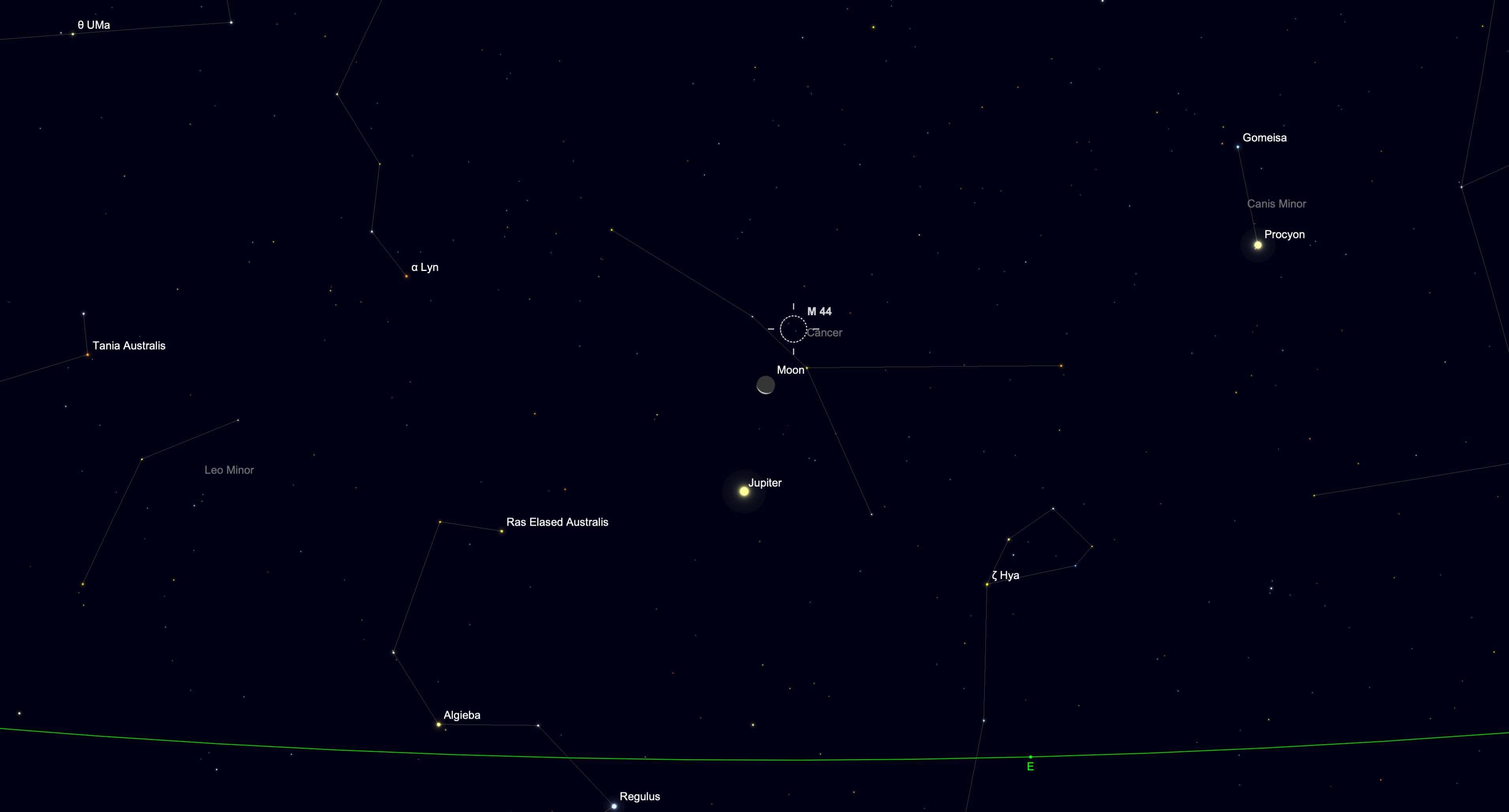
If you make the effort to set up a telescope before dawn’s early light, you can be among the first to see what became of Jupiter’s tumultuous cloud belts and Great Red Spot while the planet was hidden in the glare of the sun from mid-June through mid-August. On the morning of Sept. 8, you’ll find it hovering about 4½ degrees below a waning crescent Moon. Later that afternoon, the moon will cross in front of Jupiter (called an occultation) for much of North America.
Saturn
Saturn is an engaging object all September. It rises due east earlier in the dusk each week. Later in the evening, it moves up into the southeastern sky, initially shining to us from a secluded section of Pisces, on Sept. 6, it crosses over into the non-zodiacal constellation of Cetus, the Whale. It is now shining at magnitude +0.4, its brightest in several years.
In telescopes, its famous rings are narrow but dramatic, now tilted 8 degrees to our line of sight. This is the last season we’ll see the rings so narrow for a dozen years. During the summer of 2027, their tilt will have increased to 14 degrees. On Sept. 26th, you’ll find Saturn appearing as a bright yellowish-white star, shining 6 degrees below the Harvest Full Moon.
Joe Rao serves as an instructor and guest lecturer at New York’s Hayden Planetarium. He writes about astronomy for Natural History magazine, Sky and Telescope, The Old Farmer’s Almanac and other publications.
Source: 5 planets will light up the September sky — here's how to see them