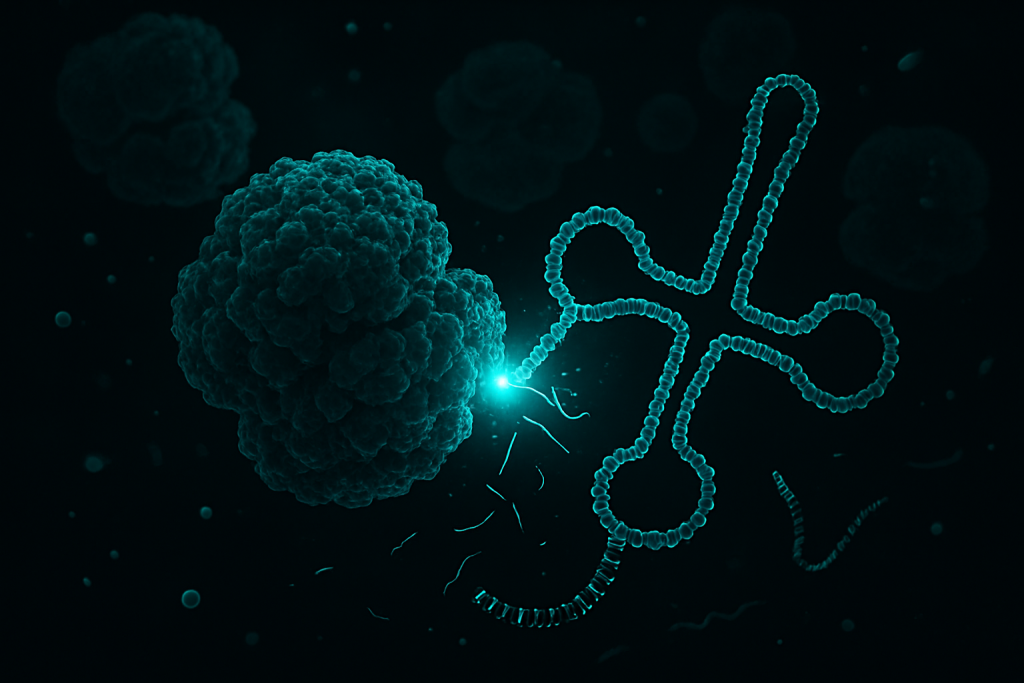
Image generated by AI
AI Insight
This study reveals that SLFN14, a ribosome-associated enzyme, causes inherited thrombocytopenia by selectively cleaving type II transfer RNAs (tRNAs), which are essential for protein synthesis. Disease-causing mutations in SLFN14 shift its target preference from ribosomal RNA to type II tRNAs, leading to ribosome stalling, widespread translational shutdown, cellular stress, and cell death. The researchers demonstrated this mechanism using human cells expressing different SLFN14 variants, showing how altered RNA substrate specificity drives the pathological phenotype.
Why it matters
This research provides the molecular explanation for how specific SLFN14 mutations cause a bleeding disorder characterized by low platelet counts. Understanding this mechanism could lead to targeted therapeutic strategies for patients with this inherited condition and reveals a broader regulatory mechanism by which selective tRNA degradation controls cell survival and function.
by Chengchao Ding, Xinyi Ashley Liu, Fushun Zhang, Saori Uematsu, Shu-Bing Qian, Yan Xiang
Schlafens proteins (SLFNs) are interferon-inducible regulators of RNA metabolism that influence antiviral defense and cell fate. Human SLFN14 is a ribosome-associated endoribonuclease whose pathogenic variants cause autosomal dominant inherited thrombocytopenia (IT), but the molecular basis of this disorder remains unclear. Here, using HEK293T cells expressing human SLFN14 variants, we show that SLFN14 represses global protein synthesis through selective cleavage of type II tRNAs. IT-linked mutations alter SLFN14 RNA substrate specificity, enhancing depletion of type II tRNAs while reducing rRNA cleavage. This shift promotes ribosome stalling at codons decoded by type II tRNAs, triggering global translational arrest, stress signaling, and cell death. These findings reveal how altered RNA targeting by SLFN14 can drive disease and highlight selective tRNA targeting as a mechanism than regulates translation and cell fate.