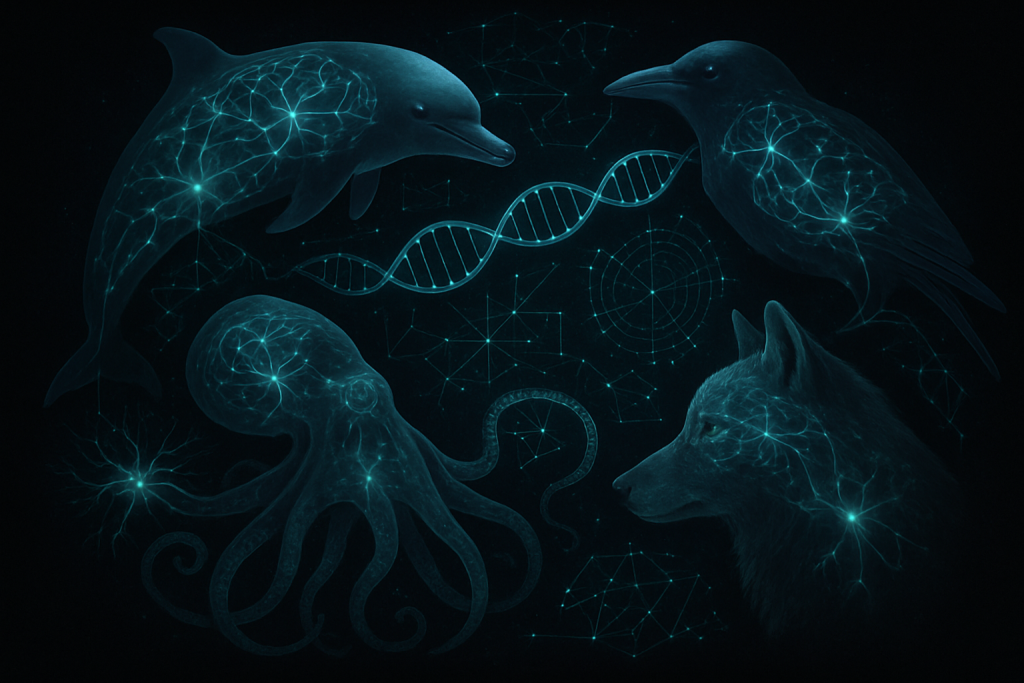
Image generated by AI
A rat freezes in fear. A crow solves a puzzle. An octopus changes color to communicate. These seemingly simple acts reveal something profound: animals across the evolutionary tree share fundamental behavioral principles that transcend the boundaries between biology, psychology, neuroscience, and computer science. The question of how and why animals behave the way they do has become one of science’s most fertile meeting grounds, where disciplines collide and merge to create entirely new ways of understanding life itself.
Understanding animal behavior has moved far beyond anecdotal observation or isolated laboratory studies. Today, researchers equipped with neuroimaging, artificial intelligence, genomic sequencing, and computational modeling are uncovering the deep mechanistic roots of behavior—revealing that whether an organism has a brain the size of a grain of sand or a human-like cortex, certain principles govern how it processes information, makes decisions, and interacts with its environment. This convergence matters urgently: as we face ecological collapse, design artificial intelligence systems, and grapple with human mental illness, the lessons learned from studying behavior across species provide a universal language for understanding minds.
What Is Behavioral Understanding Across Species?
Behavioral understanding across species refers to the comparative study of how different animals—from fruit flies to primates—process information, make decisions, and respond to their environments. It encompasses the mechanisms underlying behavior at multiple levels: the molecular signals that trigger an action, the neural circuits that orchestrate response patterns, the evolutionary pressures that shaped behavioral repertoires, and the cognitive sophistication animals bring to survival. Rather than treating each species in isolation, this approach seeks universal principles and mechanisms that operate across the tree of life, while also documenting the remarkable diversity in how different creatures solve similar problems.
The scientific study of animal behavior traces its origins to Charles Darwin, who recognized in the 1870s that behavior, like morphology, could reveal evolutionary relationships and adaptive value. But the modern interdisciplinary approach crystallized in the mid-20th century through pioneers like Konrad Lorenz and Niko Tinbergen, who founded ethology—the study of animal behavior in natural contexts. Their Nobel Prize-winning work established that behavior could be rigorously studied using the same scientific methods applied to physiology and genetics. However, what truly transformed the field was the integration of molecular biology, neuroscience, and computational theory in the 1990s and 2000s, allowing researchers to trace behavior from genes to neural circuits to whole-organism responses.
Across the Sciences
The mechanisms of behavior emerge at the intersection of multiple scientific domains. At the molecular level, neurotransmitters like dopamine and serotonin regulate mood and motivation across virtually all animals with nervous systems—a chemical language that remained largely unchanged for 500 million years of evolution. Moving upward, neural circuits integrate sensory input, compare it to internal states and memories, and generate motor outputs. At the computational level, these circuits implement algorithms for learning, decision-making, and prediction that mirror those found in machine learning and artificial intelligence. At the systems level, hormones orchestrate behavioral states—aggression, parenting, migration—that unfold over hours or seasons. Finally, at the evolutionary level, natural selection has sculpted different behavioral solutions to universal challenges: finding mates, securing food, avoiding predators, raising offspring.
Consider the simple act of a fruit fly detecting and approaching food. The sensory organs (chemoreceptors) translate molecular odors into electrical signals. These signals propagate through neural circuits in the fly’s brain—roughly 100,000 neurons, compared to the human brain’s 86 billion—where they interact with information about hunger state (signaled by neurons that release neuropeptides). The brain’s circuits then compute a decision: move toward or away from the stimulus. An animal’s past experience—its memory—modulates this decision through synaptic plasticity, the ability of connections between neurons to strengthen or weaken. The entire cascade, from molecule to behavior, unfolds in milliseconds. Yet the same basic architecture—sensory input, neural computation, motor output—operates in a mouse navigating a maze, a bird building a nest, or a human deliberating a choice.
Why This Matters for the Future
Understanding behavior across species has immediate practical applications that touch nearly every field. In medicine, researchers are using animal models—primarily mice and zebrafish—to understand the neural basis of psychiatric disorders like depression, anxiety, and autism. By studying how neural circuits malfunction in these animals, scientists identify potential drug targets and therapeutic strategies. In conservation biology, understanding animal behavior is essential for protecting endangered species; knowing how wolves hunt, how elephants grieve, or how coral reefs coordinate spawning allows us to design more effective preservation strategies. In urban planning and human-animal conflict mitigation, behavioral insights help cities coexist with wildlife. And in agriculture, understanding pest behavior enables the development of more humane and targeted pest management techniques.
Beyond these direct applications, behavioral understanding fuels cutting-edge technology development. Computer scientists studying animal cognition and decision-making have designed algorithms that mimic ant foraging behavior to solve optimization problems in logistics and telecommunications. Researchers investigating how birds navigate and maintain flock cohesion have created algorithms that control swarms of drones for search-and-rescue operations and environmental monitoring. Neuroscientists examining how the brain learns and adapts are directly informing the development of more efficient and generalizable artificial intelligence systems. Some of the most advanced AI models—particularly those dealing with decision-making and learning—are explicitly inspired by neural mechanisms discovered in animals.
Recent Breakthroughs in Behavioral Understanding Across Species
The past three years have witnessed remarkable convergences. In 2023, researchers at Google DeepMind published a landmark study using AI to predict protein structures in animals across species, revealing how conserved neural proteins contribute to similar behaviors in distantly related organisms. Simultaneously, advances in two-photon microscopy and calcium imaging have allowed neuroscientists to observe the activity of hundreds of neurons simultaneously in behaving animals—creating something approaching a “connectome movie” where researchers can watch entire neural circuits compute behavior in real time. Studies on octopuses have revealed that these animals, which diverged from vertebrates 500 million years ago, independently evolved mechanisms for learning and memory that closely parallel those in mammals, suggesting that evolution converges on certain computational solutions. Research on ravens and great apes has demonstrated metacognition—the ability to assess one’s own knowledge—in non-human animals, challenging long-held assumptions about cognitive uniqueness in primates.
Current research frontiers are increasingly focused on integrating data across scales and species. The International Brain Initiative, launched in 2020, is coordinating global efforts to map neural circuits across multiple model organisms simultaneously, seeking fundamental organizing principles. Several labs are now combining high-speed videography with machine learning to automatically classify and predict behavior, reducing human bias in observation while accelerating data collection. Others are using genetic engineering to identify the specific genes and proteins that control behavior, creating “behavior maps” that show how DNA variations translate into observable differences in how animals act. The open question that animates much current work is: how much of behavior can be predicted from knowing neural circuits and genes, and what role does experience and context play in making behavior flexible and adaptive?
Why Behavioral Understanding Across Species Matters for the Future
As artificial intelligence becomes increasingly sophisticated and increasingly integrated into society, understanding animal behavior becomes not a luxury but a necessity. Machine learning systems that exhibit learned behaviors, make decisions under uncertainty, and interact with environments do so using computational principles derived—sometimes explicitly, sometimes implicitly—from how brains have evolved to solve these problems over millions of years. By studying behavior across species, we gain insight into which solutions are computationally fundamental and which are contingent on specific evolutionary histories. This distinction matters enormously for building robust AI: systems that emulate the flexible, generalizable, creative problem-solving exhibited by intelligent animals may prove far more capable than systems based purely on mathematical optimization.
The climate crisis and biodiversity collapse have made behavioral understanding urgent in conservation. As ecosystems shift and species face novel environments, understanding the behavioral flexibility of animals—their capacity to adapt responses to new conditions—becomes critical for predicting which species might persist and which will fail. Simultaneously, behavioral understanding of human-wildlife interfaces matters as cities expand into wildlife habitats. And in global health, the COVID-19 pandemic and periodic disease outbreaks highlight how essential it is to understand animal behavior in order to predict and prevent zoonotic disease transmission. The remaining challenges are formidable: we still lack a unified framework for predicting behavior from first principles, behavior remains notoriously difficult to measure in natural conditions, and the sheer complexity of neural systems continues to outpace our ability to model them fully.
Key Takeaways
- Behavioral understanding across species is a fundamentally interdisciplinary enterprise that integrates molecular biology, neuroscience, psychology, evolution, and computer science to explain how and why animals behave.
- Behavior emerges from molecular-level neurotransmitter systems, through neural circuits that compute decisions, to evolutionary-level adaptations—and these mechanisms are conserved across vast evolutionary distances.
- The most promising near-term application is using animal models to understand human psychiatric disorders and develop new therapies by studying neural circuits underlying behavior.
- Recent breakthroughs include the use of AI to predict neural structures across species, real-time observation of neural circuits during behavior, and evidence that distant species evolve convergent solutions to behavioral problems.
- This field matters for the future because understanding animal behavior informs artificial intelligence design, conservation strategy, human-wildlife coexistence, and our fundamental understanding of what minds are and how they work.
Explore TED Talks on Behavioral Understanding Across Species:
TED content is used under CC BY-NC-ND 4.0. © TED Conferences, LLC.
Frequently Asked Questions
What fundamental behavioral principles do scientists discover are shared across evolutionarily distant animal species?
The article indicates that animals across the evolutionary tree share core principles in how they process information, make decisions, and interact with their environment—principles that appear to operate regardless of brain size or complexity. These universal mechanisms suggest convergent solutions to survival challenges that transcend species boundaries.
How do modern neuroscience and computational tools like artificial intelligence help reveal the mechanisms underlying animal behavior?
Researchers now use neuroimaging, genomic sequencing, and computational modeling to identify the deep mechanistic roots of behavior rather than relying on observation alone. These tools enable scientists to map how different nervous systems—from simple to complex—process information and generate behavioral responses.
Why is understanding animal behavior across species relevant to addressing human mental illness?
Because behavioral principles appear universal across animal brains, studying how different species process fear, decision-making, and environmental responses provides insights into fundamental neural mechanisms that directly apply to understanding human psychiatric conditions. This cross-species perspective reveals common biological pathways underlying behavior that transcend human-specific approaches.
Can studying behavioral patterns in simpler animals like octopuses or rats improve artificial intelligence system design?
Yes; because animals with vastly different neural architectures solve problems and process information efficiently, their behavioral strategies offer proven solutions to information processing and decision-making that engineers can model in AI systems. This biomimetic approach leverages millions of years of evolutionary optimization across diverse nervous systems.