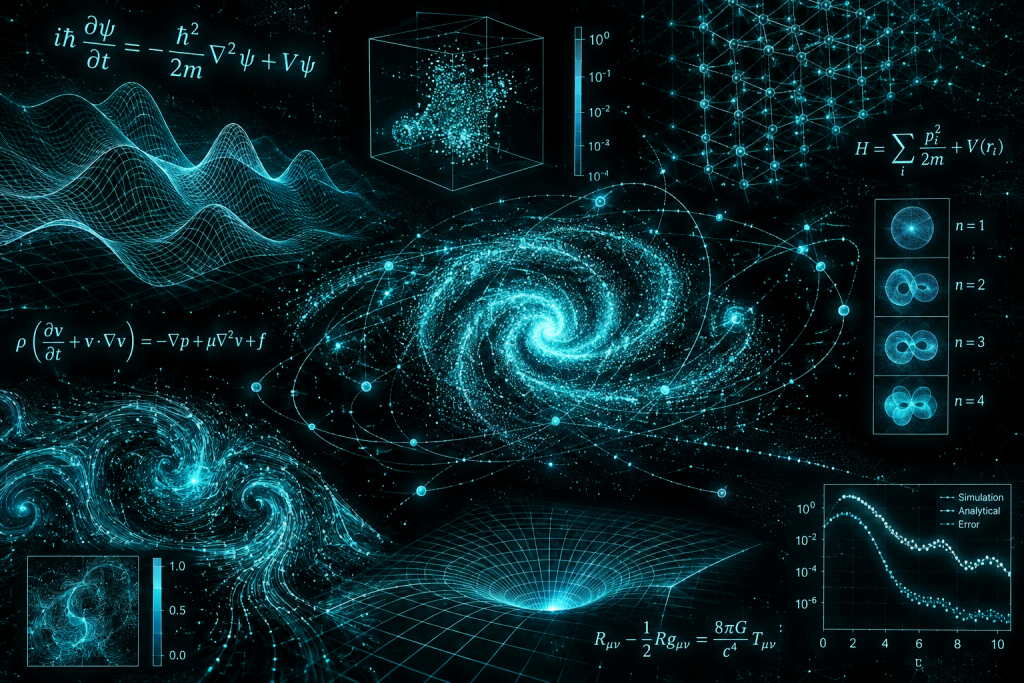
Image generated by AI
Every time a weather forecaster predicts tomorrow’s storm, a pharmaceutical company designs a new drug, or an engineer tests a bridge’s stability before construction, they rely on a invisible orchestra of mathematics and computation. Computational physics—the practice of using computers to solve the equations that describe nature—has become so integral to modern science that we often forget it’s barely fifty years old. Yet it has fundamentally transformed how we understand everything from subatomic particles to the climate of our entire planet. The question is no longer whether we can simulate reality on a computer, but rather: what aspects of the universe are we still unable to capture?
In an age where experimental equipment costs millions of dollars and some experiments are simply too dangerous, expensive, or time-consuming to perform in a laboratory, computational simulations have become a necessity rather than a luxury. During the COVID-19 pandemic, researchers used computational physics to model how the virus spreads and to design vaccines without needing to wait years for conventional trials. Today, artificial intelligence companies are building increasingly sophisticated simulations that can predict molecular behavior, optimize renewable energy systems, and even help us understand the deepest mysteries of the cosmos. Understanding how computational physics works is essential to grasping the technological future we’re rapidly entering.
What Is Computational Physics and Simulation Methods?
Computational physics is the marriage of theoretical mathematics, physical principles, and computer science. It is the art and science of translating the laws of nature—whether Newton’s equations of motion, Maxwell’s equations of electromagnetism, or the Schrödinger equation of quantum mechanics—into a form that a computer can understand and solve. Where theoretical physicists write elegant equations on a blackboard and experimental physicists design intricate laboratory setups, computational physicists write algorithms that approximate solutions to those equations using numerical methods. The goal is always the same: to predict what will happen in a physical system without having to actually build it or observe it directly.
The field emerged from practical necessity in the mid-twentieth century. During the Manhattan Project and the early Cold War, physicists needed to simulate nuclear detonations and weapons behavior, but no analytical solutions existed for the complex systems they were studying. With the advent of computers like ENIAC in the 1940s and the steady exponential growth of computational power predicted by Moore’s Law, scientists realized they could use brute-force numerical methods to solve previously intractable problems. By the 1970s and 1980s, computational physics had matured into a full discipline, with practitioners developing sophisticated algorithms for everything from fluid dynamics to molecular dynamics to climate modeling. Today, it stands as the third pillar of physics, alongside theory and experiment.
The Basic Principle
At its core, computational physics works by breaking a continuous physical problem into discrete chunks that a computer can digest. When you want to simulate how water flows around a boat hull, you can’t store an infinite amount of information in a finite computer—so instead, you divide the water into millions or billions of tiny cubic cells, each with its own properties like velocity, pressure, and temperature. You then apply the known physical laws (in this case, the Navier-Stokes equations of fluid motion) to each cell, calculating how each property changes over a tiny increment of time. By repeatedly applying these calculations—often millions or billions of times—the computer can predict the evolution of the entire system. This process is called discretization, and it’s the fundamental trick that allows us to turn continuous mathematics into discrete computations.
Think of it like a flip-book animation. When you draw slightly different pictures on each page and flip through them quickly, your brain perceives smooth, continuous motion even though the pictures are actually discrete snapshots. Similarly, when a computational physicist divides time into tiny intervals (perhaps nanoseconds or even smaller) and space into tiny cells, and then calculates how the system changes with each step, the result looks like a smooth, continuous evolution of the physical system. The computer doesn’t “know” the full trajectory of a particle or the exact shape of a wave; it only knows the state at each discrete time step. Yet when you visualize the results, you see what appears to be a realistic, continuous physical process unfolding in front of you.
Why It Matters in the Real World
The impact of computational physics extends far beyond academic curiosity. In materials science, researchers use simulations to predict the properties of new alloys before synthesizing them in the laboratory, saving months and millions of dollars. In structural engineering, simulations test how buildings respond to earthquakes, allowing architects to design safer structures. Pharmaceutical companies use computational methods to predict how drug molecules will bind to their protein targets, dramatically accelerating the drug discovery pipeline. Climate scientists rely entirely on computational simulations to project future climate scenarios and test the effectiveness of potential interventions. Without computational physics, modern technology and science as we know it simply would not exist.
Consider the automotive industry: before a new car design ever reaches a crash test facility, engineers have already run thousands of computational simulations to optimize safety features. Aerodynamics engineers at Tesla or Ferrari use computational fluid dynamics to design bodywork that reduces drag without ever building a physical prototype. In renewable energy, simulations help wind turbine manufacturers optimize blade design and predict power output under various weather conditions. Medical device manufacturers use computational biomechanics to test artificial joints, heart valves, and implants before human trials. From Netflix’s recommendation algorithms that rely on statistical physics simulations to predict user behavior, to the algorithms that optimize delivery routes for shipping companies, computational physics has become woven into the fabric of modern commerce and innovation.
Recent Breakthroughs in Computational Physics and Simulation Methods
The past few years have witnessed a convergence of computational physics with machine learning and artificial intelligence, creating a new frontier called physics-informed neural networks (PINNs). These hybrid systems combine the pattern-recognition power of deep learning with the constraint of physical laws, allowing researchers to solve differential equations and predict physical behavior with unprecedented speed and accuracy. In 2023 and 2024, researchers published breakthrough results showing that PINNs could solve certain types of inverse problems—where you know the outcome but need to discover the underlying physical mechanism—far faster than traditional numerical methods. Additionally, quantum computing has begun to show promise for simulating quantum systems, where classical computers have fundamental limitations. Companies like IBM, Google, and IonQ have demonstrated that quantum computers can simulate certain quantum phenomena more efficiently than classical machines, though we’re still in the early stages of this revolution.
Researchers are currently pushing the boundaries of scale and complexity in computational simulations. Climate scientists are running increasingly detailed global climate models with finer spatial resolution and more comprehensive treatment of feedback mechanisms. In cosmology, researchers are attempting to simulate the entire universe’s evolution from the Big Bang to the present day, accounting for dark matter and dark energy. One major open question is how to make simulations faster and more accurate while using less energy—as computational demands grow exponentially, the energy footprint of running these simulations becomes a real concern. Another frontier is developing better methods for uncertainty quantification: when you run a simulation, how confident can you be in the results, and how does this uncertainty propagate through the system?
Why Computational Physics and Simulation Methods Matters for the Future
As we face global challenges like climate change, disease pandemics, and the need for sustainable energy, computational physics will become increasingly indispensable. The ability to simulate complex systems and run thousands of “what-if” scenarios before committing to costly real-world interventions could mean the difference between success and failure in addressing these challenges. Future computational approaches combined with real-time sensor data and artificial intelligence could enable dynamic, responsive systems that adapt to their environment in real-time. In the coming decades, we may see the emergence of “digital twins”—complete computational models of physical systems that evolve in lockstep with their real-world counterparts, enabling unprecedented levels of monitoring, optimization, and control.
However, significant challenges remain. The computational cost of high-fidelity simulations continues to grow faster than Moore’s Law can keep up with, meaning some important problems remain computationally intractable with current technology. There’s also a growing recognition that many simulations, despite their mathematical sophistication, may not capture all relevant physical phenomena or may contain subtle biases in their formulation. Validating computational models against experimental data remains challenging, especially in cases where experiments are sparse or expensive. Furthermore, as we rely increasingly on computational models for critical decisions—in healthcare, climate policy, and infrastructure planning—the question of how to ensure these models are trustworthy, transparent, and free from hidden assumptions becomes ever more pressing.
Key Takeaways
- Computational physics uses computers to solve the mathematical equations that describe nature, enabling scientists to simulate physical systems that are too expensive, dangerous, or time-consuming to study experimentally.
- The fundamental mechanism involves discretizing continuous physical problems into tiny spatial cells and time steps, then repeatedly applying physical laws to calculate how the system evolves, creating a detailed picture of reality step by step.
- The most promising near-term applications include physics-informed neural networks that combine machine learning with physical constraints, enabling faster and more accurate solutions to complex problems in climate science, materials design, and drug discovery.
- Recent breakthroughs have demonstrated that hybrid AI-physics approaches can solve certain inverse problems faster than traditional methods, while quantum computers show early promise for simulating quantum systems.
- As global challenges from climate change to pandemic response intensify, computational physics will become essential infrastructure for testing solutions and informing policy decisions, though challenges around computational cost, model validation, and trustworthiness remain significant hurdles.
Explore TED Talks on Computational Physics and Simulation Methods:
TED content is used under CC BY-NC-ND 4.0. © TED Conferences, LLC.
Frequently Asked Questions
How do computers solve the complex mathematical equations that describe physical systems?
Computers break down complex differential equations into simpler, discrete steps that can be calculated iteratively, using numerical methods like finite difference, finite element, or Monte Carlo techniques. These methods approximate continuous physical phenomena into computational algorithms that a processor can execute millions of times per second.
Why is computational simulation necessary when we could theoretically solve physics equations on paper?
Most real-world physical systems involve nonlinear equations and multiple interacting variables that are mathematically impossible or impractical to solve analytically by hand. Computational methods allow scientists to handle thousands or millions of variables simultaneously, making it possible to model weather systems, molecular dynamics, and fluid flows that would be unsolvable through traditional mathematical approaches.
What accuracy limitations do computational simulations have compared to real experiments?
Computational simulations are constrained by numerical precision (rounding errors), discretization errors (breaking continuous space into finite grid points), and the simplified assumptions built into the mathematical model itself. Validation against experimental data is essential because simulations can only be as accurate as both their underlying physics equations and the computational resolution allow.
Can computational physics predict outcomes for experiments that are too expensive or dangerous to perform physically?
Yes—computational simulations can model scenarios like nuclear reactor failures, extreme climate conditions, or high-energy particle collisions before investing in costly physical experiments. This approach saved time and resources during vaccine development and is routinely used in bridge engineering, aerospace design, and astrophysics where direct experimentation is impractical.