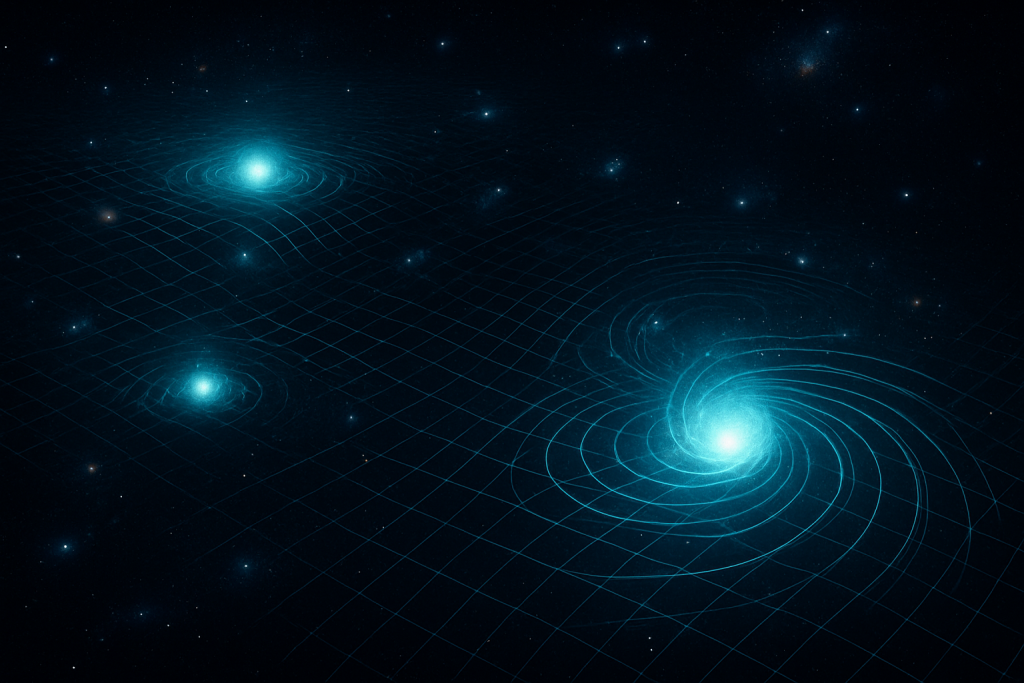
Image generated by AI
Imagine the entire universe as a cosmic symphony, where gravity conducts every note—from the trajectories of distant galaxies to the birth of black holes. Yet for centuries, humanity operated with two fundamentally incompatible scores: Einstein’s elegant description of gravity bending spacetime itself, and quantum mechanics governing the subatomic realm. This deep tension between our largest and smallest scales remains one of physics’ most profound unsolved mysteries, one that gravitational theory and cosmological models continue to grapple with today.
Understanding how gravity shapes the cosmos isn’t merely academic curiosity. These models determine whether the universe will expand forever or eventually collapse, whether dark matter and dark energy truly exist or whether we’ve fundamentally misunderstood gravity itself, and how we interpret observations from the most distant galaxies and the remnants of the Big Bang itself. As telescopes peer deeper into space and gravitational wave detectors listen to the universe’s violent collisions, our models are being tested and refined in real time, reshaping our understanding of reality’s fundamental architecture.
What Is Gravitational Theory and Cosmological Models?
Gravitational theory is humanity’s best mathematical description of how mass and energy warp the fabric of spacetime, causing objects to accelerate toward one another. Rather than thinking of gravity as a mysterious force pulling at a distance, modern gravitational theory—particularly Einstein’s general relativity—describes it as the geometry of spacetime itself. When massive objects like stars and galaxies exist in the universe, they literally bend and curve the spacetime around them, and other objects follow the curved paths this creates, much like marbles rolling along the contours of a warped rubber sheet. Cosmological models, by contrast, are mathematical frameworks that apply this understanding of gravity to the universe as a whole, attempting to describe its origin, evolution, and ultimate fate by treating the cosmos as a single, coherent system governed by physical laws.
The journey toward our modern understanding began with Isaac Newton’s revolutionary insight in the 17th century: gravity could be described mathematically as a force inversely proportional to the square of the distance between objects. For over two centuries, Newton’s framework remained supreme, accurately predicting planetary motions and celestial mechanics. However, in 1915, Albert Einstein published his theory of general relativity, fundamentally reimagining gravity not as a force but as curved spacetime itself. This shift in perspective proved essential: it explained phenomena Newton could not, from the precession of Mercury’s orbit to the behavior of light around massive objects. When applied to the entire universe by physicists like Friedmann, Lemaître, and Robertson in the 1920s, general relativity gave birth to modern cosmology—the science of the cosmos itself.
The Basic Principle
At the heart of gravitational theory lies a deceptively simple yet profound idea: massive objects don’t pull on each other through empty space; instead, they curve the spacetime that surrounds them, and this curvature determines how all objects move. Einstein’s field equations—a set of ten coupled nonlinear partial differential equations—mathematically describe this relationship between the distribution of matter and energy on one side and the resulting curvature of spacetime on the other. When you place a heavy object in spacetime, it creates a dip, a depression in the geometric fabric. Other objects naturally follow the contours of this warped landscape, which we experience as gravitational attraction. Cosmological models extend this principle universally: if we know the density and distribution of all matter and energy in the universe, we can in principle calculate how spacetime curves everywhere and how the universe evolves over time.
To make this tangible, imagine a trampoline stretched taut across a frame. A bowling ball placed at the center creates a deep depression. A marble rolling on the trampoline’s surface won’t be “pulled” toward the ball by an invisible force; instead, it naturally rolls along the curved surface toward the depression. The ball doesn’t reach out and grab the marble—the marble follows the geometry of the warped surface. Now scale this up infinitely: spacetime is the trampoline, massive objects are the bowling ball, and all the moving bodies in the universe are marbles following paths through curved spacetime. This is gravity reimagined not as action at a distance, but as geometry. Light itself follows these curves—it takes the shortest path through spacetime, called a geodesic, which is why light bends around massive objects like the sun, a phenomenon Einstein predicted and Eddington confirmed during the 1919 solar eclipse.
Why It Matters in the Real World
Gravitational theory and cosmological models aren’t confined to abstract mathematics or philosophical speculation—they have direct, measurable consequences for how we understand everything from the smallest scales we observe to the age and fate of the universe itself. GPS satellites in orbit around Earth must account for relativistic corrections to gravitational time dilation; without adjusting for the fact that time runs slightly faster in orbit than on Earth’s surface, GPS would accumulate errors of several kilometers per day. Modern cosmological models tell us that the universe is approximately 13.8 billion years old, that it underwent an initial period of rapid expansion called inflation, and that its current expansion is accelerating due to a mysterious component called dark energy. These models also predict the existence of dark matter, an invisible substance comprising about 85 percent of all matter in the universe, whose presence is inferred entirely through gravitational effects on visible galaxies and the cosmic microwave background radiation.
The technological and scientific applications are extensive and growing. Gravitational wave detectors like LIGO (the Laser Interferometer Gravitational-Wave Observatory) rely on predictions from gravitational theory to detect ripples in spacetime caused by colliding black holes and neutron stars—a discovery awarded the 2017 Nobel Prize and opening an entirely new window on the universe. Cosmological models inform the analysis of data from missions like the James Webb Space Telescope, helping astronomers interpret observations of the universe’s earliest galaxies. The understanding of how gravity behaves in extreme conditions—near black holes, in the early universe, at scales near quantum mechanics—shapes research programs at institutions worldwide and guides the search for a unified theory of physics. Insurance companies and financial firms even use cosmological principles and computational methods developed in astrophysics to model complex systems and optimize algorithms.
Recent Breakthroughs in Gravitational Theory and Cosmological Models
The past few years have witnessed remarkable convergence between different observational methods and theoretical predictions, alongside new puzzles that challenge our understanding. In 2022, the Event Horizon Telescope collaboration released the first direct image of a black hole’s shadow at the center of galaxy M87, providing stunning visual confirmation of general relativity’s predictions in the most extreme regime. Simultaneously, precise measurements from the cosmic microwave background by satellites like Planck, combined with observations of distant supernovae and the large-scale structure of galaxies, have refined our estimates of the universe’s composition: approximately 68 percent dark energy, 27 percent dark matter, and just 5 percent ordinary matter. However, a growing tension has emerged between different methods of measuring the current expansion rate of the universe—the Hubble constant—with some measurements suggesting the universe is expanding faster than older observations indicated, potentially signaling new physics beyond our current models.
Current research frontiers are equally exciting and perplexing. Scientists are probing whether modifications to general relativity might explain dark matter and dark energy without invoking invisible substances, with theories like Modified Newtonian Dynamics (MOND) and f(R) gravity receiving serious investigation. The nascent field of quantum gravity—attempting to reconcile general relativity with quantum mechanics—continues exploring candidates like string theory, loop quantum gravity, and asymptotic safety. Researchers are also using gravitational wave observations to test whether black holes behave exactly as general relativity predicts or whether surprising deviations might emerge. The detection of gravitational waves from neutron star collisions in 2017 allowed scientists to simultaneously measure both electromagnetic and gravitational signals, providing unprecedented tests of our theories and yielding information about the equation of state of nuclear matter under extreme conditions.
Why Gravitational Theory and Cosmological Models Matter for the Future
The ultimate stakes could hardly be higher: understanding gravity and cosmology touches questions humans have asked since ancient times, but with the rigor and precision of modern science. Will the universe expand forever, thinning into cold darkness in trillions of years, or might it eventually collapse back upon itself? Is the Big Bang truly the beginning, or does time extend infinitely backward? What is the nature of the singularities at the centers of black holes and at the universe’s origin? These aren’t merely philosophical puzzles—they’re physical questions that gravitational theory aims to answer. Success in reconciling quantum mechanics with gravity would represent perhaps the deepest unification in all of science, transforming our fundamental understanding of reality and potentially unlocking new technologies we can barely imagine. Conversely, failure to reconcile these theories might point us toward revolution: perhaps space and time aren’t fundamental at all, but emergent properties of some deeper structure.
The challenges ahead are formidable. We still cannot fully explain dark matter and dark energy, which together comprise 95 percent of the universe’s contents. The singularities predicted by general relativity—infinities where the theory breaks down—suggest our equations are incomplete. We lack a quantum theory of gravity that preserves the insights of both Einstein and Heisenberg. And we face practical observational challenges: testing gravitational theories in new regimes requires ever-more-sensitive instruments, expensive space missions, and computational resources. Yet these obstacles have historically spurred innovation. The pursuit of understanding gravity drove Einstein to revolutionary mathematics, motivated construction of the world’s most sensitive instruments, and continues to attract brilliant minds to physics. The next breakthrough might come from any direction: a surprise from gravitational wave astronomy, an unexpected pattern in distant galaxies, or a theoretical insight that reframes how we think about spacetime itself.
Key Takeaways
- Gravitational theory describes gravity not as a force but as the curvature of spacetime caused by mass and energy, with Einstein’s general relativity providing the mathematical framework.
- Cosmological models apply gravitational theory to the entire universe, allowing us to predict its age (13.8 billion years), composition (5% ordinary matter, 27% dark matter, 68% dark energy), and ultimate fate.
- Real-world applications range from GPS satellites requiring relativistic corrections to gravitational wave detectors opening new observational windows on violent cosmic events like merging black holes.
- Recent breakthroughs include direct imaging of black holes and growing tension in measurements of cosmic expansion, suggesting our models may need refinement or expansion.
- Future progress in reconciling quantum mechanics with gravity could represent physics’ deepest unification, potentially revolutionizing our understanding of reality and enabling technologies currently beyond our imagination.
Explore TED Talks on Gravitational Theory and Cosmological Models:
TED content is used under CC BY-NC-ND 4.0. © TED Conferences, LLC.
Frequently Asked Questions
What is the fundamental incompatibility between Einstein's general relativity and quantum mechanics that the article mentions?
Einstein's general relativity describes gravity as the curvature of spacetime at large scales, while quantum mechanics governs particle behavior at subatomic scales, and these two frameworks produce contradictory predictions when applied to extreme conditions like black hole singularities or the Big Bang. Reconciling these theories remains unsolved because gravity's effects become significant only at scales where quantum effects should also matter, yet we lack a unified mathematical framework to describe both simultaneously.
How do cosmological models use gravitational theory to predict the universe's ultimate fate?
Cosmological models apply gravitational theory to determine whether gravity's attractive force will eventually overcome the universe's expansion and cause it to collapse, or whether the expansion will continue indefinitely. These predictions depend on measuring the universe's total mass-energy density and the strength of cosmic expansion, which gravitational theory connects through equations that describe how matter and energy curve spacetime.
Why might dark matter and dark energy challenge our current gravitational theories?
Observations of galaxy rotation and cosmic expansion don't match predictions from gravitational theory when accounting only for visible matter, leading cosmologists to propose dark matter and dark energy as explanations. However, these proposals suggest either that unknown forms of matter and energy exist, or that gravitational theory itself may be fundamentally incomplete or incorrect at cosmological scales.
How are gravitational wave detectors helping to refine gravitational theory and cosmological models?
Gravitational wave detectors observe the ripples in spacetime produced by violent cosmic collisions, directly confirming predictions from Einstein's general relativity and providing new data about massive objects like neutron stars and black holes. These observations allow scientists to test whether gravitational theory remains accurate under extreme conditions and to refine cosmological models based on real-time measurements of the universe's violent events.