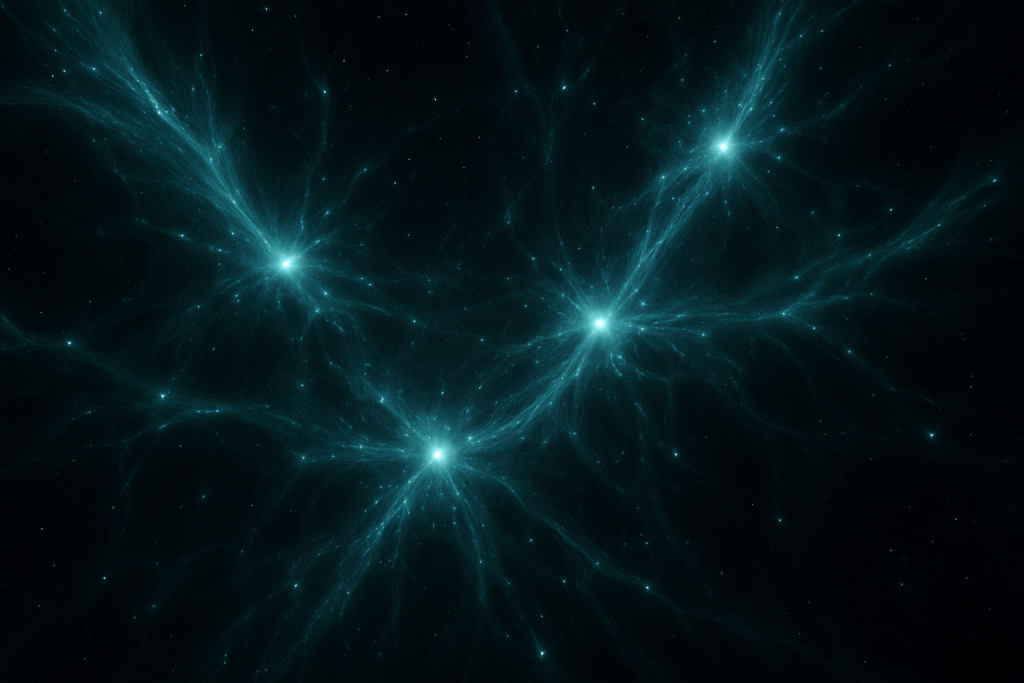
Image generated by AI
Imagine standing in a vast forest at night, able to see only the nearest trees clearly while distant trees fade into darkness. Now imagine that instead of a forest, you’re looking at the entire universe, and those trees represent billions of galaxies stretched across incomprehensible distances. This is the challenge astronomers face when trying to map the large-scale structure of the cosmos—creating a three-dimensional atlas of how matter is distributed throughout the universe. Over the past few decades, scientists have developed increasingly sophisticated surveys that allow us to see farther, faster, and with greater precision than ever before, revealing a cosmos that is far more complex and beautiful than we ever imagined.
Understanding how galaxies are arranged across space is far more than an academic exercise; it strikes at the very heart of modern cosmology and our understanding of the universe’s origin, evolution, and ultimate fate. These cosmic surveys have revealed unexpected patterns—vast filaments of galaxies stretching hundreds of millions of light-years, enormous voids of near-empty space, and intricate cosmic webs that challenge our theoretical models. Today, as new telescopes come online and computational power increases exponentially, we stand at the threshold of creating the most detailed three-dimensional map of the universe ever constructed, with profound implications for physics, technology, and our place in the cosmos.
What Is Mapping the Universe: Large-Scale Structure and 3D Cosmic Surveys?
Mapping the large-scale structure of the universe through 3D cosmic surveys is the systematic process of measuring the positions, distances, and properties of millions to billions of galaxies to create a three-dimensional map of cosmic matter distribution. Rather than simply cataloging individual galaxies, astronomers measure their redshifts—the stretching of light wavelengths caused by the expansion of space—which reveals both their positions on the sky and their distances from Earth. By combining these measurements with careful statistical analysis, researchers can reveal the underlying architecture of the universe: how galaxies cluster together, what patterns emerge from their arrangement, and how dark matter—the invisible scaffolding holding everything together—is distributed through space. These surveys represent a monumental effort in data collection and analysis, involving thousands of observations from ground-based and space-based telescopes, sophisticated instruments capable of measuring light from galaxies billions of light-years away, and computational systems that process petabytes of data.
The modern era of large-scale cosmic surveys began in the 1980s and 1990s, when astronomers realized that cataloging individual galaxies wasn’t enough to understand the universe’s structure. Pioneering surveys like the Center for Astrophysics Redshift Survey, conducted by researchers at Harvard and the Smithsonian Institution, revealed that galaxies weren’t randomly distributed but formed into walls, filaments, and clusters. The Sloan Digital Sky Survey, which began observations in 2000, revolutionized the field by mapping over a million galaxy redshifts and creating the first large-scale 3D map of the universe. This breakthrough revealed the cosmic web—a structure so intricate and unexpected that it fundamentally changed how astronomers think about cosmology and challenged many theoretical predictions about how the universe should be organized.
What We Know So Far
The process of mapping the universe’s large-scale structure relies on a elegant principle: light from distant galaxies becomes shifted toward longer, redder wavelengths as the universe expands and stretches the light waves during their journey to us. This cosmic redshift allows astronomers to calculate distance with remarkable precision—a galaxy with twice the redshift is roughly twice as far away. Modern surveys use multi-fiber spectroscopy, a technology that allows astronomers to simultaneously measure the spectra of hundreds or thousands of galaxies in a single observation, dramatically accelerating the mapping process. The resulting data creates a map where each galaxy becomes a point in three-dimensional space, revealing patterns invisible when galaxies are observed individually: chains of galaxies stretching across space, cosmic walls composed of thousands of galaxies, and mysterious voids of near-empty space where galaxies are remarkably sparse.
To understand these patterns, imagine a three-dimensional sponge, where the solid parts represent filaments of galaxies and the holes represent cosmic voids. The universe’s structure is remarkably similar to this analogy—filaments of galaxies weave through space like the strands of a web, held together by the gravitational pull of dark matter, while voids create pockets of relative emptiness. Galaxy clusters sit at the intersections of these filaments, sometimes containing thousands of galaxies bound together by gravity. Some filaments are so massive they contain more galaxies than our entire Milky Way cluster, yet they’re separated from other filaments by voids millions of light-years across where only scattered galaxies exist. This structure didn’t form randomly but emerged from tiny density fluctuations present just after the Big Bang, which gravity amplified over billions of years into the intricate web we observe today.
The Future of Exploration
The next generation of cosmic surveys promises to map billions of galaxies with unprecedented precision, revealing details of the universe’s structure previously hidden from view. The Dark Energy Spectroscopic Instrument (DESI), which began full operations in 2021, will measure the redshifts of approximately 35 million galaxies and quasars over its five-year mission, creating the largest 3D map of the observable universe ever made. Meanwhile, surveys using the Large Synoptic Survey Telescope (LSST), now under construction in Chile, will image the entire available sky repeatedly, creating a “movie” of the universe that reveals how structures evolve over cosmic time. These advances require not only better telescopes but also revolutionary approaches to data processing—artificial intelligence and machine learning systems are increasingly being used to classify galaxies, measure redshifts, and identify patterns that human researchers might miss.
The applications of these cosmic maps extend far beyond pure research into cosmology. Researchers use large-scale structure data to test theories of dark energy, the mysterious force driving the universe’s accelerating expansion, by examining how galaxy clustering changes with cosmic time. Cosmologists leverage these maps to constrain fundamental physics—measurements of the universe’s curvature, the total amount of matter it contains, and the properties of the earliest moments after the Big Bang. Climate researchers have even begun exploring analogies between large-scale structure formation and complex systems on Earth, while data analysis techniques developed for cosmic surveys are increasingly applied to other scientific fields from genomics to economics. The computational infrastructure required to handle cosmic survey data—distributed computing systems, advanced algorithms, and massive databases—has also spurred innovations in computer science and information technology that benefit the broader scientific community.
Recent Breakthroughs in Mapping the Universe: Large-Scale Structure and 3D Cosmic Surveys
In 2023 and 2024, the DESI collaboration released its first major results, revealing a universe that is both familiar and surprising compared to our previous understanding. The initial data release, comprising measurements of 5.1 million galaxies and quasars, confirmed many predictions from our standard cosmological model while also revealing subtle hints of anomalies in the universe’s expansion history that physicists are still working to understand. These measurements were so precise that they allowed researchers to measure the “baryon acoustic oscillations”—an imprint left by sound waves traveling through the early universe—with unprecedented clarity, providing the most precise measurements yet of how dark energy has changed over cosmic time. Additionally, researchers used the data to reveal new details about the clustering of galaxies at different epochs, showing how the cosmic web has evolved and grown more structured over the past several billion years.
Current research is focusing on several fascinating questions that these unprecedented datasets are beginning to address. Is the universe’s expansion rate consistent with predictions from the early universe, or do we need to revise our understanding of fundamental physics? How did the first galaxies seed the formation of the cosmic web, and what role did supermassive black holes play in this process? Researchers are also using large-scale structure data to search for evidence of exotic phenomena—primordial black holes, cosmic strings, or other relics from the earliest moments after the Big Bang. The coming years will see the completion of DESI observations and the commencement of new surveys using next-generation telescopes, promising data that will push the boundaries of our cosmic knowledge even further.
Why Mapping the Universe: Large-Scale Structure and 3D Cosmic Surveys Matters for the Future
Understanding the large-scale structure of the universe is fundamental to answering the deepest questions about existence itself—how did the cosmos begin, what is it made of, and where is it headed? These maps provide crucial tests of our most fundamental theories of physics, from Einstein’s general relativity to quantum mechanics, revealing whether these frameworks remain valid on the largest scales across billions of light-years. The discovery that the universe’s expansion is accelerating, made possible by studying the distribution and properties of distant galaxies, earned the Nobel Prize in Physics and revealed that a mysterious dark energy comprises about 68 percent of the universe’s total content. Moreover, these surveys have demonstrated that understanding the universe requires not just bigger telescopes but also increasingly sophisticated methods of data analysis, leading to innovations in artificial intelligence and computational science that have applications far beyond astronomy. The cosmic perspective gained from these maps also has philosophical and cultural significance, reminding us of our place in a vast, complex universe governed by elegant physical principles.
However, significant challenges remain in our quest to fully understand cosmic structure. Photometric redshift measurements—estimating distances based on galaxy colors rather than precise spectroscopy—remain less accurate than spectroscopic measurements, limiting the utility of some survey data. Systematic errors in observations, from atmospheric distortion to instrumental calibration issues, can propagate through datasets and affect conclusions about fundamental physics. Perhaps most challenging is the “missing satellite problem” and other puzzles where observations seem to conflict with predictions from dark matter simulations of how the universe should have evolved. Future surveys will need to push beyond current limitations, combining observations from multiple wavelengths, developing new instruments capable of reaching fainter and more distant objects, and creating more sophisticated models that account for the complex physics governing galaxy formation and evolution.
Key Takeaways
- Large-scale cosmic surveys map the three-dimensional distribution of billions of galaxies by measuring their redshifts, revealing an intricate cosmic web of filaments, clusters, and voids.
- The universe’s structure emerges from tiny density fluctuations amplified by gravity over billions of years, creating a sponge-like architecture that connects galaxies across hundreds of millions of light-years.
- Modern surveys like DESI and upcoming instruments promise to create the most detailed maps of the universe ever made, testing fundamental physics and revealing the properties of dark energy and dark matter.
- Current research stands at a frontier where unprecedented data is revealing subtle anomalies that may point to physics beyond our current theoretical models.
- Understanding cosmic structure matters for fundamental physics, technological innovation, and our philosophical understanding of humanity’s place in an ancient, vast, and beautifully complex universe.
Explore TED Talks on Mapping the Universe: Large-Scale Structure and 3D Cosmic Surveys:
TED content is used under CC BY-NC-ND 4.0. © TED Conferences, LLC.
Frequently Asked Questions
What are cosmic voids and filaments revealed by 3D surveys?
Cosmic voids are enormous regions of near-empty space containing very few galaxies, while filaments are vast structures where billions of galaxies cluster together, stretching hundreds of millions of light-years across the universe. Together, they form an intricate cosmic web that represents the large-scale distribution of matter revealed by modern astronomical surveys.
How do 3D cosmic surveys help us understand the universe's origin and evolution?
By mapping how galaxies are distributed across space and time, surveys allow astronomers to trace the universe's history back to its earliest stages and test theoretical models of cosmic expansion, dark matter, and dark energy. This spatial information reveals patterns that constrain our understanding of fundamental cosmological processes and the universe's ultimate fate.
Why is three-dimensional mapping more effective than two-dimensional observation of galaxies?
Three-dimensional surveys measure not only the position of galaxies on the sky but also their distance from Earth (using redshift measurements), revealing the true spatial relationships and structure of the cosmos rather than just their projected appearance. This depth dimension is essential for discovering the genuine patterns of cosmic structure, like filaments and voids, that would be invisible in flat, two-dimensional data.
What technological advances are enabling increasingly detailed cosmic surveys?
New, more powerful telescopes and dramatically increased computational power allow astronomers to observe galaxies farther away, measure their properties with greater precision, and process vast datasets more quickly than previous generations of surveys. These advances are making it possible to construct the most comprehensive three-dimensional map of the universe ever created.