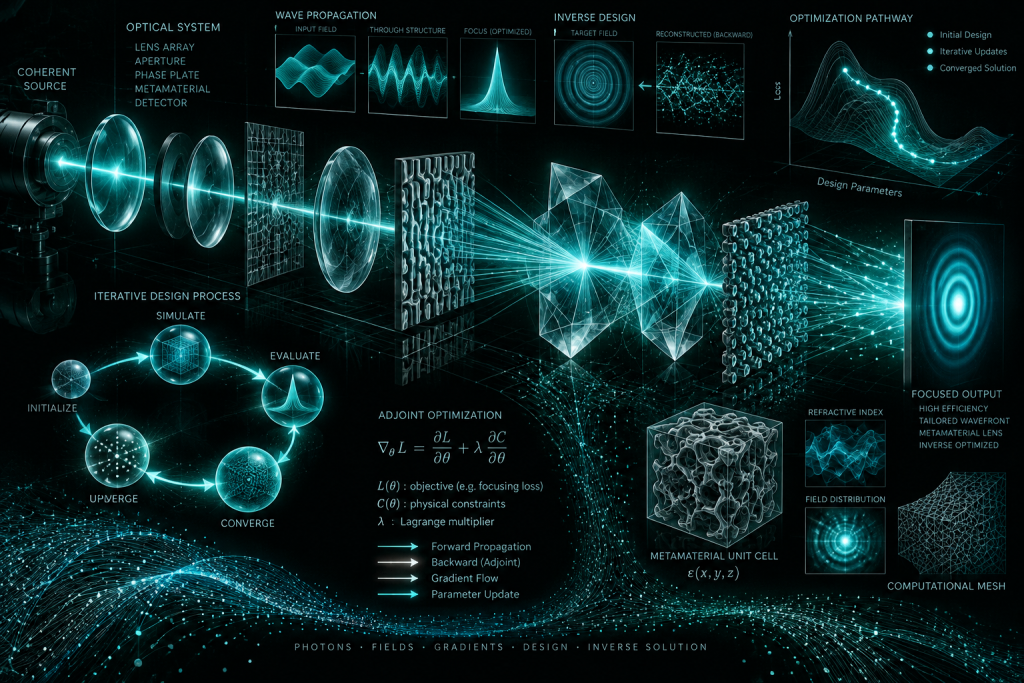
Image generated by AI
Imagine you want to build a perfect lens, but instead of starting with a guess and testing it thousands of times, a computer simply tells you exactly what shape it should be. This is the power of inverse design—a revolutionary approach that flips traditional physics on its head. Rather than asking “what happens when I build this structure?”, physicists now ask “what structure do I need to make this specific thing happen?” The difference may sound subtle, but it represents a fundamental shift in how we engineer everything from solar cells to medical imaging devices.
In an era where materials are increasingly expensive, energy demands are mounting, and performance requirements are more stringent than ever, the ability to design systems optimally from first principles has become invaluable. Companies and research institutions are racing to harness inverse design techniques to create technologies that were previously thought impossible or prohibitively costly to manufacture. From the smartphone in your pocket to advanced cancer detection systems, inverse design is quietly revolutionizing how we innovate.
What Is Inverse Design and Optimization in Physics?
Inverse design is a computational approach that determines the optimal physical structure or system configuration needed to achieve a specific desired outcome. Rather than simulating forward from a design to predict its behavior, inverse design works backward from desired performance goals to find the system that achieves them. At its core, it answers the question: “If I want light to bend in a certain way, what material structure would make that happen?” This flips the traditional engineering workflow, which has historically relied on intuition, trial-and-error, and incremental improvements.
The technique emerged in earnest during the 1990s and early 2000s, though its mathematical foundations trace back further to inverse problems in mathematics and signal processing. Pioneering work by researchers in topology optimization and metamaterials design laid the groundwork, with scientists like Ole Sigmund at Denmark’s Technical University developing computational methods to systematically explore design spaces that human intuition alone could never navigate. Today, inverse design has become a cornerstone of modern applied physics, leveraging machine learning, artificial intelligence, and advanced numerical methods to solve increasingly complex engineering challenges.
The Basic Principle
At its heart, inverse design relies on a mathematical framework where computers search through the vast landscape of possible structures to find the one that best satisfies your objectives. Think of it as exploring an enormous mountain range in the dark, where each peak represents a different design configuration and the height of the peak indicates how well that design performs. The optimization algorithm works like a sophisticated hiker with a headlamp, using gradients and feedback to navigate toward the tallest peak—the best possible design. The process involves setting clear performance targets, defining what materials and manufacturing constraints are available, and then letting algorithms systematically search for solutions that balance all these competing requirements.
Here’s a useful analogy: traditional design is like a chef inventing a new recipe by making a dish, tasting it, and adjusting seasonings. Inverse design is like telling a computer “I want a dish that tastes sweet but not cloying, has a complex flavor profile, and can be made with these specific ingredients”—and the computer automatically generates the precise recipe. The algorithm tests thousands of ingredient combinations computationally, identifies which ones meet all your criteria, and hands you not just one recipe, but several ranked by overall quality. The difference is that computational exploration can examine possibilities far beyond what human intuition would ever consider.
Why It Matters in the Real World
Inverse design has profound practical implications because it dramatically accelerates innovation while reducing waste and cost. In semiconductor manufacturing, for example, designing optimal photomasks—the templates used to pattern circuits—used to take months of trial and error. With inverse design, engineers can now computationally determine the exact mask patterns needed to create specific circuit features, considering factors like light diffraction and process variations that would be nearly impossible to account for manually. Similarly, in photonic engineering, inverse design has enabled the creation of optical devices with properties previously thought unachievable, opening entirely new technological possibilities.
The pharmaceutical and medical device industries are increasingly adopting inverse design to optimize drug delivery systems, prosthetics, and diagnostic tools. Solar cell manufacturers use it to design materials that capture a broader spectrum of sunlight with fewer defects. Acoustic engineers employ it to create noise-canceling systems with unprecedented precision. Even aerospace companies leverage inverse design to optimize wing structures that are simultaneously lighter, stronger, and more fuel-efficient than traditionally designed alternatives. In each case, the ability to computationally discover optimal solutions has translated into real products that perform better while consuming fewer resources.
Recent Breakthroughs in Inverse Design and Optimization in Physics
Over the past two to three years, the convergence of deep learning and inverse design has generated remarkable advances. Researchers have developed neural networks that can solve inverse design problems orders of magnitude faster than traditional optimization algorithms, effectively creating a “lookup table” for design solutions. In 2023 and 2024, multiple teams published work showing that machine learning models trained on simulated data can predict optimal device designs in milliseconds rather than hours or days. This acceleration opens the possibility of real-time design optimization during manufacturing or deployment, where systems could adapt and reconfigure themselves based on changing requirements.
Current research frontiers include inverse design for quantum systems, where researchers are working to determine the exact configurations of quantum dots and photonic structures needed for quantum computing and communication. Other teams are exploring inverse design for complex biological systems, attempting to computationally determine protein structures that would perform specific functions. The integration of generative AI models with physics-based constraints represents another cutting-edge direction, allowing algorithms to explore design spaces that satisfy both performance requirements and fundamental physical laws. Open questions remain about how to efficiently handle multiple competing objectives, how to incorporate manufacturing uncertainties, and how to guarantee that computationally designed structures will perform as predicted when built in the real world.
Why Inverse Design and Optimization in Physics Matters for the Future
The implications of inverse design extend far beyond incremental technological improvements. As we face challenges like climate change and resource scarcity, the ability to systematically discover materials and devices that perform optimally with minimal waste becomes strategically crucial. Inverse design could accelerate the development of better solar cells, more efficient batteries, and novel materials for carbon capture. In medicine, it promises to enable personalized medical devices tailored to individual patients’ physiological characteristics. The democratization of design—where smaller companies and research groups gain access to powerful optimization tools—could shift innovation away from resource-intensive laboratories toward distributed networks of researchers worldwide.
However, significant challenges remain to be overcome before inverse design achieves its full potential. Computational costs for complex, multi-physics problems remain substantial, and designing systems that are both optimal on paper and feasible to manufacture at scale presents ongoing difficulties. There’s also the fundamental challenge of inverse design’s brittleness—a design optimized for one set of conditions may perform poorly under slightly different circumstances. Building robustness and adaptability into computationally designed systems remains an active area of research. Additionally, as designs become more complex and counterintuitive, validating that they’ll work as predicted requires extensive real-world testing, which can offset some of the time and cost savings gained from computational design.
Key Takeaways
- Inverse design flips the traditional physics problem by working backward from desired outcomes to determine optimal physical structures, rather than predicting outcomes from given designs.
- The mechanism relies on computational algorithms—increasingly powered by machine learning—that systematically search through possible configurations to find solutions that meet specified performance goals and constraints.
- Most promising applications include semiconductor manufacturing, photonic devices, solar cells, medical implants, and materials discovery where inverse design dramatically accelerates innovation.
- Recent breakthroughs have integrated deep learning with inverse design, enabling solutions to be computed in milliseconds instead of hours, with current research extending to quantum systems and biological applications.
- Inverse design will become increasingly important for addressing global challenges in energy, sustainability, and medicine, though challenges around computational efficiency, manufacturing feasibility, and design robustness persist.
Explore TED Talks on Inverse Design and Optimization in Physics:
TED content is used under CC BY-NC-ND 4.0. © TED Conferences, LLC.
Frequently Asked Questions
How does inverse design differ fundamentally from traditional forward simulation in physics?
Traditional forward design starts with a proposed structure and simulates what physical outcomes it produces, while inverse design begins with a desired outcome and computationally determines what structure is needed to achieve it. This reversal allows engineers to skip countless trial-and-error iterations by working directly from performance specifications.
What computational methods enable inverse design to find optimal physical structures?
Inverse design typically uses optimization algorithms combined with physics simulations—such as gradient-based methods, machine learning, or genetic algorithms—that iteratively adjust structural parameters to minimize the difference between achieved and desired performance. These methods leverage computing power to explore vast design spaces that would be impossible to search manually.
Why is inverse design particularly valuable for expensive or difficult-to-manufacture materials?
Inverse design minimizes material waste and manufacturing iterations by identifying optimal designs before fabrication begins, which is critical when materials are costly or when producing prototypes requires extensive time and resources. By getting the design right computationally first, researchers avoid expensive failed experiments and unnecessary material consumption.
Can inverse design be applied to different types of physical systems, or is it limited to specific domains?
Inverse design is broadly applicable across multiple physics domains including optics (lens design), photonics (solar cells), acoustics, electromagnetics, and thermal systems—anywhere a desired physical outcome can be mathematically specified. The core principle of working backward from performance goals to find optimal structures remains consistent across these diverse applications.