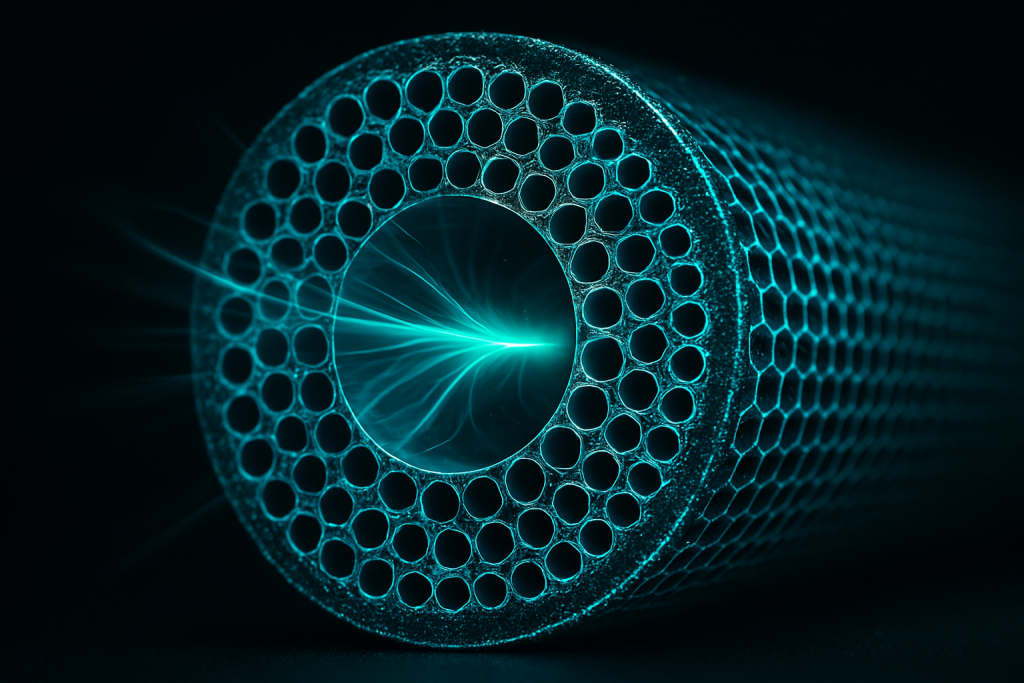
Image generated by AI
AI Insight
Photonic crystal fibers are optical fibers engineered with microscopic air holes arranged in precise patterns along their length. These holes create photonic bandgaps through interference effects, allowing certain wavelengths of light to propagate while blocking others, giving engineers unprecedented control over light guidance. Hollow-core variants can guide light through air rather than glass, significantly reducing signal distortion.
Why it matters
PCFs enable faster, longer-distance telecommunications with reduced signal loss compared to conventional fibers. Medical applications include high-resolution endoscopic imaging, while sensing applications and precision laser technologies benefit from the ability to guide specific wavelengths with minimal distortion.
Imagine a fiber-optic cable that guides light using tiny air holes instead of solid glass—that’s the revolutionary idea behind photonic crystal fiber. These engineered materials are transforming telecommunications, medical imaging, and laser technology by controlling light in ways conventional fibers simply cannot.
The Basic Principle
Photonic crystal fibers (PCFs) are optical fibers studded with a precise, repeating pattern of microscopic air holes running along their entire length. Light travels down the fiber’s core, but here’s the clever part: these holes create what physicists call a “photonic bandgap”—essentially a forbidden zone for certain wavelengths of light. Think of it like a musical instrument: just as specific frequencies create resonant tones while others are suppressed, photonic crystals allow certain colors of light through while blocking others. The key mechanism is interference: light waves reflecting off the holes either amplify or cancel each other out depending on their wavelength and the hole spacing. This lets engineers design fibers that guide light with unprecedented control, trapping wavelengths that would normally escape through the fiber’s sides.
Why It Matters in the Real World
PCFs have become game-changers in fiber-optic communications, where they enable faster, clearer data transmission over longer distances than traditional fibers. The medical field has embraced them too—endoscopes using photonic crystal fibers can transmit high-resolution images from inside the human body with minimal light loss. Perhaps most strikingly, researchers have created “hollow-core” PCFs that guide light through air rather than glass, dramatically reducing signal distortion. This matters for everything from next-generation internet infrastructure to precision laser surgery. Beyond telecommunications, scientists are exploring PCFs for sensing applications, where the fiber itself acts as a detector, and for generating new colors of light through nonlinear effects—phenomena that occur when light becomes intense enough to change the fiber’s optical properties.
Key Takeaways
- Photonic crystal fibers use precisely arranged air holes to control which wavelengths of light can travel through them, working much like a musical filter for light.
- These engineered materials enable faster telecommunications, clearer medical imaging, and new laser technologies that weren’t possible with conventional fiber optics.
- Hollow-core PCFs represent a frontier technology, guiding light through air instead of glass to achieve unprecedented signal clarity and control.
The future we're building — and boring — Elon Musk →
TED content is used under CC BY-NC-ND 4.0. © TED Conferences, LLC.