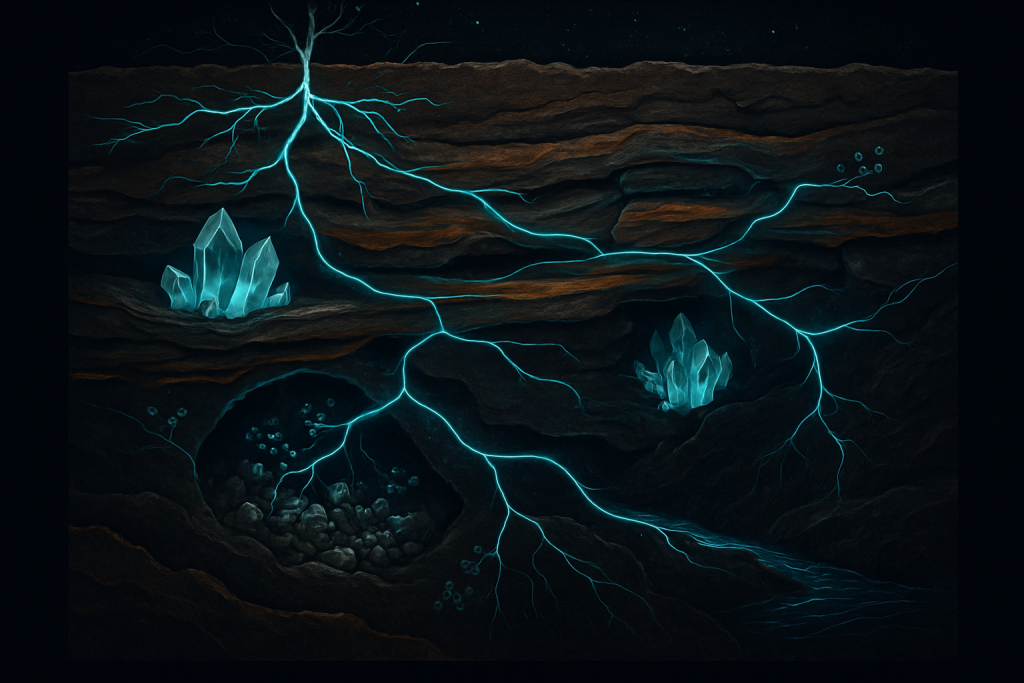
Image generated by AI
Beneath our feet lies an invisible realm as complex and interconnected as the visible world above. What happens in the darkness of soil, groundwater, cave systems, and subsurface geology shapes climate patterns, influences disease transmission, guides the search for resources, and holds clues to Earth’s evolutionary past. The scientific investigation of these hidden systems—once the domain of a few specialized geologists and hydrologists—has become a convergence point for physicists, biologists, chemists, engineers, and data scientists, each bringing their own tools and perspectives to uncover what lies underground.
The urgency to understand these systems has never been greater. Climate change is altering groundwater patterns that billions of people depend on for fresh water. Emerging diseases are spreading through soil and aquatic pathways we barely comprehend. Our search for critical minerals, energy sources, and stable storage solutions for everything from nuclear waste to carbon dioxide requires unprecedented knowledge of subsurface geology. In this moment, hidden systems research has evolved from a niche pursuit into a central challenge for understanding planetary health, resource security, and humanity’s future.
What Is Hidden Systems and Underground Discovery?
Hidden systems and underground discovery refers to the scientific study of processes, structures, and organisms that exist beneath Earth’s surface—in soil layers, aquifers, cave networks, subsurface rock formations, and the interfaces between groundwater and geological materials. These systems operate largely invisible to our everyday observation, yet they profoundly influence surface phenomena. The research methodology combines direct sampling through drilling and excavation with remote sensing technologies, chemical analysis, biological surveys, computational modeling, and innovative imaging techniques that allow scientists to “see” what exists in complete darkness or beneath impenetrable rock.
The modern investigation of underground systems began in earnest during the 19th century when geologists like William Smith developed stratigraphic mapping—the practice of dating and identifying rock layers—to understand Earth’s subsurface structure. However, the field truly accelerated in the mid-20th century with technological advances in drilling technology, radiometric dating, and eventually satellite imagery that could detect subtle surface signals of underground activity. Today, hidden systems research has matured into a genuinely interdisciplinary enterprise, drawing from geology, hydrology, microbiology, geochemistry, engineering, and increasingly from physics and data science.
Across the Sciences
The discovery and understanding of hidden systems requires an integration of multiple scientific disciplines because the underground is fundamentally a place where physical, chemical, and biological processes occur simultaneously and intimately intertwined. A single cubic centimeter of healthy soil contains more microorganisms than there are humans on Earth, and these microbial communities participate in chemical reactions that transform rocks into soil, cycling nutrients that support surface life. Simultaneously, water flows through this same medium, dissolving minerals and transporting everything from beneficial ions to harmful contaminants. Pressure, temperature, and chemical gradients create energy landscapes that drive processes entirely different from what occurs on the surface.
Consider groundwater aquifers as a concrete example. A hydrologist studies the flow rates and patterns of water movement through soil and rock. A geochemist analyzes the chemical composition of that water and how it reacts with surrounding minerals. A microbiologist investigates the diverse bacterial and archaeal communities living in the aquifer, some of which consume oil or radioactive elements. A geologist maps the subsurface architecture that determines where water can and cannot flow. An engineer designs systems to safely extract water or remediate contamination. A physicist models how contaminants disperse and can predict future water quality. A data scientist integrates all these datasets into predictive models. None of these disciplines alone could adequately explain what happens in a real aquifer—they need each other.
Why This Matters for the Future
The practical applications of hidden systems research are becoming impossible to ignore. Approximately two billion people worldwide depend on groundwater as their primary source of drinking water, yet we understand the accessibility and safety of these resources remarkably poorly in many regions. Climate change is creating unprecedented stress on aquifers as precipitation patterns shift, drought deepens, and population pressures increase demand for water in regions already approaching scarcity. Meanwhile, the subsurface is increasingly being recruited as a solution repository: for carbon dioxide sequestration to slow climate change, for nuclear waste storage spanning thousands of years, for compressed air energy storage, and for geothermal heating and cooling systems that reduce carbon emissions from buildings.
In the medical realm, hidden systems research is illuminating how diseases spread through environmental pathways. Antibiotic-resistant bacteria migrate through groundwater. Radon seeping from subsurface rocks into homes increases cancer risk. Arsenic naturally present in aquifers poisons millions of people across Bangladesh, India, and other regions. Understanding soil microbiomes is revealing connections between soil health, crop nutrition, and human immune function. In agriculture, subsurface processes determine soil fertility and crop productivity for much of the world’s food production. Emerging technologies like in-situ mining and subsurface data storage depend on deep understanding of how underground systems behave and respond to human intervention.
Recent Breakthroughs in Hidden Systems and Underground Discovery
The last few years have witnessed remarkable advances in our ability to explore and understand hidden systems without destroying them in the process. Advanced seismic tomography now allows scientists to create three-dimensional images of subsurface architecture with extraordinary resolution, revealing aquifer structures, fault zones, and magma chambers with unprecedented detail. Machine learning algorithms are analyzing massive datasets from thousands of wells and boreholes to identify patterns in groundwater movement and contamination that would be invisible to human researchers. DNA sequencing technology has revolutionized microbial ecology, allowing scientists to catalog the vast genetic diversity of subsurface microbial communities and understand how they metabolically engineer their environments.
One particularly exciting frontier involves discovering entirely new subsurface biospheres and ecosystems. Researchers have found thriving microbial communities several kilometers beneath the surface, in conditions previously thought to be sterile or inhospitable to life. These deep subsurface biospheres may hold insights into how life originated on Earth and how it might exist on other planets. Simultaneously, new technologies are revealing that cave systems harbor far more complexity than previously recognized—not just geological formations but intricate ecosystems with species found nowhere else on Earth. Scientists are developing increasingly sophisticated methods to extract information from subsurface samples with minimal contamination and to conduct experiments in situ, in underground laboratories where conditions can be precisely controlled.
Why Hidden Systems and Underground Discovery Matters for the Future
As humanity confronts the dual crises of climate change and resource depletion, our relationship with hidden systems becomes increasingly central to our survival and wellbeing. The subsurface represents our largest freshwater reserves, our most promising avenue for long-term carbon storage, a potential repository for our most dangerous waste products, and increasingly, a source of critical minerals essential for renewable energy technology and electronics. Understanding these systems thoroughly enough to use them safely and sustainably requires the most sophisticated science we can muster—the kind of interdisciplinary collaboration that brings together expertise from seemingly distant fields. The questions we must answer cannot be addressed by any single discipline working in isolation.
Yet significant challenges remain. In many parts of the world, subsurface data is scarce or proprietary, making it difficult to build comprehensive models. The extreme difficulty of accessing the deep subsurface means that our understanding remains limited by our ability to drill and sample. Modeling the complex interactions of water flow, chemical reactions, and microbial activity remains computationally intensive and requires parameters we don’t fully understand. Predicting how human-induced changes—from mining to waste storage to climate warming—will impact subsurface systems over decades and centuries remains highly uncertain. Perhaps most fundamentally, we lack the unified theoretical framework that would allow researchers from different disciplines to speak a common language about underground processes.
Key Takeaways
- Hidden systems research integrates geology, hydrology, microbiology, geochemistry, physics, and engineering to understand subsurface processes that directly impact water security, climate, and human health
- The underground functions as an integrated system where water flow, chemical reactions, and microbial metabolism occur simultaneously, requiring multiple scientific perspectives to understand
- Most promising applications include sustainable groundwater management for two billion dependent people, permanent carbon dioxide storage for climate mitigation, and safe nuclear waste disposal
- Recent breakthroughs in seismic imaging, DNA sequencing, and machine learning have dramatically expanded our ability to map and understand subsurface systems without destructive sampling
- As climate change and resource pressures intensify, hidden systems research has shifted from specialized academic pursuit to essential framework for planetary stewardship and human security
Explore TED Talks on Hidden Systems and Underground Discovery:
TED content is used under CC BY-NC-ND 4.0. © TED Conferences, LLC.
Frequently Asked Questions
How do groundwater patterns influence climate on a global scale?
Groundwater systems regulate water cycling and heat distribution through subsurface aquifers, which affect evaporation rates, precipitation patterns, and regional temperature stability. Changes in these underground water patterns—accelerated by climate change—can amplify or dampen climate effects across continents.
Why is understanding soil and aquatic pathways critical for disease transmission research?
Pathogens can survive and spread through soil microhabitats and groundwater systems, reaching human populations through contaminated water supplies and agricultural systems that we don't fully understand. Mapping these hidden transmission routes is essential for predicting and preventing disease outbreaks.
What geological knowledge is required to safely store carbon dioxide and nuclear waste underground?
Scientists must understand subsurface rock formations, their porosity, permeability, and geochemical stability to ensure stored materials remain isolated from groundwater and the biosphere for centuries or millennia. This requires integrated knowledge of geology, hydrogeology, and chemical interactions in deep subsurface environments.
How do multiple scientific disciplines contribute different tools to underground discovery?
Physicists use seismic imaging and electromagnetic sensing, biologists study subsurface microbial ecosystems, chemists analyze mineral composition and contaminant behavior, and engineers design drilling and monitoring systems. Data scientists then integrate these diverse datasets to create comprehensive models of hidden systems.