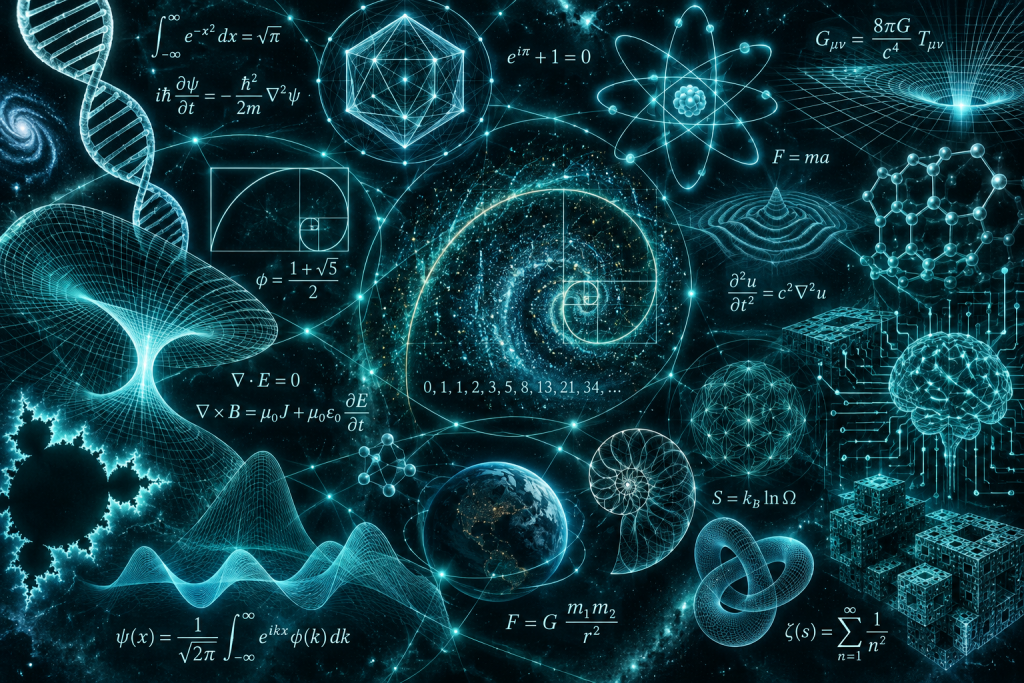
Image generated by AI
Why can a simple equation describe both the orbit of planets and the growth of bacteria colonies? This is perhaps the deepest mystery at the heart of science: the uncanny ability of abstract mathematics to capture the behavior of the physical world. The physicist Eugene Wigner famously called this phenomenon “the unreasonable effectiveness of mathematics,” and it remains one of the most profound questions in the philosophy of science. Yet this same mathematical framework seamlessly connects disciplines as disparate as cosmology, molecular biology, neuroscience, and materials engineering.
Understanding how mathematical abstractions model physical reality has become increasingly urgent as science faces complex, interconnected challenges—from climate modeling to drug discovery to artificial intelligence. When researchers from different fields speak the language of mathematics, they can share insights, transfer solutions, and collaborate in ways that would be impossible if each discipline remained isolated in its own vocabulary. This cross-disciplinary power has already transformed how we approach everything from pandemic prediction to materials design, and its importance will only grow as we tackle the polymathic problems of the 21st century.
What Is How Mathematical Abstractions Model Physical Reality?
Mathematical abstractions model physical reality by translating observable phenomena into symbolic systems governed by logical rules and operations. Rather than describing the world in words, scientists encode the relationships between quantities—distances, forces, populations, probabilities—as equations and abstract structures. These mathematical representations allow us to make precise predictions, identify hidden patterns, and discover universal principles that apply across vastly different contexts. The key insight is that the structure of mathematics often mirrors the structure of nature itself, creating a correspondence between abstract symbol systems and tangible physical processes.
This approach emerged gradually over centuries, crystallizing during the scientific revolution of the 16th and 17th centuries. Galileo’s use of mathematics to describe falling bodies, Newton’s development of calculus to model motion and gravitation, and Maxwell’s elegant equations unifying electricity and magnetism all demonstrated that nature speaks a mathematical language. By the early 20th century, Einstein showed that spacetime itself could be understood as a geometric abstraction, while quantum mechanics revealed that probability and linear algebra describe the deepest level of physical reality. What began as a practical tool for engineers and astronomers evolved into a fundamental principle: the universe’s laws are written in mathematics.
Across the Sciences
The power of mathematical abstractions to connect sciences lies in their universality and translation capacity. Consider the differential equation—a relationship between a quantity and its rate of change. This single mathematical form appears in physics (describing how velocity changes with time), in chemistry (modeling how reactant concentrations decrease), in epidemiology (tracking disease spread through populations), and in finance (predicting asset price movements). By recognizing this shared mathematical structure, scientists from these different fields can directly transfer solutions and insights. A technique developed to solve quantum mechanical equations can illuminate how neurons fire; a model built to predict stock market volatility can improve weather forecasting.
Think of mathematics as a universal translator. A biologist studying enzyme kinetics writes down the Michaelis-Menten equation, which describes how reaction rate depends on substrate concentration. An engineer analyzing how quickly a tank drains finds that the same mathematical form governs fluid flow. A pharmacologist modeling drug absorption in the bloodstream works with identical equations. None of these researchers is describing mathematics for its own sake—each is describing a specific physical system. Yet by translating their observations into mathematical language, they discover they’re all studying the same underlying structure. This is why a statistical technique developed for analyzing experimental errors in physics can be immediately applied to genomics, or why network theory born in mathematics finds applications in everything from neuroscience to ecology to social media.
Why This Matters for the Future
As scientific challenges become increasingly complex and multifaceted, the ability of mathematics to bridge disciplines has become economically and socially essential. Climate change requires integrating atmospheric physics, ocean chemistry, ecology, and economics into coherent models. Drug development demands simultaneous understanding of molecular biology, pharmacology, and human physiology. Artificial intelligence relies on mathematical frameworks—linear algebra, probability theory, information theory—that apply equally to computer vision, natural language processing, and protein folding. When crises like the COVID-19 pandemic emerge, the speed of response depends critically on interdisciplinary collaboration, which is only possible when scientists can communicate through the shared language of mathematics.
Contemporary applications reveal this cross-disciplinary power in action. Machine learning algorithms originally developed from statistical physics now guide medical imaging diagnosis, genetic sequence analysis, and materials discovery. Network theory, which emerged from topology and graph theory, now powers drug discovery by modeling protein interaction networks and predicts infrastructure failure by analyzing power grids. Differential geometry, an abstract branch of mathematics studied for its own sake, became essential when Einstein showed it describes gravity; today it’s finding unexpected applications in data science and machine learning. Even ancient mathematics enjoys unexpected relevance—number theory, long considered purely theoretical, now underpins cryptography protecting global finance and digital security.
Recent Breakthroughs in How Mathematical Abstractions Model Physical Reality
The past few years have witnessed remarkable convergences between previously distant fields enabled by shared mathematical frameworks. In 2023, researchers successfully used techniques from quantum field theory—a highly abstract mathematical formalism developed to describe subatomic particles—to model collective behavior in biological systems and social networks. Deep learning architectures inspired by neuroscience have been analyzed using random matrix theory, a mathematical tool from physics, revealing unexpected universal properties in how artificial neural networks learn. Simultaneously, biophysicists have discovered that equations originally developed to model how particles settle in fluid flow perfectly describe how cancer cells migrate through tissue, suggesting fundamental principles govern both processes.
Current frontier research explores mathematical structures that may be even more fundamental than any single discipline. Researchers are investigating whether category theory—an abstract mathematical framework so general it has been called “the mathematics of mathematics”—provides a unified language encompassing quantum mechanics, general relativity, and biological organization. Others are discovering unexpected connections between topological properties (abstract geometric features that remain unchanged under continuous deformation) and practical phenomena like how proteins fold, how materials conduct electricity, and how ecosystems organize. The central open question driving this research is whether nature’s deep laws are ultimately mathematical in nature, or whether mathematics is simply the most efficient language we’ve developed to describe them.
Why How Mathematical Abstractions Model Physical Reality Matters for the Future
The future trajectory of science depends increasingly on recognizing and exploiting these cross-disciplinary mathematical connections. As problems become more complex—designing materials with novel properties, engineering biological systems, predicting extreme climate events, understanding the brain—no single discipline possesses sufficient perspective alone. Mathematics provides the connective tissue that allows expertise to flow across boundaries. A physicist who understands how randomness operates in quantum systems can offer insights to a neuroscientist studying noise in neural firing patterns. An engineer skilled in optimization theory can revolutionize how biologists design genetic circuits. This democratization of powerful ideas accelerates innovation and deepens our understanding of nature’s fundamental principles.
Yet significant challenges remain in fully realizing this potential. Different scientific fields have developed distinct mathematical cultures and vocabularies, sometimes obscuring underlying connections. The explosion of data in biology, astronomy, and physics has outpaced our mathematical frameworks for analyzing it; developing new mathematics adequate to the data’s complexity remains an unsolved problem. Additionally, the assumption that nature fundamentally obeys mathematical laws remains philosophically contested—some argue we project mathematical structure onto reality rather than discovering it inherent in nature. The challenge for future science is to develop better methods for translating insights across disciplines, cultivate scientists fluent in multiple mathematical languages, and remain epistemologically humble about what our mathematical models truly reveal about reality.
Key Takeaways
- Mathematical abstractions translate complex physical phenomena into symbolic systems governed by logical rules, enabling universal principles to emerge across disparate scientific disciplines.
- Differential equations, network theory, probability distributions, and other mathematical structures appear across physics, biology, engineering, and social sciences, revealing deep connections between seemingly unrelated systems.
- Machine learning algorithms and topological methods developed in pure mathematics now drive innovations in medicine, materials science, drug discovery, and climate modeling.
- Recent breakthroughs show that frameworks like quantum field theory and category theory may illuminate fundamental organizing principles that transcend individual scientific disciplines.
- The future of science depends on exploiting mathematical connections across fields to solve complex, multidisciplinary problems that no single discipline can address alone.
Explore TED Talks on How Mathematical Abstractions Model Physical Reality:
TED content is used under CC BY-NC-ND 4.0. © TED Conferences, LLC.
Frequently Asked Questions
What does Eugene Wigner mean by 'the unreasonable effectiveness of mathematics' in modeling physical reality?
Wigner observed that abstract mathematical equations—developed without direct reference to physical phenomena—can accurately describe and predict real-world behavior across entirely different domains, which seems philosophically mysterious and unjustifiable. This refers to the paradox that mathematics appears almost supernaturally suited to capture physical laws despite being a human intellectual abstraction.
How can the same mathematical equation describe both planetary orbits and bacterial colony growth?
Both systems follow underlying mathematical patterns related to exponential or power-law relationships, differential equations, and symmetry principles that govern physical and biological systems independently of their material composition. When mathematical abstractions capture these fundamental structural patterns, they reveal deep organizational similarities between seemingly unrelated phenomena.
Why does mathematical language enable cross-disciplinary collaboration between physics, biology, and engineering?
Mathematics provides a universal framework that translates domain-specific phenomena into shared abstract structures, allowing researchers to recognize analogous mechanisms, transfer proven solutions between fields, and communicate concepts without disciplinary jargon barriers. This common language reveals that problems in climate modeling, drug discovery, and materials design often share identical mathematical architectures despite their different physical substrates.
Can mathematical abstractions accurately model complex interconnected systems like pandemic prediction or climate modeling?
Yes, when researchers combine mathematical frameworks across disciplines—integrating epidemiological models, population dynamics, environmental physics, and computational methods—they create more comprehensive abstractions that capture the nonlinear interactions within complex systems. However, accuracy depends on identifying which mathematical structures genuinely capture the system's essential dynamics versus which are merely correlational approximations.