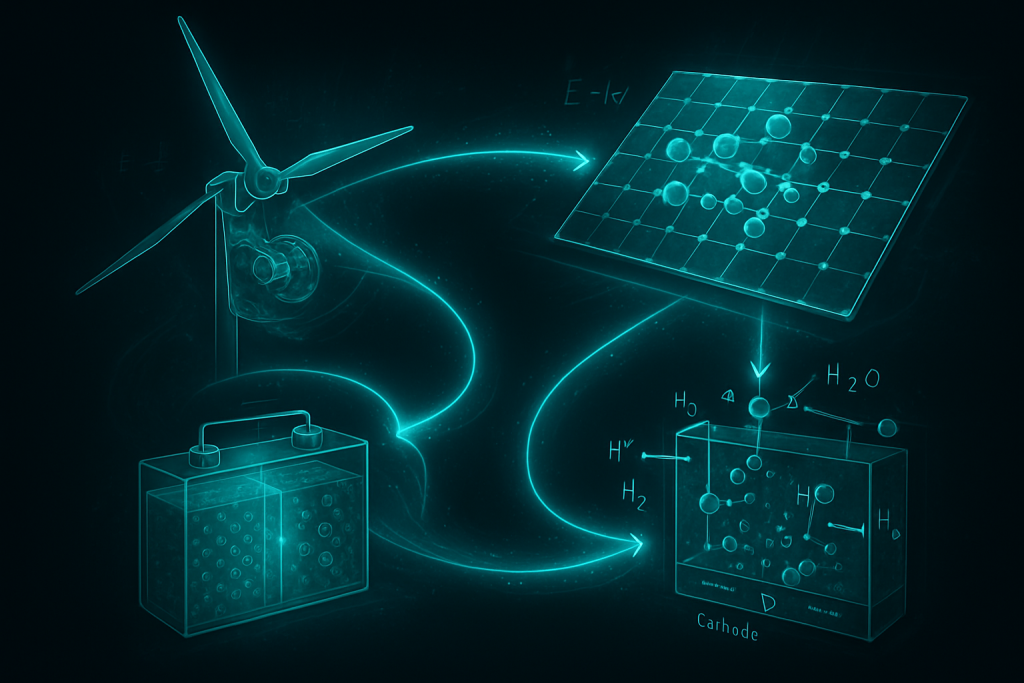
Image generated by AI
When sunlight strikes a silicon wafer, electrons leap across invisible quantum barriers. When wind turbines spin, they translate fluid dynamics into electricity. When bacteria metabolize organic matter, they release chemical energy that engineers can harness. These seemingly disparate phenomena all belong to a single grand challenge: converting the energy nature provides into the electricity civilization demands. Yet solving this challenge requires insights from quantum mechanics, thermodynamics, electrochemistry, materials science, electrical engineering, and even biology—each discipline essential, none sufficient alone.
The transformation of renewable energy sources into usable electricity represents one of the most consequential scientific endeavors of our time. As global emissions from fossil fuels drive climate change and populations demand clean power, renewable energy conversion has shifted from a niche concern to a central pillar of technological innovation. The renewable energy sector now accounts for over 30 percent of global electricity generation, and this fraction continues growing, yet most people remain unaware of the extraordinary scientific complexity underlying this transition. Understanding how renewable energy conversion works reveals something profound: modern technology doesn’t belong to any single discipline but emerges from the interplay of multiple sciences in conversation.
What Is Renewable Energy Conversion Technologies?
Renewable energy conversion technologies encompass the scientific principles and mechanical systems that transform naturally replenishing energy sources—sunlight, wind, flowing water, geothermal heat, and biomass—into electrical power or useful thermal energy. Unlike fossil fuel combustion, which is fundamentally a chemistry problem of controlled oxidation, renewable conversion involves harnessing energy that has already been generated by natural processes: the sun’s nuclear fusion, the Earth’s rotation, the water cycle, or biological growth. The core challenge is remarkably diverse: each renewable source behaves according to different physical laws and requires distinct technological approaches. Photovoltaic cells must convince electrons to escape their atomic orbits, wind turbines must efficiently capture kinetic energy from turbulent air, and hydroelectric dams must leverage gravitational potential energy across vertical distances. The unifying principle isn’t the energy source itself but the goal of conversion—turning one form of energy into another that humans can distribute and use.
The scientific foundations of renewable energy conversion trace back centuries, though their integration into a coherent technological framework is remarkably recent. Benjamin Franklin’s kite experiment in 1752 first demonstrated electrical properties of lightning, while in 1839 Alexandre-Edmond Becquerel discovered the photovoltaic effect—the capacity of certain materials to generate electric current when exposed to light. Yet these discoveries languished as curiosities for more than a century. The modern era of renewable energy conversion truly began in the 1970s, sparked by the oil crisis and environmental awakening. Danish engineers pioneered the first modern wind turbines in the 1980s, while Bell Laboratories researchers achieved 14-percent efficient silicon solar cells in 1954—a milestone that launched the space program’s reliance on photovoltaics. Today’s renewable energy conversion technologies represent the maturation of insights accumulated across multiple disciplines, finally converging into systems that compete economically with fossil fuels.
Across the Sciences
The physics underlying renewable energy conversion operates at multiple scales, from the subatomic realm of quantum mechanics to the planetary scale of atmospheric circulation. At the quantum level, photovoltaic devices exploit the photoelectric effect: when a photon strikes a semiconductor’s surface, it transfers energy to an electron, exciting it from the valence band into the conduction band, where it can flow as electric current. This process requires exquisite material engineering—the semiconductor must have precisely the right band gap energy to absorb relevant wavelengths of sunlight without losing energy as heat. Wind turbines, by contrast, operate according to fluid dynamics principles governing how air moves around curved surfaces. Bernoulli’s principle explains how curved turbine blades create pressure differentials that induce lift, converting the kinetic energy of moving air into rotational motion. Hydroelectric systems rely on gravitational physics: water’s gravitational potential energy at higher elevations converts to kinetic energy as it falls, then transforms into rotational energy within turbines. Geothermal systems harness thermal energy from the Earth’s interior, governed by thermodynamic principles of heat transfer and entropy.
Consider the journey of a photon through a solar cell as a concrete illustration of this cross-disciplinary complexity. The photon arrives as electromagnetic radiation, a physics phenomenon described by Maxwell’s equations. It strikes the cell’s surface, where quantum mechanics takes over—the photon’s energy must match the band gap precisely enough to excite an electron (chemistry and quantum mechanics intersecting). The excited electron must then travel through the semiconductor lattice without losing its energy to heat or recombination with a hole, requirements that depend on the material’s purity and crystal structure (materials science). As electrons accumulate on one side of a p-n junction, they create an electric field that drives current through an external circuit (electrical engineering). Meanwhile, the cell generates heat due to thermodynamic inefficiencies, which raises its operating temperature and reduces its efficiency, requiring careful thermal management (mechanical engineering). A complete solar cell design requires insights from all these domains working in concert; excellence in any single discipline cannot compensate for weakness in another.
Why This Matters for the Future
Renewable energy conversion technologies have moved from experimental curiosities to essential infrastructure, yet tremendous room for improvement remains. Modern silicon solar cells operate at roughly 20-22 percent efficiency under standard test conditions, meaning nearly 80 percent of incident solar energy is either reflected or converted to heat. Wind turbines currently achieve 35-45 percent of the theoretical maximum (Betz limit) efficiency, and this fraction hasn’t improved substantially in decades. Hydroelectric systems approach thermodynamic limits but often face environmental concerns, while emerging technologies like perovskite solar cells promise higher efficiency but suffer from stability challenges. The scientific frontier involves fundamental questions: Can we design materials that convert photons to electrons with greater efficiency? Can we develop batteries that store renewable energy without degradation? Can we create smart grids that distribute variable renewable power reliably? Each question requires multiple disciplines collaborating, pushing the boundaries of what each science can alone achieve.
Real-world applications now depend on this integrated approach at an unprecedented scale. Germany generates over 50 percent of its electricity during peak hours from renewable sources, requiring sophisticated electrical engineering and grid management systems rooted in control theory and computer science. Tesla’s battery facilities combine electrochemistry, thermal management, automation engineering, and software optimization to produce cells competitive with fossil fuels on pure economic grounds. The offshore wind industry relies on materials science innovations—developing corrosion-resistant alloys and fatigue-resistant composites that can withstand ocean conditions for 25+ years. Concentrated solar power plants use thermodynamic principles to achieve temperatures exceeding 500 degrees Celsius, enabling thermal storage and direct industrial heating applications. Agricultural systems now integrate biomass conversion with microbiology to optimize anaerobic digestion processes that convert waste into biogas and fertilizer.
Recent Breakthroughs in Renewable Energy Conversion Technologies
The years 2022-2024 have witnessed remarkable convergences across multiple scientific disciplines that promise to reshape renewable energy conversion. Researchers at MIT and elsewhere have achieved record efficiency gains in perovskite-silicon tandem solar cells—layering a perovskite absorber on top of traditional silicon to capture a broader spectrum of sunlight, with laboratory prototypes exceeding 33 percent efficiency. This advancement required simultaneous breakthroughs in quantum mechanical understanding of charge transport in perovskites, materials engineering to prevent degradation, and device physics to optimize how charges flow between layers. In wind energy, direct-drive turbines without mechanical gearboxes have become commercially viable, representing advances in electrical generator design, power electronics, and control systems working together. Breakthrough Institute researchers have demonstrated molten salt thermal storage systems that can retain heat above 700 degrees Celsius for days, enabling renewable energy plants to deliver power on demand—a challenge requiring chemistry, materials science, heat transfer engineering, and thermodynamic analysis of phase transitions. In biomass conversion, scientists have engineered enzymes and microorganisms using synthetic biology to more efficiently convert cellulose and other agricultural waste into biofuels, combining molecular biology with chemical engineering and fermentation science.
Current research frontiers push even further into interdisciplinary territory. The “floating solar” concept combines photovoltaics with hydrodynamics and aquatic ecology—designing systems that generate electricity while minimizing water evaporation and environmental impact. Hydrogen production through water electrolysis is experiencing renewed attention, with researchers optimizing catalysts using quantum chemistry, designing electrode materials through nanotechnology, and engineering electrolyzer systems for grid integration. Flow battery technologies represent another frontier, where electrochemistry meets materials science meets electrical engineering—storing energy in liquid electrolytes that can be pumped and discharged with remarkable flexibility. Long-duration energy storage, a critical need for renewable energy systems, involves multiple promising approaches: gravity-based systems (mechanical engineering and physics), air compression (thermodynamics), and various chemical storage methods (electrochemistry and synthetic chemistry)—each with distinct scientific challenges and advantages.
Why Renewable Energy Conversion Technologies Matters for the Future
The convergence of multiple sciences around renewable energy conversion signals a fundamental shift in how humanity generates power, but its implications extend far beyond electricity generation. Decarbonizing civilization requires not just replacing fossil fuel power plants but reimagining entire industrial ecosystems—steel production, cement manufacturing, chemical synthesis, transportation, and heating. Each sector requires tailored renewable energy conversion approaches, each demanding its own interdisciplinary synthesis. The emerging field of sector coupling illustrates this necessity: converting excess renewable electricity into heat for industrial processes or into hydrogen for chemical synthesis requires expertise spanning electrical engineering, thermochemistry, materials science, and process engineering. Similarly, electric vehicle adoption depends not only on battery technology but on charging infrastructure, electrical grid management, materials science for lightweight construction, and systems optimization across the entire transportation network.
Scientific challenges remain formidable, and understanding them requires acknowledging where disciplines reach their limits. The intermittency problem—renewable sources don’t generate power consistently—requires solutions combining meteorology, battery chemistry, computer science, and grid engineering that no single field can solve. Material degradation under harsh conditions remains a persistent challenge: solar panels degrade in sunlight (paradoxically), wind turbine blades suffer fatigue and lightning damage, and battery materials face irreversible chemical changes after thousands of cycles. Scaling proven laboratory demonstrations to industrial manufacturing involves engineering challenges distinct from the scientific principles underlying the technologies. Geographic and resource constraints impose limits no science can overcome: some regions receive insufficient solar radiation, others lack sufficient wind, and water for hydroelectric power isn’t universally available. Moving beyond these constraints will require innovations in less-traditional areas: building-integrated photovoltaics that turn surfaces into power generators, offshore wind farms in deeper waters, and enhanced geothermal systems that create artificial reservoirs of hot rock.
Key Takeaways
- Renewable energy conversion technologies require simultaneous breakthroughs across physics, chemistry, materials science, electrical engineering, and multiple other disciplines—no single field can solve these challenges independently.
- The fundamental mechanisms vary dramatically by source: photovoltaics exploit quantum mechanics and semiconductor physics, wind turbines leverage fluid dynamics, hydroelectric systems use gravitational physics, and geothermal systems apply thermodynamics.
- Modern applications like perovskite-silicon tandem solar cells, molten salt thermal storage, and synthetic biology-enhanced biofuel production represent genuine interdisciplinary achievements where advances in one domain enable innovations in others.
- Current research frontiers—long-duration storage, hydrogen production, direct-air carbon capture powered by renewables, and sector coupling for industrial decarbonization—all require coordinated scientific collaboration across previously separate disciplines.
- Renewable energy conversion will determine whether civilization successfully decarbonizes, making this perhaps the most consequential convergent science challenge of the 21st century.
Explore TED Talks on Renewable Energy Conversion Technologies:
TED content is used under CC BY-NC-ND 4.0. © TED Conferences, LLC.
Frequently Asked Questions
How do electrons move across quantum barriers in silicon solar cells when sunlight strikes them?
Photons from sunlight excite electrons in silicon atoms to a higher energy state, allowing them to cross the energy barrier (band gap) at the p-n junction and flow as electric current. This process, called the photovoltaic effect, relies on quantum mechanics to explain why certain photon energies can liberate electrons while others cannot.
What role does thermodynamics play in limiting the efficiency of renewable energy conversion systems?
The second law of thermodynamics dictates that no energy conversion process can be 100% efficient, as some energy must be lost as heat; this fundamental constraint applies to all renewable technologies from solar cells to wind turbines. The Carnot efficiency limit and resistive losses in electrical systems represent unavoidable thermodynamic penalties that engineers must minimize through better materials and designs.
Why can bacteria be used as a source of renewable energy, and what is the underlying biochemistry?
Certain bacteria metabolize organic matter through respiration or fermentation, releasing chemical energy stored in molecular bonds that can be captured in bioelectrochemical systems or converted to biogas. The key is that microbial metabolism breaks down complex organic molecules into simpler compounds, transferring electrons that can either generate methane gas or directly produce electricity in microbial fuel cells.
How do wind turbines convert the kinetic energy of moving air into electrical energy through multiple scientific disciplines?
Wind turbines use principles of fluid dynamics to optimize blade shape and capture kinetic energy from air movement, then employ mechanical engineering and electromagnetic induction to convert rotational motion into electricity. Materials science ensures the blades can withstand stress, while electrical engineering maximizes power transmission from generator to grid.