AI Insight
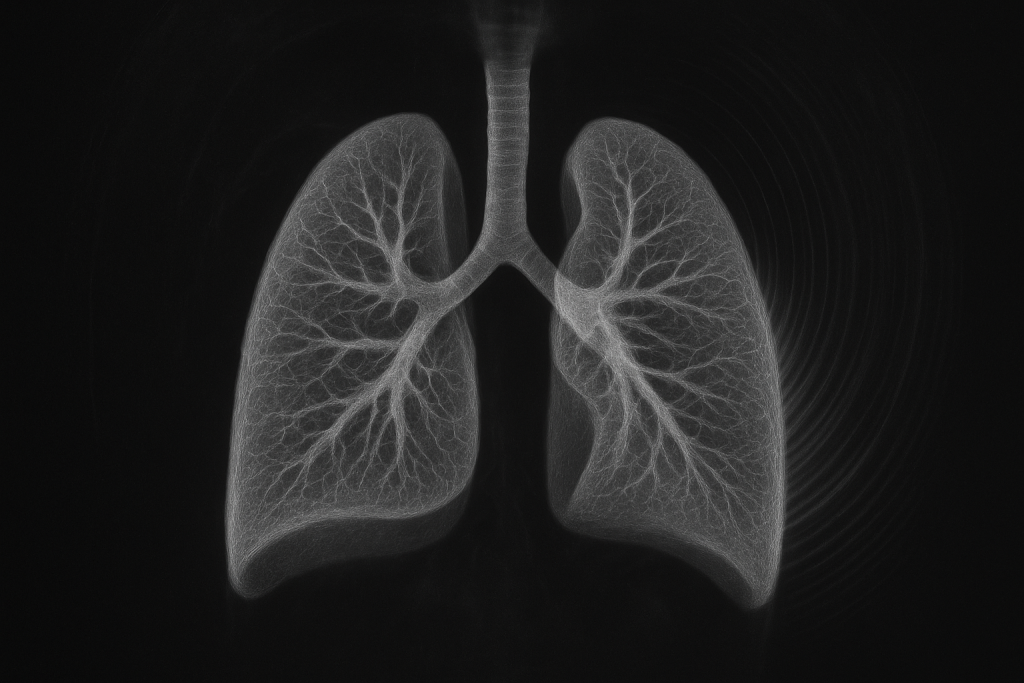
Researchers demonstrated that propagation-based phase-contrast CT, using monochromatic X-rays and a photon-counting detector at the Australian Synchrotron, can produce high-resolution lung images in lamb models (used as proxies for paediatric patients) at radiation doses up to 1,225 times lower than conventional CT reconstruction. By optimising beam energy and propagation distance, the technique achieved a voxel size of 75 micrometres while remaining within Australian guidelines for infant chest CT exposure of less than 2.5 mSv effective dose. Phase retrieval algorithms were critical to recovering image quality even when raw projections contained substantial proportions of zero-photon-count pixels, which would cause severe data loss under standard CT reconstruction.
Why it matters
Reducing radiation exposure in infant lung imaging is a significant clinical priority given the heightened radiosensitivity of young patients, and this approach could enable earlier and more accurate diagnosis of paediatric lung disease with substantially lower risk. The minimal hardware modifications required for propagation-based phase contrast suggest a plausible pathway toward clinical translation.
Understand the Science
arXiv:2407.06527v3 Announce Type: replace
Abstract: Many lung diseases require detailed visualisation for accurate diagnosis and treatment. High-resolution computed tomography (CT) is the gold-standard technique for non-invasive lung disease detection, but it presents a risk to the patient through the relatively high ionising radiation dose required. Utilising the X-ray phase information may allow improvements in image resolution at equal or lower radiation levels than current clinical imaging. Propagation-based phase-contrast imaging requires minimal adaption of existing medical systems, and is well suited to lung imaging due to the strong phase gradients introduced by the lung-air material interfaces. Herein, propagation-based phase contrast CT is demonstrated for large animals, namely lambs, as a model for paediatric patients, using monochromatic radiation and a photon-counting detector at the Imaging and Medical Beamline of the Australian Synchrotron. Image quality, normalised against radiation dose, was optimised as a function of the beam energy and propagation distance, with the optimal conditions used to test the available image quality at very low radiation dose. The resulting CT images demonstrate superior resolution to existing high-resolution CT systems, pushing dose to the quantum limit to comply with current Australian guidelines for infant chest CT exposure of $<2.5:text{mSv}$ effective dose. Constituent raw projections are shown to have significant proportions of pixels with zero photon counts that would create severe information loss in conventional CT. Phase retrieval enabled clear visualisation of minor lung airways at doses up to 1,225$pm$31% times lower than conventional CT reconstruction, at a voxel size of just 75$mathrm{mu}$m.
Source: Low-dose, high-resolution CT of infant-sized lungs via propagation-based phase contrast