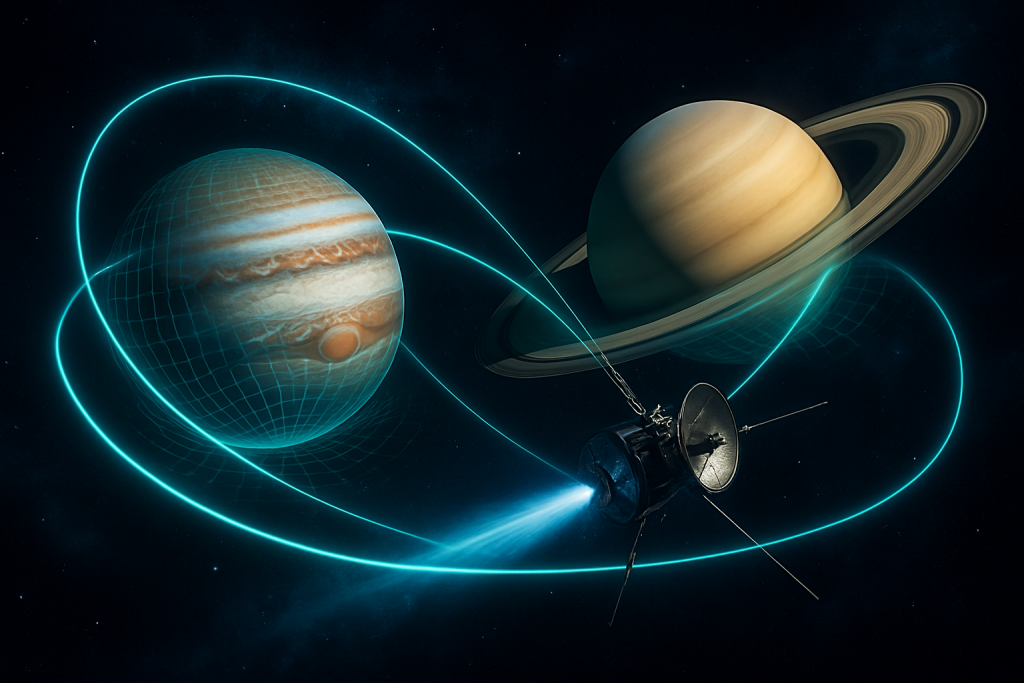
Image generated by AI
AI Insight
Space exploration is governed by fundamental physics principles, including Newton's laws of motion, orbital mechanics, and gravitational theory. Spacecraft must reach an escape velocity of approximately 11.2 km/s to break free from Earth's gravitational field, while fuel-efficient trajectory planning relies on techniques such as Hohmann transfer orbits. Current NASA missions, including the James Webb Space Telescope, the Artemis program, the Perseverance rover, and the Parker Solar Probe, apply disciplines ranging from infrared spectroscopy and plasma physics to quantum mechanics in order to advance our understanding of the universe.
Why it matters
These missions generate scientific data with broad implications, from refining models of planetary composition and cosmic structure to developing technologies that support future human spaceflight and potential resource utilization beyond Earth.
“`html
The Physics of Spaceflight
Space exploration relies on fundamental physics principles, particularly Newton’s laws of motion and gravity. Rockets achieve space by overcoming Earth’s gravitational pull through thrust generated by burning fuel. This follows Newton’s Third Law: for every action (expelled exhaust), there’s an equal and opposite reaction (upward propulsion). To escape Earth’s gravity entirely, spacecraft must reach escape velocity of approximately 11.2 km/s. NASA missions use orbital mechanics—the gravitational dance between celestial bodies—to plot efficient routes. The Hohmann transfer orbit, for example, allows spacecraft to move between orbits using minimal fuel by precisely timing acceleration burns when entering and exiting orbital paths.
Modern NASA Missions and Discoveries
NASA’s contemporary missions showcase advanced physics applications. The James Webb Space Telescope uses infrared spectroscopy and quantum mechanics principles to observe the universe’s earliest galaxies, revealing insights into cosmology and dark matter. The Artemis program aims to return humans to the Moon, requiring detailed understanding of orbital mechanics and lunar gravity (1/6th Earth’s strength). Meanwhile, rovers like Perseverance on Mars employ physics-based engineering, navigating terrain through precise calculations of friction, momentum, and terrain interaction. The Parker Solar Probe ventures closest to the Sun, studying plasma physics and magnetic fields at extreme temperatures exceeding 1 million degrees Celsius. These missions generate gravitational data through instruments like accelerometers that measure minute changes in acceleration caused by gravitational anomalies, helping scientists refine our understanding of planetary composition and the laws governing celestial motion.
- Rockets achieve space by applying Newton’s Third Law and overcoming gravitational pull with sufficient thrust
- Escape velocity of 11.2 km/s is required to break free from Earth’s gravitational influence
- Orbital mechanics enable fuel-efficient space travel using Hohmann transfers and gravitational assists
- Modern NASA missions apply spectroscopy, plasma physics, and quantum mechanics to explore space
- Gravitational measurements help scientists understand planetary composition and cosmic phenomena
Key Takeaways
“`