AI Insight
On May 15, 2026, SpaceX launched its 34th commercial resupply mission to the International Space Station aboard a Falcon 9 rocket, delivering approximately 6,500 pounds of cargo for the Expedition 74 crew. The Dragon spacecraft is scheduled to dock autonomously at the station's Harmony module on May 17 and will carry multiple scientific experiments, including investigations into microgravity simulation accuracy, bone scaffold development from wood-based materials for treating conditions such as osteoporosis, red blood cell and spleen behavior in space, charged particle monitoring around Earth, planetary formation processes, and solar reflectance measurement. The mission supports ongoing research in biology, biotechnology, physical sciences, and Earth and space science conducted aboard the orbiting laboratory.
Why it matters
The delivered experiments have direct biomedical relevance, particularly the bone scaffold research, which could yield new therapeutic approaches for osteoporosis and other fragile bone conditions affecting millions of people on Earth. Additionally, the charged particle instrument and solar reflectance measurements contribute to protecting critical infrastructure such as power grids and satellites while advancing fundamental planetary science.
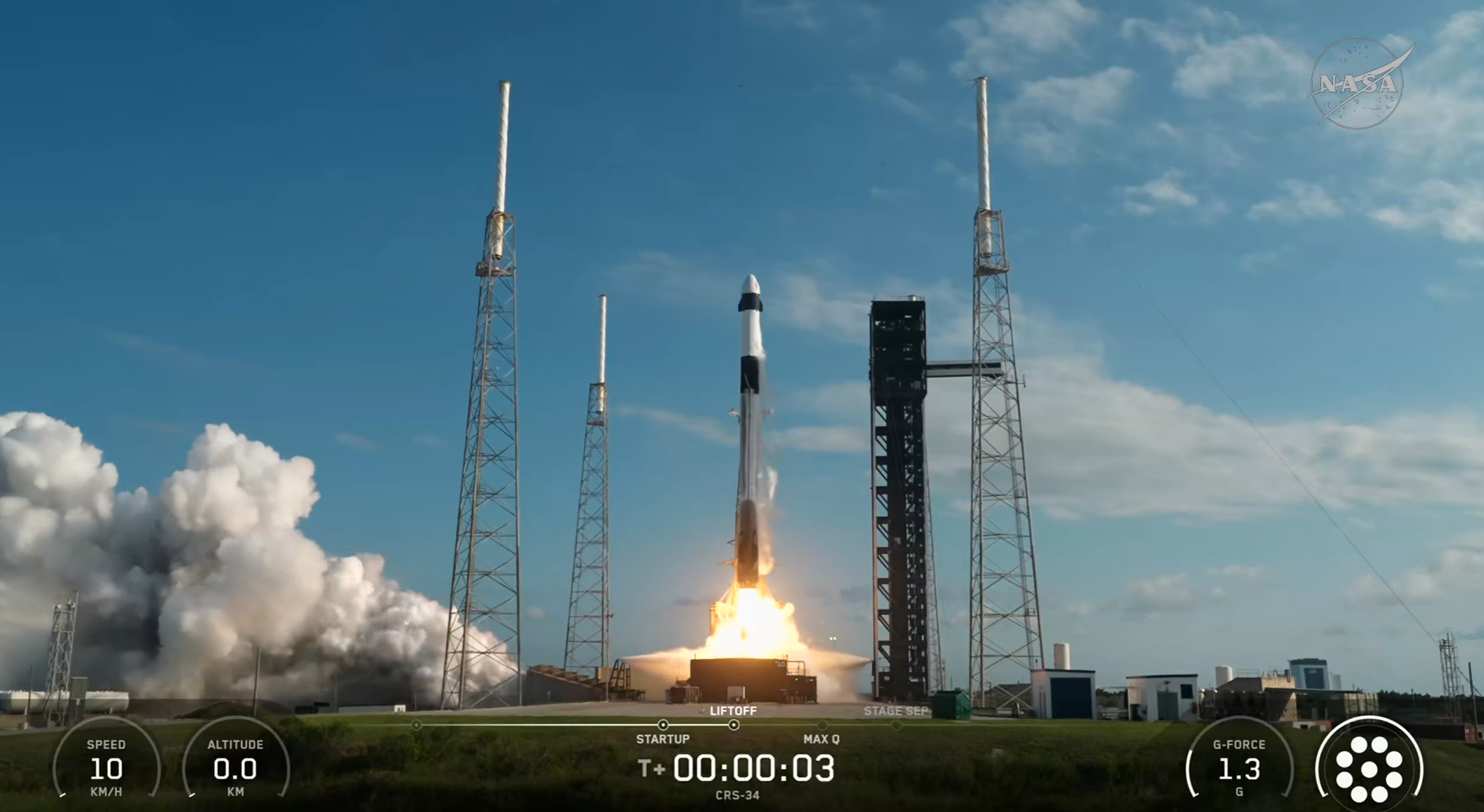
The 34th SpaceX commercial resupply mission under contract with NASA is headed to the International Space Station with new scientific experiments after lifting off at 6:05 p.m. EDT Friday on a Falcon 9 rocket from Space Launch Complex 40 at Cape Canaveral Space Force Station in Florida.
The SpaceX spacecraft, loaded with nearly 6,500 pounds of cargo for the space station’s Expedition 74 crew, is scheduled to autonomously dock at about 7 a.m. Sunday, May 17, to the forward port of the station’s Harmony module.
Watch NASA’s live rendezvous and docking coverage beginning at 5:30 a.m. on NASA+, Amazon Prime, and the agency’s YouTube channel. Learn how to watch NASA content through a variety of online platforms, including social media.
In addition to cargo for the crew aboard the space station, Dragon will deliver several new experiments, including a project to determine how well Earth-based simulators mimic microgravity conditions, a bone scaffold made from wood that could produce new treatments for fragile bone conditions like osteoporosis, and equipment to help researchers evaluate how red blood cells and the spleen change in space. The Dragon spacecraft also will carry a new instrument to study charged particles around Earth that can impact power grids and satellites, an investigation that could provide a fundamental understanding of how planets form, and an instrument designed to take highly accurate measurements of sunlight reflected by Earth and the Moon.
These experiments are just a sample of the hundreds of investigations conducted aboard the orbiting laboratory in the areas of biology and biotechnology, physical sciences, and Earth and space science. For more than 25 years, people have lived and worked continuously aboard the International Space Station, advancing scientific knowledge and making research breakthroughs that aren’t possible on Earth. The space station helps NASA understand and overcome the challenges of human spaceflight, expand commercial opportunities in low Earth orbit, and build on the foundation for long-duration missions to the Moon, as part of the Artemis program, and to Mars.
The Dragon spacecraft is scheduled to remain at the station until mid-June, when it will depart and return to Earth with time-sensitive research and cargo, ahead of splashing down off the coast of California.
Learn more about International Space Station research, operations, and its crews at:
-end-
Jimi Russell
Headquarters, Washington
202-358-1100
james.j.russell@nasa.gov
Danielle Sempsrott / Leejay Lockhart
Kennedy Space Center, Fla.
321-867-2468
danielle.c.sempsrott@nasa.gov / leejay.lockhart@nasa.gov
Sandra Jones / Joseph Zakrzewski
Johnson Space Center, Houston
281-483-5111
sandra.p.jones@nasa.gov / joseph.a.zakrzewski@nasa.gov
Source: NASA Science, Cargo Launch on 34th SpaceX Resupply Mission to Station