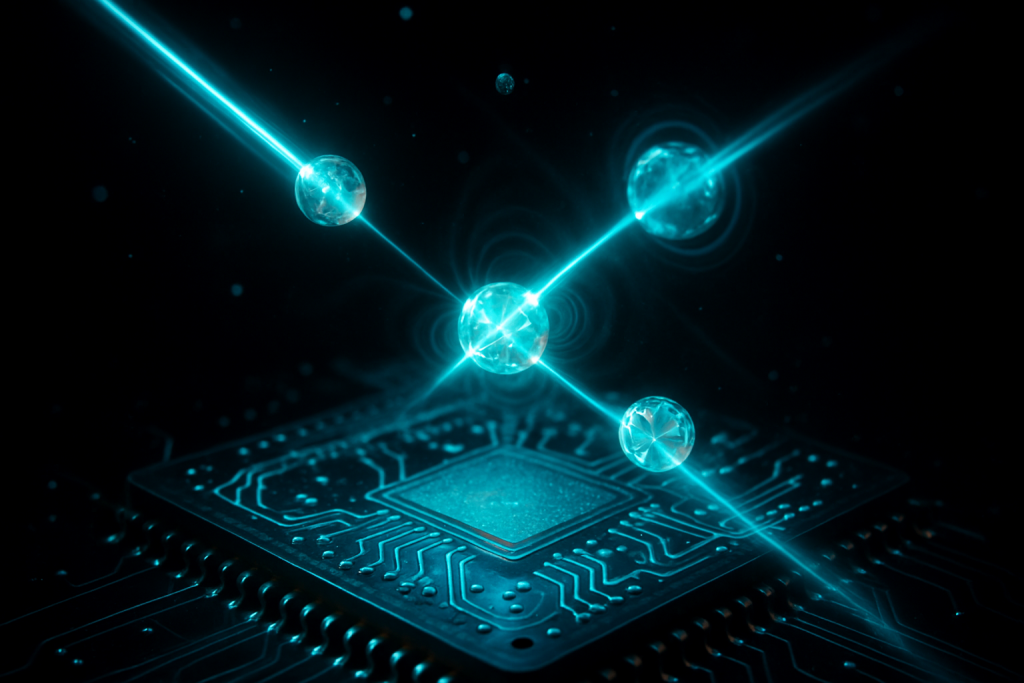
Image generated by AI
AI Insight
Quantum computers utilize light-matter interactions to control and manipulate qubits, the fundamental units of quantum information. Photons transfer energy to qubits through resonant absorption, enabling state transitions, entanglement creation, and measurement of quantum states. Photonic quantum computers use photons themselves as qubits, taking advantage of their minimal environmental interaction to preserve quantum information for longer periods.
Why it matters
This technology enables the development of scalable quantum computers that can operate at room temperature, unlike many alternative approaches. Light-matter interaction principles are also advancing quantum sensors for gravitational wave detection, theoretically unhackable quantum communication networks, and quantum simulations for drug and materials design.
Quantum computers harness the strange dance between light and matter to solve problems that would take classical computers millions of years. At the heart of this technology lies a quantum phenomenon: the ability of photons (particles of light) to interact with and manipulate quantum bits, or qubits, the fundamental units of quantum information.
The Basic Principle
Imagine a qubit as a spinning coin that can be heads, tails, or both simultaneously—this “both at once” state is called superposition, and it’s purely quantum. Light-matter interaction allows us to control and read these qubits by using photons as messengers. When a photon with the right energy hits a qubit, it can flip the qubit’s state, create entanglement between multiple qubits, or measure its current state. The interaction works because photons carry energy in discrete packets called quanta, and if that energy matches the energy gap between quantum states in the qubit, the photon gets absorbed and triggers a transition—much like how a tuning fork vibrates only when struck at its natural frequency.
In photonic quantum computers, the qubits themselves are made of light. Photons travel through circuits of mirrors, beam splitters, and detectors that manipulate their properties—including polarization and phase—to encode and process information. This approach offers a significant advantage: photons don’t easily interact with their environment, meaning quantum information stays protected longer.
Why It Matters in the Real World
Light-matter interactions are crucial for building practical quantum computers because they provide a reliable way to control qubits and measure results. Companies like Xanadu and Rigetti are developing photonic quantum computers using this principle, betting that photon-based systems could be more scalable and room-temperature compatible than other approaches.
Beyond computing, understanding light-matter interactions at the quantum level is transforming quantum sensors that detect gravitational waves, enabling quantum communication networks that are theoretically unhackable, and advancing quantum simulation—letting scientists model molecular behavior to design better drugs and materials. These technologies could revolutionize fields from medicine to cryptography.
Key Takeaways
- Photons interact with qubits by transferring energy, controlling their quantum states through resonant absorption
- Photonic quantum computers use light itself as the qubit, offering advantages in stability and temperature requirements
- Mastering light-matter interactions unlocks applications in quantum sensing, secure communication, and molecular simulation
Explore TED Talks on Quantum Computing and Light-Matter Interactions:
TED content is used under CC BY-NC-ND 4.0. © TED Conferences, LLC.
Frequently Asked Questions
How does a photon's energy determine whether it can flip a qubit's state?
A photon can only flip a qubit when its energy exactly matches the energy gap between the qubit's quantum states, similar to how a tuning fork only vibrates at its natural frequency. If the photon's energy doesn't match this gap, it won't be absorbed and no state transition will occur.
What is superposition and why is it important for quantum computing with light-matter interactions?
Superposition is a quantum state where a qubit exists in multiple states simultaneously (like a coin being both heads and tails at once), allowing quantum computers to process vastly more information in parallel than classical bits. Light-matter interactions enable us to manipulate and exploit this superposition by using photons to control and measure qubits without collapsing their quantum properties prematurely.
Why do photonic quantum computers have an advantage over other quantum computing approaches?
Photons don't easily interact with their environment, which means quantum information encoded in photons remains protected from decoherence longer than in other qubit systems. This environmental isolation allows the quantum states to persist long enough for more computations to be performed.
How do photons create entanglement between multiple qubits in a quantum computer?
When a photon interacts with qubits through light-matter interactions, it can correlate their quantum states such that measuring one qubit instantly determines the state of another, regardless of separation. This entanglement allows quantum computers to process information across multiple qubits in ways that classical systems cannot.