AI Insight
MIT's Center for Computational Science and Engineering launched a standalone PhD program in 2023, designed to train researchers in cross-cutting methodological aspects of computational science and engineering through a blend of coursework and thesis work. Emily Williams, supported by a Department of Energy Computational Science Graduate Fellowship, is positioned to become the first graduate of the program, with research focused on stochastic and generative modeling for multiscale chaotic systems. The program emphasizes interdisciplinary collaboration and curricular flexibility, allowing students to engage with a broad range of computational methods beyond the constraints of discipline-specific degree tracks.
Why it matters
A standalone PhD in computational science and engineering at a leading institution like MIT helps formalize and elevate an interdisciplinary field that is increasingly central to advances in engineering, applied mathematics, and scientific computing. Graduates trained in cross-domain computational methods are well positioned to address complex, multidisciplinary problems in areas such as climate modeling, aerospace, and large-scale simulation.
Understand the Science
In 2023, the Center for Computational Science and Engineering (CCSE), an academic unit in the MIT Schwarzman College of Computing, introduced a new standalone PhD degree program. This interdisciplinary PhD program blends both coursework and a thesis, enabling students to pursue research in cross-cutting methodological aspects of computational science and engineering.
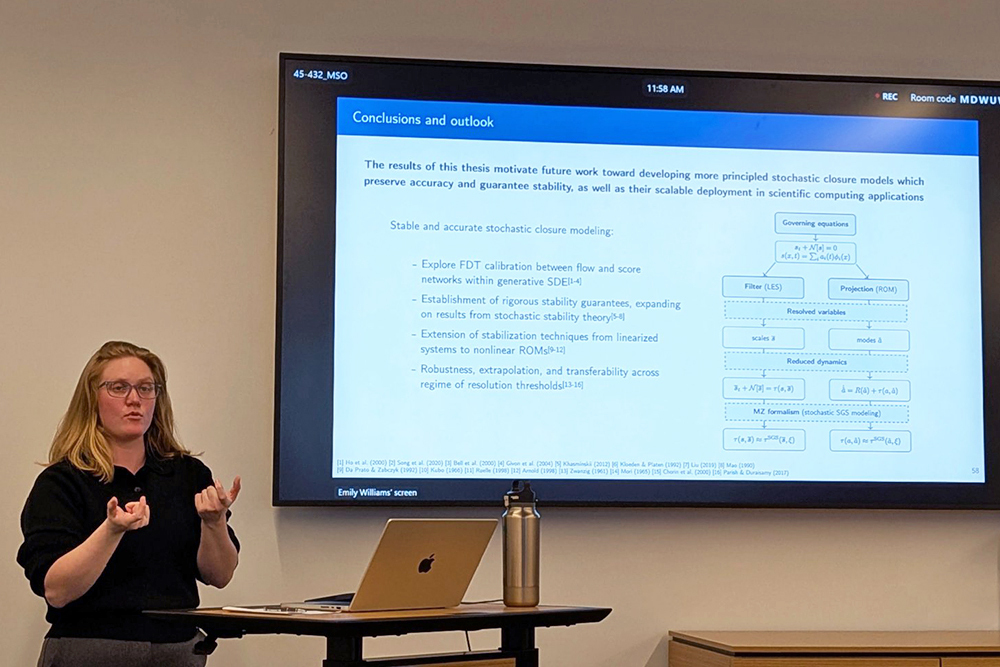
PhD candidate Emily Williams is poised to be the first graduate of the program. With a technical background in aerospace engineering and applied mathematics, her research interests include stochastic and generative modeling for multiscale chaotic systems. She earned a BS in aerospace engineering from the University of Illinois Urbana-Champaign and an MS in aeronautics and astronautics from MIT. She was awarded the Department of Energy Computational Science Graduate Fellowship, which funded her doctoral research. Here, she discusses her experience with the program and its impact on her career trajectory.
Q: What has been a highlight of the CCSE degree program?
A: I found the program curriculum to be extremely thoughtful and intentional. In particular, the program of study was constructed to cover many important areas of computational science and engineering research and education, from engineering and mathematical modeling to scientific and parallel computing. I found a lot of overlap with the DoE CSGF program of study, so I was given a lot of freedom to pursue very interesting technical electives that fit within CSE that I might not have been able to explore if I had been in a discipline-centric program.
Q: Why is this program so impactful, especially in the context of having a stand-alone PhD program?
A: I think a stand-alone PhD program helps to further establish the MIT CCSE as a leader in CSE research and education. The joint programs give graduate researchers more opportunity to learn and apply leading CSE methodologies to their disciplinary areas and primarily stay within their home department. For me, I’ve found that I’ve had more opportunities for collaboration, in potentially applying my methods to a wide range of different exciting applications. I think this theme of collaboration will continue to foster through those advancing through the standalone program in particular.
Q: What advice would you give to students considering this program?
A: I think my advice would be to keep an open mind. My interest in CSE was shaped by common threads in my education and research interests over the years that I didn’t think were connected at all. Through my fellowship and the standalone program, I felt like I was able to create my own path to my degree and take courses that excited me and fit within the CSE themes of our program of study.
Source: Q&A: The path to a PhD in computational science and engineering at MIT