AI Insight
Astronomers have discovered a massive 10-sided cloud structure at Saturn's south pole, spanning approximately 104,250 miles in diameter. This "decagon" is the first polygonal atmospheric formation found on Saturn besides the famous hexagonal cloud pattern that has persisted at the planet's north pole since its discovery in 1988. The structure was first observed in 2023 Hubble Space Telescope images after Saturn's southern hemisphere became visible from Earth again, and it completes one rotation around the planet every 800 days.
Why it matters
This discovery challenges the previous assumption that Saturn's hexagon was a unique atmospheric phenomenon and advances understanding of planetary meteorology. Studying how these polygonal jet streams form and evolve could provide insights into atmospheric dynamics applicable to weather patterns on other planets and potentially Earth.
Understand the Science
A mysterious giant 10-sided pattern of clouds has recently formed around Saturn’s south pole, a new study finds.
This newfound “decagon” joins the bizarre colossal hexagon seen for decades at Saturn’s north pole. Saturn’s hexagon — a cloud pattern about 20,000 miles (32,000 kilometers) wide — was first discovered in 1988 by scientists reviewing data from NASA’s Voyager flybys of Saturn in 1980 and 1981. Despite decades of observations, no similar structure was seen anywhere else on Saturn — until now, as scientists have discovered an even larger structure on Saturn.
The newfound decagon is about 104,250 miles (167,820 kilometers) wide, with each of its 10 sides measuring about 10,425 miles (16,782 km) long. “This is a very unusual atmospheric phenomenon that is helping us to advance our understanding of meteorology in general,” study lead author Agustin Sanchez-Lavega, a planetary scientist at the University of the Basque Country in Bilbao, Spain, told Space.com. “It tells us that the hexagon is not a unique, singular feature, as was previously thought.”
In the new study, researchers investigated recent images of Saturn captured with NASA’s Hubble Space Telescope. The way that Saturn’s axis is tilted meant that the ringed planet’s southern hemisphere was not visible from Earth from 2012 to 2023.
Hubble images from 2023 revealed the decagon to scientists for the first time. “It certainly came as a surprise,” Sanchez-Lavega said. Ever since the hexagon was discovered in Saturn’s north, he and his colleagues had investigated pictures of Saturn “to see if there was a polygonal formation in the south. And there was no sign of it.”
The decagon moves slowly. “It takes about 800 days to complete a rotation about Saturn,” Sanchez-Lavega said.
Previous research suggested Saturn’s hexagon results from an eastward jet within its atmosphere flowing in a curving path near the ringed planet’s north pole. Small perturbations in the jet — the kind one might expect from jostling with other air currents — made it meander into a hexagonal shape.
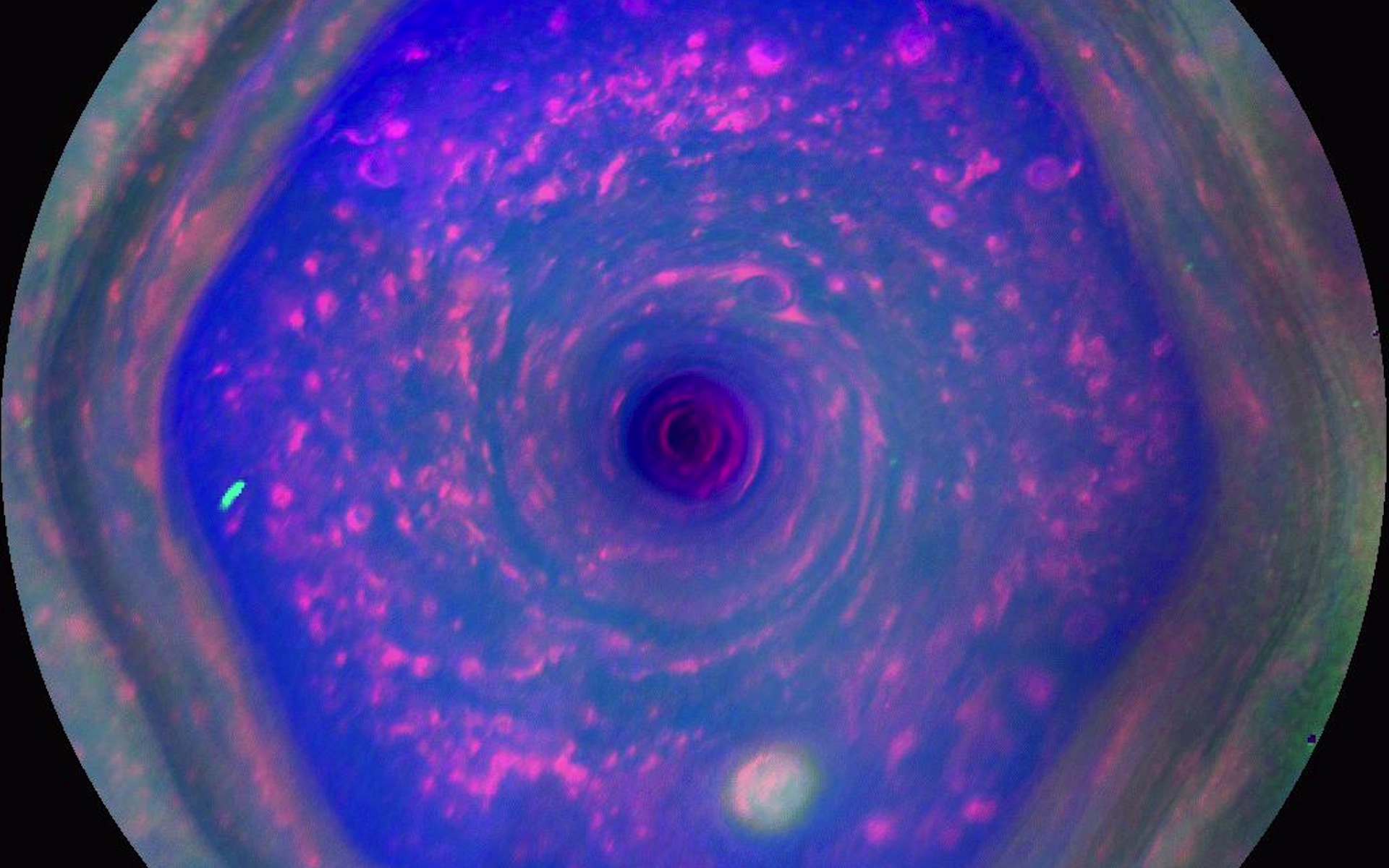
Similarly, experiments that Sanchez-Lavega and his colleagues performed with computer simulations of currents in shallow water suggest the decagon formed because of a meandering wave trapped by a curving atmospheric jet. Unlike the hexagon, whose sides and points have remained equally dark for decades, the decagon varies in darkness across its features. This could mean that it may still be evolving.
“We need to understand how the decagon evolves — in other words, whether in the coming years it will become unstable and break up, or conversely, become more stable and robust as solar radiation increases, which will peak at its latitude of around 60 degrees south in 2032,” Sanchez-Lavega said.
The scientists also want to gain a more detailed understanding of the three-dimensional structure of the decagon’s clouds, hazes, winds and temperatures. This will help them “develop more advanced models of its formation,” Sanchez-Lavega said.
The scientists detailed their findings Sept. 2 in the journal Science Advances.
Source: Astronomers discover mysterious 10-sided cloud structure at Saturn's south pole