AI Insight
ESA's SMILE satellite (Solar wind Magnetosphere Ionosphere Link Explorer), a joint mission between the European Space Agency and the Chinese Academy of Sciences, was successfully launched on 19 May 2026 aboard a Vega-C rocket from Europe's Spaceport in French Guiana. The spacecraft reached orbit via a four-stage rocket system, combining three solid-propellant stages with a final liquid-propellant stage for precise orbital insertion. SMILE carries four science instruments designed to investigate how Earth's magnetosphere and ionosphere respond to the solar wind.
Why it matters
Understanding the interaction between solar wind and Earth's magnetic environment is critical for improving space weather forecasting, which has direct implications for protecting satellites, power grids, and communication infrastructure from geomagnetic storm disruptions.
Understand the Science

Video:
00:04:00
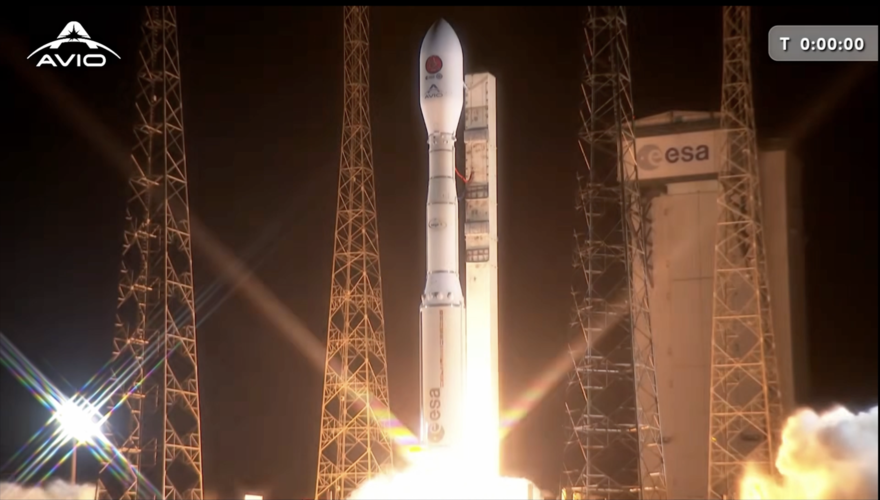
ESA’s Smile satellite launched aboard a Vega-C rocket from Europe’s Spaceport in French Guiana. The rocket lifted off on at 04:52 BST / 05:52 CEST (00:52 local time) on 19 May 2026.
Smile flew to space on Vega-C flight VV29. At 35 m tall, a Vega-C weighs 210 tonnes on the launch pad and the rocket used three solid-propellant-powered stages to take Smile to orbit before the fourth liquid-propellant stage took over for a precise drop-off around Earth.Smile (the Solar wind Magnetosphere Ionosphere Link Explorer) is a joint mission between the European Space Agency (ESA) and the Chinese Academy of Sciences (CAS).
Smile will use four science instruments to study how Earth responds to the solar wind from the Sun. In doing so, Smile will improve our understanding of solar storms, geomagnetic storms and the science of space weather.
Access the version without music or on‑screen text.
Source: Smile launch highlights