AI Insight
Researchers developed a comprehensive framework combining physics, engineering, and economics to estimate the impact of severe geomagnetic storms on the U.S. power grid and economy. Their model predicts that a 1-in-100-year storm would cause 3.5 million people to lose power with daily economic losses of $1.22 billion, while a 1-in-250-year storm could affect 5 million Americans and cause total daily losses of $1.81 billion. The framework was validated against actual measurements from the 2024 Gannon storm at Tennessee Valley Authority substations.
Why it matters
This study provides the first integrated assessment of space weather threats to critical infrastructure, offering concrete data to guide investment decisions for protecting the electrical grid. Understanding these risks is essential for emergency preparedness, especially given potential compound disasters if geomagnetic storms coincide with heat waves or hurricanes.
Understand the Science
Source: AGU Advances
In 1967, a solar storm nearly triggered World War III by jamming early-warning radar systems in the United States, causing U.S. leaders to think the Soviet Union was responsible. Though society averted catastrophe thanks to some timely intel from solar forecasters, the threat from space weather remains real and present.
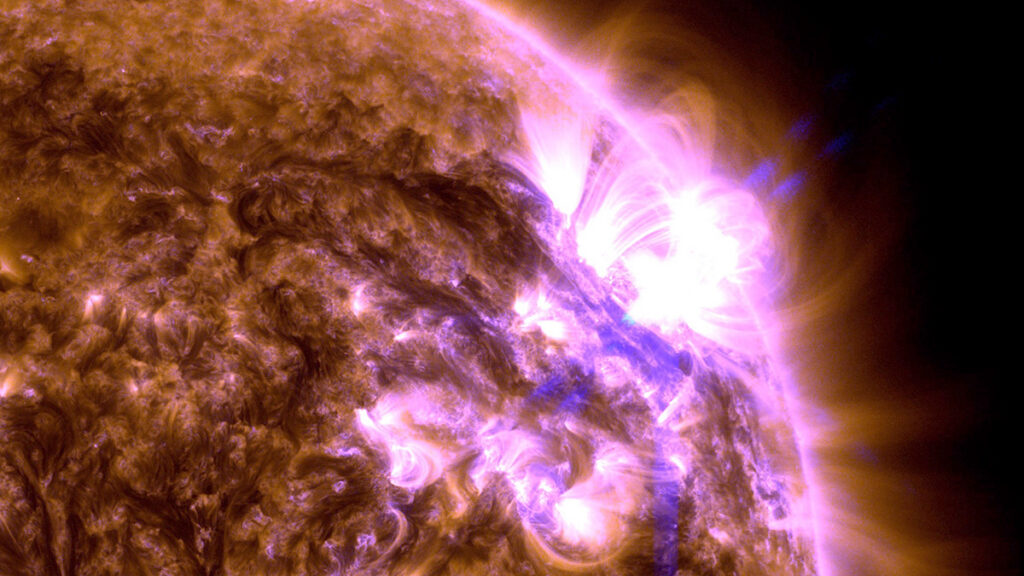
Solar, or geomagnetic, storms form as the Sun expels plasma and magnetic field from its corona during coronal mass ejections. After traversing space and encountering Earth’s magnetic field, the energy can interact with conducting materials such as the crust or ocean and induce geoelectric fields. The currents destabilize electrical transmission as they flow over the extrahigh-voltage transformers that toggle electricity voltage in the grid.
Yet despite their potential for havoc, geomagnetic storms are an underquantified threat. Existing socioeconomic assessments of space weather are often siloed by discipline and overlook the relationship between geophysical drivers and the function of the power grid.
To comprehensively assess the threat from space weather, Oughton et al. developed a novel framework to estimate the economic consequences of a 1-in-250-year (250-year, in short) geomagnetic storm in the United States. The model combines physics, engineering, and economics to characterize hazards, vulnerability in the power grid, and potential socioeconomic consequences under varying storm severities.
To validate the model, the authors compared simulated effects at electric substations to measurements taken by the Tennessee Valley Authority during the 2024 Gannon storm.
During a 100-year geomagnetic storm, 3.5 million people and 91,000 businesses are predicted to lose power, with daily economic losses of $1.22 billion. A 250-year storm, the most intense storm evaluated, would affect up to 5 million Americans and more than 135,000 businesses. Such an extreme storm would cause direct losses of roughly $980 million per day and total losses of $1.81 billion per day.
The study provides a rigorous assessment of the socioeconomic hazard posed by space weather and offers direction for investment in the power grid to safeguard against future storms. The authors note that future research should examine cascading power grid dynamics and multihazard interactions, for example, if a geomagnetic storm hit during a heat wave or hurricane. (AGU Advances, https://doi.org/10.1029/2026AV002367, 2026)
—Aaron Sidder, Science Writer