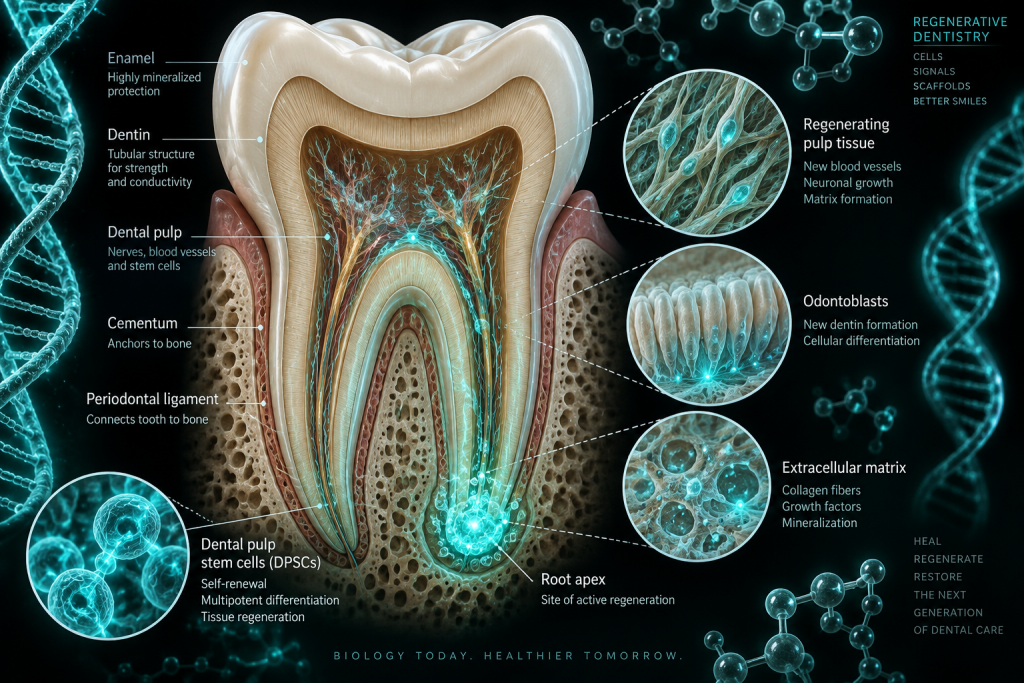
Image generated by AI
Your teeth stop growing after childhood, a fact most of us accept without question. Yet deep within the pulp chamber of every tooth lies a reservoir of specialized cells that, under the right conditions, can produce new dentinal tissue—a capability that has captivated researchers for decades. Scientists are now asking a provocative question: what if we could harness this latent regenerative potential to repair or even regrow teeth damaged by decay, trauma, or disease? The answer could transform one of medicine’s most persistent problems: how to restore teeth once they’re lost.
Tooth loss affects over 140 million people worldwide who are missing at least one tooth, making it one of the most common human disabilities. Unlike skin or bone, which regenerate throughout life, mature teeth have virtually no capacity for self-repair once their enamel and underlying dentin are breached—a limitation that has forced dentistry to rely on prosthetics, implants, and restorations for centuries. But recent advances in stem cell biology, tissue engineering, and regenerative medicine are rewriting this narrative, offering new pathways to rebuild dental tissues at the cellular level and potentially eliminate tooth loss altogether.
What Is Oral Health and Dental Regeneration?
Oral health encompasses the condition of teeth, gums, and supporting tissues, while dental regeneration refers to the biological process of creating new dental tissues to replace or repair damaged structures. At its core, regenerative dentistry seeks to grow functional teeth or dental components using cells, scaffolds, and molecular signals—essentially guiding the body’s own repair mechanisms to rebuild what has been lost. This differs fundamentally from traditional dentistry, which repairs damage through fillings, crowns, and implants that are biologically inert and require maintenance or eventual replacement. Regenerative approaches aim to produce living tissue that integrates with the mouth’s natural ecosystem, responds to stimuli, and can theoretically last a lifetime.
The scientific foundation for dental regeneration emerged in the mid-20th century when researchers discovered that teeth contain multiple populations of stem cells capable of differentiating into various cell types. Early pioneers, including Japanese and American researchers in the 1990s, identified stem cells in the dental pulp—the soft tissue at the tooth’s center—and in the periodontal ligament, which anchors teeth to bone. This discovery revealed that teeth possessed regenerative capacity comparable to other tissues in the body, a realization that opened entirely new therapeutic possibilities and redirected dental research toward biological solutions rather than purely mechanical ones.
What the Research Shows
At the cellular level, dental regeneration relies on the behavior of dental pulp stem cells (DPSCs) and periodontal ligament stem cells (PDLSCs), which possess remarkable plasticity—the ability to transform into different cell types depending on their environment. When extracted from tooth tissue and cultured in the laboratory, these cells can differentiate into odontoblasts (cells that produce dentin), osteoblasts (bone-forming cells), and even adipocytes (fat cells). This plasticity is controlled by chemical signals called growth factors, particularly bone morphogenetic proteins (BMPs) and fibroblast growth factors (FGFs), which act like molecular instruction manuals directing stem cells toward specific developmental pathways. Researchers have learned to manipulate these signaling cascades to coax stem cells into producing new dentin or supporting tissues in a controlled manner, essentially creating a biological template for tooth repair.
Think of this process like urban renewal at the cellular scale. Imagine that a decayed or damaged tooth is like a building with a compromised foundation. Traditional dentistry fills the gap with inert materials—concrete and steel—that stabilize the structure but never truly become part of it. Regenerative dentistry, by contrast, brings in construction workers (stem cells) and architects (growth factors) to grow new, living tissue that seamlessly integrates with what remains, gradually becoming indistinguishable from the original structure. The living tissue responds to temperature, pressure, and disease-causing bacteria just as natural tissue would, maintaining homeostasis and potentially self-repairing minor damage over time.
What This Means for Patients and Science
The clinical implications of dental regeneration are profound and multifaceted. Current applications focus on regenerating dentin—the tooth structure beneath enamel that protects the sensitive pulp—through minimally invasive procedures that stimulate the tooth’s own repair mechanisms. When a cavity penetrates deep enough to reach the pulp, dentists can now apply bioactive materials containing growth factors or stem cells that encourage the pulp to regenerate protective dentin rather than extracting the nerve, as root canal therapy traditionally requires. This regenerative approach preserves tooth vitality, maintains the tooth’s natural sensory and defensive functions, and can be repeated if needed, whereas root canals create a “dead” tooth prone to brittleness and eventual failure. Beyond single-tooth repair, researchers are developing strategies to regenerate entire tooth structures, including the crown, root, and supporting periodontal tissues—an achievement that would eliminate the need for implants in many cases.
In practice, regenerative dental procedures are beginning to reach clinical reality through several pathways. Endodontic regeneration, pioneered by clinicians at universities like Harvard and NYU, uses a three-step protocol called “revascularization” to restore blood flow and cellular activity to immature teeth with infected or dying pulps. Companies like RegenMed and academic medical centers are developing scaffolds infused with stem cells and growth factors that can be placed into extraction sockets to generate new bone and periodontal tissue before implant placement. Bioengineered tooth-like structures, created entirely from stem cells in the laboratory, have been successfully implanted into mice and pigs, demonstrating proof-of-concept that complete tooth regeneration is theoretically achievable in larger animals and eventually humans.
Recent Breakthroughs in Oral Health and Dental Regeneration
The past two to three years have witnessed accelerating progress in laboratory and early clinical studies. In 2022, researchers at Karolinska Institute in Sweden published landmark work showing that a combination of two growth factors—bone morphogenetic protein and fibroblast growth factor—could trigger regeneration of all three major layers of tooth tissue in mouse models when applied with biocompatible scaffolds. Simultaneously, clinical trials for regenerative endodontic procedures have expanded globally, with results indicating that teeth treated with regenerative protocols preserve greater vitality and show superior long-term survival compared to traditional root canal therapy, particularly in young patients. Additionally, advances in three-dimensional bioprinting technologies have enabled researchers to construct complex dental tissue structures with precise anatomical architecture, moving beyond simple scaffolds toward fully functional tooth organoids that recapitulate the natural tooth’s intricate cellular organization.
Current research frontiers are pushing toward several ambitious goals. Scientists are investigating how to fully recapitulate the developmental process by which tooth buds form in embryos, using this knowledge to guide stem cell differentiation toward complete tooth formation in culture. Researchers at institutions like King’s College London and Tufts University are exploring ways to integrate multiple tissue types—enamel-forming cells, dentin-forming cells, and periodontal ligament cells—into single regenerative structures that function as seamlessly as natural teeth. The field is also grappling with practical questions: how to ensure regenerated teeth integrate with the jaw and withstand chewing forces; how to scale laboratory successes to clinical reality; and how to make regenerative treatments affordable and accessible to the millions who need them.
Why Oral Health and Dental Regeneration Matters for the Future
The significance of dental regeneration extends far beyond cosmetic or comfort concerns. Tooth loss is linked to malnutrition, cardiovascular disease, cognitive decline, and reduced quality of life, particularly in aging populations where tooth loss is nearly universal. By offering biologically integrated replacements for lost teeth, regenerative dentistry could prevent these downstream health consequences and reduce healthcare costs associated with tooth loss complications. More broadly, teeth serve as a testing ground for regenerative medicine principles applicable to other tissues. The tooth’s relatively simple anatomy, abundant cell sources, and well-characterized developmental biology make it an ideal model system for understanding tissue regeneration, vascularization, and innervation—knowledge that could eventually inform regenerative treatments for bone, cartilage, and other damaged tissues throughout the body. Furthermore, the success of dental regeneration could catalyze a broader paradigm shift in medicine, demonstrating that biological replacement therapies can outperform the prosthetic and pharmaceutical approaches that have dominated medical practice for decades.
Significant hurdles remain before dental regeneration achieves widespread clinical adoption. The challenge of creating fully functional enamel—the crystalline outer layer that provides protection and aesthetic appeal—remains largely unsolved, as enamel-forming ameloblasts are difficult to propagate and integrate into regenerative structures. Scaling regenerative procedures from laboratory prototypes to cost-effective clinical treatments requires solving manufacturing, sterilization, and regulatory challenges that have delayed other regenerative therapies. Additionally, individual variation in stem cell quality, aging effects on regenerative capacity, and systemic diseases like diabetes that impair healing all complicate the development of standardized regenerative protocols that work reliably across patient populations.
Key Takeaways
- Teeth contain stem cells with the capacity to regenerate dentin and supporting tissues, a capability that is now being harnessed to repair and replace lost dental structures through biological means rather than prosthetics alone.
- Dental regeneration works by isolating stem cells from tooth pulp or periodontal ligament, guiding their differentiation using growth factors and biocompatible scaffolds, and transplanting these structures to sites of dental damage or loss.
- Regenerative endodontic procedures that preserve tooth vitality by regrowing infected or dead pulp tissue are moving into clinical practice and showing superior long-term outcomes compared to traditional root canal therapy.
- Laboratory breakthroughs in three-dimensional bioprinting and multi-tissue integration have demonstrated that complete tooth-like structures can be engineered in vitro, bringing whole-tooth regeneration closer to clinical reality, though significant challenges remain in enamel formation and functional integration.
- Successful dental regeneration could transform oral health outcomes globally, particularly for aging and disadvantaged populations, while simultaneously advancing our understanding of tissue regeneration principles applicable to other organs and systems throughout the body.
Explore TED Talks on Oral Health and Dental Regeneration:
TED content is used under CC BY-NC-ND 4.0. © TED Conferences, LLC.
Frequently Asked Questions
What specialized cells in the pulp chamber are responsible for producing new dentinal tissue during dental regeneration?
The pulp chamber contains stem cells that, under appropriate biological conditions, can differentiate and produce odontoblasts—the cells that generate new dentin. These stem cells represent the tooth's latent regenerative capacity that researchers aim to activate therapeutically.
Why do mature teeth lack self-repair capacity once their enamel and dentin are damaged, unlike skin or bone?
Unlike skin and bone, which maintain stem cell populations and continue remodeling throughout life, mature teeth have limited or no regenerative stem cell activity after development is complete. Once the enamel and dentin are breached, the tooth cannot spontaneously repair these tissues through biological mechanisms.
How might tissue engineering and stem cell biology be applied to restore lost dental tissues at the cellular level?
Tissue engineering approaches aim to manipulate stem cells from the pulp or other sources to differentiate into odontoblasts and other dental cell types, potentially regenerating dentin and supporting structures. By combining stem cell biology with scaffolding materials and growth factors, researchers seek to recreate the cellular environment necessary for natural tooth regeneration.
Is dental regeneration theoretically capable of eliminating tooth loss as a persistent medical problem?
While the article indicates that advancing regenerative medicine offers new pathways to rebuild dental tissues, true regeneration that could eliminate tooth loss depends on successfully controlling stem cell differentiation and recreating complex tooth structure. Current research suggests this is a promising direction, though significant scientific challenges remain before widespread clinical application.