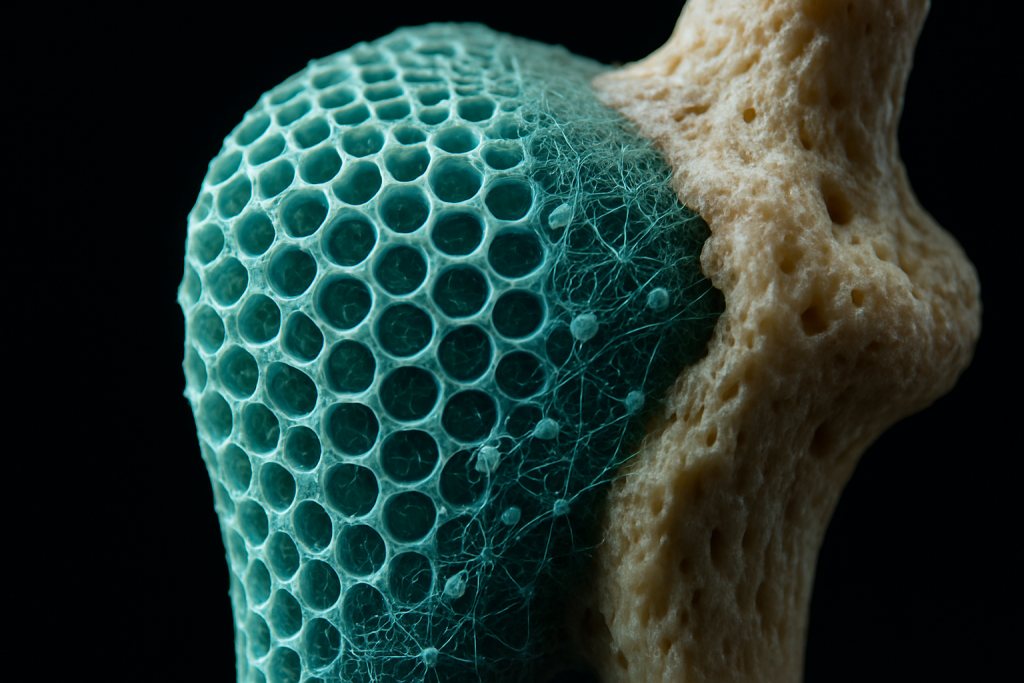
Image generated by AI
Nature has spent four billion years perfecting materials that surpass anything we’ve engineered in laboratories. A spider’s silk is stronger than steel at a fraction of the weight; abalone shells shatter-proof themselves through microscopic architecture; and wood combines rigidity with flexibility in ways that defy conventional physics. Biomaterials and bio-inspired engineering represent humanity’s attempt to reverse-engineer these biological masterpieces, learning from evolution’s solutions to create materials that are stronger, lighter, more sustainable, and more intelligent than what conventional chemistry and physics have produced.
This field has moved from academic curiosity to urgent necessity. As we face climate crisis, resource scarcity, and an aging population requiring new medical solutions, the pressure to innovate beyond petroleum-based plastics and energy-intensive synthetic materials has never been greater. Biomaterials offer a compelling alternative: materials grown rather than manufactured, derived from renewable sources, and often biodegradable. Bio-inspired engineering takes this further, asking not just what organisms are made of, but how they assemble, adapt, and self-repair—principles that could revolutionize everything from construction to medicine.
What Is Biomaterials and Bio-inspired Engineering?
Biomaterials are substances—either derived directly from living organisms or synthesized to mimic biological structures—that can interact with biological systems without triggering harmful immune responses. They include materials like collagen (found in skin and bone), chitosan (derived from shellfish exoskeletons), and engineered proteins. Bio-inspired engineering, or biomimicry, goes deeper: it’s the systematic extraction of principles from nature and their application to solve human problems. This might mean copying the hierarchical structure of bone to create stronger ceramics, or mimicking how mussels adhere to rocks to develop adhesives that work underwater. The two approaches are complementary—biomaterials provide the “what,” while bio-inspired engineering reveals the “how.”
The formal study of biomaterials began in earnest during the 1960s when researchers realized that certain materials could be implanted in the body without causing rejection. Clemson University’s Clemson Bioengineering Laboratory and similar institutions pioneered the field, initially focusing on replacements for damaged tissues. However, the conceptual roots run deeper. Isambard Kingdom Brunel studied how shipworms bored through wood in the 1800s; engineers have long observed termite mounds and beehives to understand principles of construction and cooling. What has changed is our ability to observe, measure, and replicate these designs at molecular scales using advanced imaging and computational tools.
How It Works in Nature
Nature’s materials science is fundamentally different from ours. Instead of melting raw ingredients at high temperatures and pouring them into molds, organisms build materials through self-assembly—the spontaneous organization of molecules into ordered structures driven by entropy and chemical bonds. Spider silk, for instance, is produced by a spider’s spinnerets as a liquid protein solution that solidifies as it’s extruded, achieving tensile strength comparable to steel while remaining flexible. The secret lies not in any single ingredient but in the precise arrangement of amino acids and the way the protein chains align and interact. Bone accomplishes something equally remarkable: it’s only about 70 percent mineral (hydroxyapatite crystals), 30 percent collagen, and water—yet this composite is both rigid and resilient, able to bear weight while absorbing impact without shattering.
Consider the nacre, or mother-of-pearl, that lines abalone shells. Under a microscope, it reveals a brick-and-mortar structure: microscopic tiles of aragonite (a form of calcium carbonate) are glued together with a thin layer of protein. This arrangement is elegantly simple, but the result is profound. While aragonite crystals alone are brittle, nacre is nearly three times tougher. Cracks propagate slowly through the structure because they must navigate around the protein layers, dissipating energy with each obstacle. A conventional engineer, given the same materials, would create something far more fragile. The difference is that nature optimizes for energy efficiency, redundancy, and gradual failure—not maximum strength in isolation.
Medical and Scientific Relevance
The medical applications of biomaterials have transformed healthcare. Artificial joints, heart valves, and dental implants are now routinely made from biomaterials engineered to integrate with the body’s tissues rather than being rejected as foreign objects. Scaffolds made from collagen or synthetic polymers can guide tissue regeneration, allowing doctors to repair cartilage damage, rebuild bone after trauma, and even engineer entire organs in laboratory settings. In regenerative medicine, the goal is not merely replacement but restoration—encouraging the body’s own cells to migrate into a biomaterial scaffold and rebuild damaged tissue. This approach has shown remarkable promise in treating spinal cord injuries, where researchers have created scaffolds that guide nerve growth and restore some degree of motor function in paralyzed patients.
Current applications span an impressive range. Surgeons use decellularized tissue—organs or tissue structures from donors with all cells removed, leaving behind a protein scaffold—as a template for regeneration. Researchers are developing bio-inks derived from alginate and collagen for 3D bioprinting, where living cells are printed layer by layer to create tissue constructs. In wound care, advanced dressings made from chitosan or silk fibroin accelerate healing and reduce infection risk. The dental industry has embraced biomimetic restorations that mimic the natural structure of teeth. And in ophthalmology, corneal implants made from recombinant collagen are restoring sight to patients with scarred corneas.
Recent Breakthroughs in Biomaterials and Bio-inspired Engineering
The past few years have witnessed accelerating innovation driven by advances in structural biology, machine learning, and nanotechnology. In 2023, researchers at MIT published work on programmable matter—metamaterials that can change their properties in response to external stimuli, inspired by how cephalopods like squid change color and texture by manipulating skin pigments and muscle fibers. That same year, scientists successfully created artificial spider silk using genetically modified silkworms, producing commercial quantities of material with the strength-to-weight ratio that has long eluded conventional manufacturing. Meanwhile, teams at Cambridge University and other institutions have engineered mycelium-based materials—composites grown from mushroom roots—that are entirely biodegradable yet possess structural properties suitable for building materials and packaging.
The frontier is moving toward programmable and responsive biomaterials. Researchers are engineering proteins that respond to light, temperature, pH, or mechanical stress by changing shape or releasing drugs on demand. There’s also growing interest in whole-organism biomaterials—living composites that literally grow and self-repair. Some labs are developing bacterial cellulose (produced by certain microbes) as a leather alternative. The challenge now isn’t demonstrating proof-of-concept, but scaling these technologies and reducing costs to compete with conventional materials.
Why Biomaterials and Bio-inspired Engineering Matters for the Future
As we confront the limits of petroleum-derived plastics and the energy costs of conventional manufacturing, biomaterials offer a fundamentally different pathway forward. The built environment could be transformed if we could construct buildings from rapidly renewable materials that sequester carbon, biodegrade safely at end-of-life, and require minimal processing energy. Medical treatments could become more effective and less traumatic if we could reliably regenerate damaged tissues rather than replacing them with inert substitutes. Climate change makes this transition urgent: traditional cement production alone generates 8 percent of global CO2 emissions; bio-inspired alternatives could drastically reduce that footprint while actually improving performance characteristics.
However, significant obstacles remain. Scaling biomaterial production from laboratory quantities to industrial volumes without compromising quality or sustainability benefits is non-trivial. Regulatory pathways for novel biomaterials remain underdeveloped—approval timelines for bioengineered tissues can stretch over a decade. Cost barriers are substantial; engineered spider silk currently costs hundreds of times more than steel per kilogram, though this gap is narrowing. There’s also the risk of unintended ecological consequences if bio-inspired or biomaterial organisms escape into the environment. These challenges will require continued investment in fundamental research, regulatory innovation, and public-private partnerships.
Key Takeaways
- Biomaterials and bio-inspired engineering represent a paradigm shift from synthesizing materials through industrial chemistry to growing or mimicking them through biological principles that evolution has perfected over millions of years.
- Nature achieves superior performance—strength, flexibility, durability, and self-repair—by organizing materials hierarchically through self-assembly, a process fundamentally different from conventional manufacturing.
- Medical applications including tissue scaffolds, regenerative medicine, and bioengineered implants are already transforming healthcare and moving toward restoration rather than mere replacement of damaged tissues.
- Recent breakthroughs in programmable biomaterials, artificial spider silk production, and mycelium-based composites demonstrate that the field is transitioning from proof-of-concept to commercial viability.
- As climate urgency and resource constraints intensify, biomaterials represent a necessary pathway toward sustainable manufacturing, circular economy principles, and more effective medical solutions—but realizing this potential requires solving significant scaling, regulatory, and economic challenges.
Explore TED Talks on Biomaterials and Bio-inspired Engineering:
TED content is used under CC BY-NC-ND 4.0. © TED Conferences, LLC.
Frequently Asked Questions
How does spider silk achieve greater strength than steel while being lighter in weight?
Spider silk derives its exceptional strength-to-weight ratio from its molecular structure—specifically, the arrangement of protein chains (primarily spidroin proteins) that form beta-sheet crystalline regions interspersed with amorphous segments, allowing both rigidity and elasticity. This hierarchical architecture distributes stress more efficiently than steel's crystalline structure, enabling superior performance at a fraction of the density.
What specific microscopic architectural principle allows abalone shells to resist shattering?
Abalone shells use a nacre structure—alternating layers of hard aragonite (calcium carbonate) platelets and soft protein matrix—that absorbs impact energy through controlled crack deflection and layer delamination rather than catastrophic failure. This nacre design demonstrates how hierarchical layering at multiple scales can transform brittle materials into remarkably tough composites.
Why are biomaterials grown rather than manufactured considered more sustainable than synthetic alternatives?
Biomaterials grown through biological processes require significantly lower energy input, operate at ambient temperatures and pressures, and often utilize renewable feedstocks and enzymatic processes rather than petroleum-based chemistry and high-temperature industrial synthesis. Additionally, many biomaterials are biodegradable or compostable, reducing persistent environmental accumulation compared to synthetic polymers.
How do bio-inspired engineering principles of self-assembly and self-repair differ from conventional materials engineering approaches?
Bio-inspired engineering leverages molecular-level self-assembly driven by thermodynamic and chemical interactions, allowing complex structures to form spontaneously, whereas conventional materials rely on external manufacturing processes and fixed designs. Self-repair in biological systems occurs through active biological mechanisms or reversible molecular bonds, whereas most engineered materials lack intrinsic repair capacity and require external intervention.