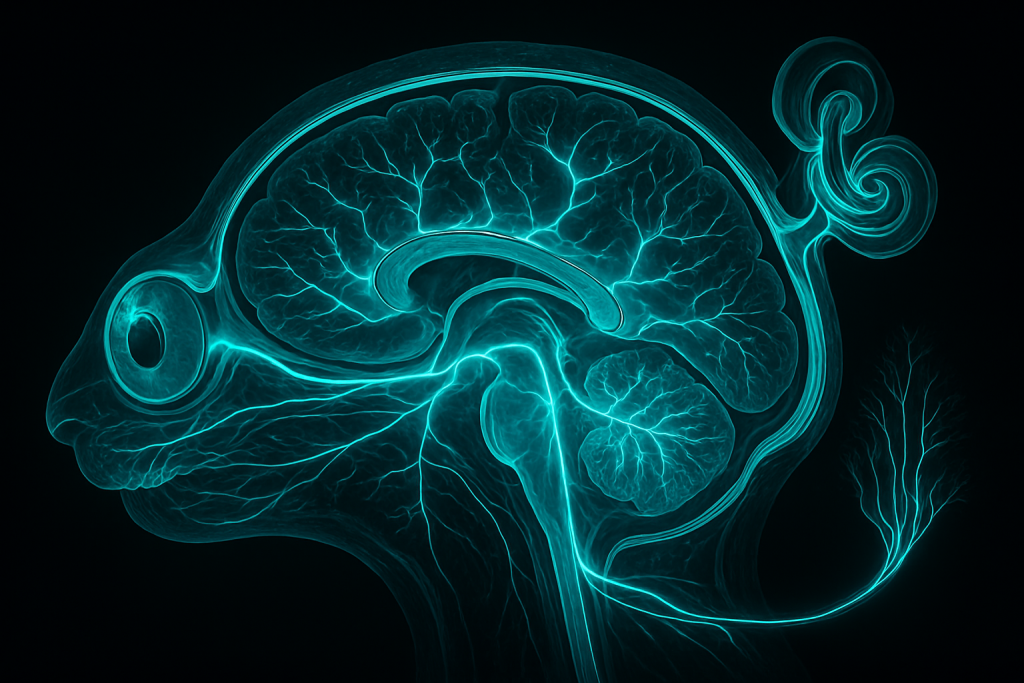
Image generated by AI
A tiny fruit fly can detect a single photon of light, navigate a three-dimensional world in real time, and make split-second decisions about where to fly—all with a brain containing just 100,000 neurons. Meanwhile, the human visual cortex alone contains roughly 30 million neurons, yet we still struggle to understand how we perceive a sunset or recognize a loved one’s face. The gap between sensory input and behavioral output—the journey from detecting a stimulus to acting on it—remains one of biology’s most profound mysteries, and it all hinges on how sensory systems and neural circuits work together across the animal kingdom.
Understanding sensory systems and neural circuits has become increasingly urgent as artificial intelligence researchers attempt to build machines that can perceive and respond to the world as animals do, and as neuroscientists seek new treatments for sensory disorders, neurological diseases, and psychiatric conditions. From the development of better prosthetic limbs to the discovery of new therapies for blindness and deafness, the insights gained from studying how animals sense and process information are transforming both medicine and technology. In an era of rapid ecological change, understanding how sensory systems evolved also helps us predict which species will adapt to new environments and which may disappear.
What Is Sensory Systems and Neural Circuits in Animals?
Sensory systems and neural circuits represent the biological machinery that allows animals to detect the world around them and convert that information into behavior. A sensory system typically begins with specialized receptor cells—photoreceptors in the eye, mechanoreceptors in the skin, chemoreceptors in the nose and mouth—that respond to physical or chemical stimuli by generating electrical signals. These signals travel along neurons to the brain and spinal cord, where neural circuits—networks of interconnected nerve cells—process the information, integrate it with memory and other sensory inputs, and ultimately send commands back out to muscles and glands. The entire process, from detection to response, happens through the coordinated activity of billions of neurons communicating via chemical and electrical signals at connection points called synapses.
The study of sensory systems and neural circuits emerged as a formal discipline in the late 19th and early 20th centuries, when scientists like Santiago Ramón y Cajal used newly developed staining techniques to visualize individual neurons and discover that the nervous system is composed of discrete cells rather than a continuous network. In the 1950s and 1960s, pioneering electrophysiologists such as David Hubel and Torsten Wiesel made groundbreaking discoveries by recording electrical activity from neurons in the visual cortex while showing animals images, revealing that neurons respond selectively to specific visual features like edges and orientations. Since then, tools have evolved from crude electrodes to optogenetics—the ability to control neurons with light—and modern imaging techniques that allow scientists to watch thousands of neurons firing simultaneously in living, behaving animals, transforming our understanding of how circuits generate perception and action.
How It Works in Nature
At the foundation of sensory processing lies the concept of receptor specificity: each type of sensory receptor is tuned to respond to a particular kind of stimulus with extraordinary sensitivity. A single photoreceptor in the retina can respond to a single photon, while olfactory receptors in mammals can detect certain chemical compounds at concentrations as low as one part per trillion. When a stimulus meets a receptor, it causes physical changes in the receptor cell—ion channels open or close, the electrical membrane potential shifts, and if the signal is strong enough, the neuron fires an action potential, a rapid electrical impulse that travels down the axon to release neurotransmitter molecules at synapses. This simple detection system, however, is just the beginning; the real complexity emerges as signals propagate through layered circuits that compare, contrast, and combine information.
Consider how a barn owl hunts in complete darkness using only sound. Each ear receives sound waves at slightly different times and volumes, and the owl’s brain contains a specialized neural circuit in the midbrain that compares these tiny timing differences—sometimes as small as 20 microseconds—to pinpoint prey location with stunning accuracy. The circuit works like a biological cross-correlator, with neurons arranged in a mathematical grid that computes the time difference by comparing the arrival times of action potentials from the two ears. This elegant system demonstrates a principle repeated throughout neuroscience: sensory circuits often extract behaviorally relevant features from raw sensory data through the precise arrangement and connectivity of neurons, performing computations that engineered systems require sophisticated algorithms to accomplish.
Medical and Scientific Relevance
The clinical applications of sensory neuroscience are expanding rapidly as researchers translate fundamental discoveries into therapies for human disease. Retinitis pigmentosa, a genetic disorder that causes progressive blindness, is now being treated experimentally by implanting microelectrode arrays directly into the eye that stimulate remaining healthy neurons, allowing some blind patients to perceive simple shapes and patterns. Similarly, cochlear implants have restored hearing to hundreds of thousands of deaf people by bypassing damaged hair cells and directly stimulating the auditory nerve with electrical signals patterned to encode sound information. Beyond restoration of lost senses, understanding sensory circuits has illuminated the neural basis of conditions like autism spectrum disorder, which appears to involve atypical sensory processing and circuitry, and chronic pain syndromes, where miscommunication between sensory and emotional circuits creates persistent suffering.
Neurotechnology companies are developing increasingly sophisticated brain-computer interfaces that rely on decoding the activity of sensory and motor circuits to control robotic limbs or restore function after paralysis. A tetraplegic patient with electrodes implanted in motor cortex can now use thought alone to control a prosthetic arm with surprising dexterity, because researchers have mapped which neural circuits encode intended movements. In agriculture and environmental monitoring, understanding animal sensory systems informs the design of pest-control strategies and helps conservationists predict how wildlife will respond to habitat changes. Pharmaceutical companies are also investigating sensory circuit dysfunction in depression and anxiety, where altered processing of threat-related stimuli may underlie emotional dysregulation.
Recent Breakthroughs in Sensory Systems and Neural Circuits in Animals
The past three years have witnessed a revolution in our ability to map and manipulate neural circuits thanks to advances in connectomics—the systematic tracing of all synaptic connections in a piece of nervous tissue. In 2024, researchers completed the connectome of the fruit fly brain, a map of all 3.016 billion synapses connecting its 139,000 neurons, the largest connectome ever finished and a milestone that reveals the actual wiring diagram of an organism’s sensory and motor systems. Simultaneously, advanced machine learning algorithms have begun to crack the neural code—the relationship between neural activity patterns and sensory perception or behavior—by analyzing massive datasets of simultaneous recordings from hundreds or thousands of neurons. These computational approaches have revealed that neural circuits often use population coding, where information is distributed across many neurons, providing robustness against noise and allowing for flexible representation of complex stimuli.
Another major breakthrough involves the discovery of entirely new classes of sensory neurons and circuits that process information we didn’t know animals could sense. Researchers have identified magnetoreceptor neurons in birds that may allow them to sense Earth’s magnetic field, though the exact mechanism remains debated, and have found specialized neurons in various animals that respond to infrared radiation, ultraviolet light, and vibrations in the substrate. Current research is focused on understanding how these diverse sensory inputs are integrated—how a multisensory circuit combines sight, sound, and touch to generate a unified perception of the world—and on determining whether fundamental computational principles underlie sensory processing across different animal phyla, from jellyfish to humans.
Why Sensory Systems and Neural Circuits in Animals Matters for the Future
As climate change forces rapid environmental shifts, understanding how animals sense and respond to their surroundings becomes crucial for conservation biology. Species with inflexible sensory systems or neural circuits may struggle to adapt to new predators, prey, or environmental conditions, while those with plastic, flexible sensory processing may thrive. The ongoing integration of neuroscience with artificial intelligence promises to yield smarter, more robust AI systems that perceive the world more like biological brains do—incorporating attention, context, and learned associations rather than processing every input equally. Additionally, as human populations age and neurological diseases like Alzheimer’s and Parkinson’s become increasingly common, detailed knowledge of how sensory circuits maintain brain health and how their degradation contributes to cognitive decline may point toward preventive or restorative therapies.
Major challenges remain in translating circuit-level findings to whole-organism behavior and in understanding how subjective experiences—qualia, consciousness itself—emerge from neural activity. We still lack a complete picture of how sensory information flows through brains of large animals like primates, elephants, and cetaceans, limiting our understanding of how different nervous system architectures support different kinds of perception and cognition. The technical challenges of recording from and manipulating circuits in behaving animals, while keeping them alive and healthy, continue to constrain research on larger-brained species, meaning much of what we know comes from model organisms whose brains, while simpler, may not fully reflect the complexity of human sensory experience.
Key Takeaways
- Sensory systems and neural circuits form the biological foundation of perception, converting physical and chemical stimuli into electrical signals that the brain processes to generate behavior and subjective experience.
- Sensory receptors achieve remarkable specificity and sensitivity—detecting single photons or chemical molecules at part-per-trillion concentrations—and pass signals through organized neural circuits that extract behaviorally relevant features through precise synaptic connectivity.
- Clinical applications include retinal implants and cochlear implants restoring lost senses, brain-computer interfaces enabling paralyzed patients to control prosthetic limbs, and new insights into sensory dysfunction in autism, pain syndromes, and psychiatric disorders.
- Recent breakthroughs in connectomics, particularly the fruit fly connectome, and advances in machine learning have revealed the physical wiring of neural circuits and begun to decode the relationship between neural activity and perception.
- Understanding sensory systems across animal species will be essential for predicting how wildlife adapts to climate change, for developing biologically-inspired artificial intelligence, and for treating age-related neurological diseases and sensory disorders in humans.
Explore TED Talks on Sensory Systems and Neural Circuits in Animals:
TED content is used under CC BY-NC-ND 4.0. © TED Conferences, LLC.
Frequently Asked Questions
How can a fruit fly with only 100,000 neurons perform complex tasks like real-time navigation and decision-making that require processing vast amounts of sensory information?
Fruit flies achieve this through highly efficient neural circuit organization, where neurons are densely interconnected and each connection carries significant computational weight, allowing compact brains to process and respond to sensory inputs with remarkable speed and accuracy. Their neural circuits are also specialized for specific tasks, with dedicated pathways for vision, olfaction, and motor control that minimize redundancy and maximize performance per neuron.
Why do humans require approximately 30 million neurons in the visual cortex alone while still struggling to recognize faces, when the entire fruit fly brain accomplishes comparable sensory processing with only 100,000 neurons?
Human visual processing involves far greater complexity, including color discrimination across millions of shades, high-resolution detail perception, integration with memory and emotion, and the ability to recognize subtle variations in countless different faces and objects. The apparent inefficiency reflects the evolutionary trade-off between specialization and flexibility—humans sacrifice speed and efficiency for the ability to process diverse visual information and integrate it with abstract reasoning and learning.
How do insights from studying animal sensory systems and neural circuits directly contribute to medical treatments for human sensory disorders like blindness and deafness?
Research on animal sensory systems reveals the fundamental principles of how sensory receptors detect stimuli and how neural circuits process and relay that information, knowledge that enables scientists to design prosthetics, gene therapies, and neural implants that can either restore or bypass damaged sensory pathways. For example, understanding how the retina converts light into neural signals has informed the development of retinal implants that stimulate surviving neurons to restore partial vision in blind patients.
Can understanding how different animal species have evolved different sensory systems help predict which species will survive environmental change?
Yes—species with sensory systems adapted to detect and respond to a narrow range of environmental conditions (such as specific temperature ranges or light wavelengths) may struggle when those conditions change, while species with broader sensory capabilities or greater neural plasticity are more likely to adapt and survive. By mapping the sensory capabilities and neural circuit flexibility of different species, scientists can identify which organisms are most vulnerable to rapid environmental shifts like climate change or habitat loss.