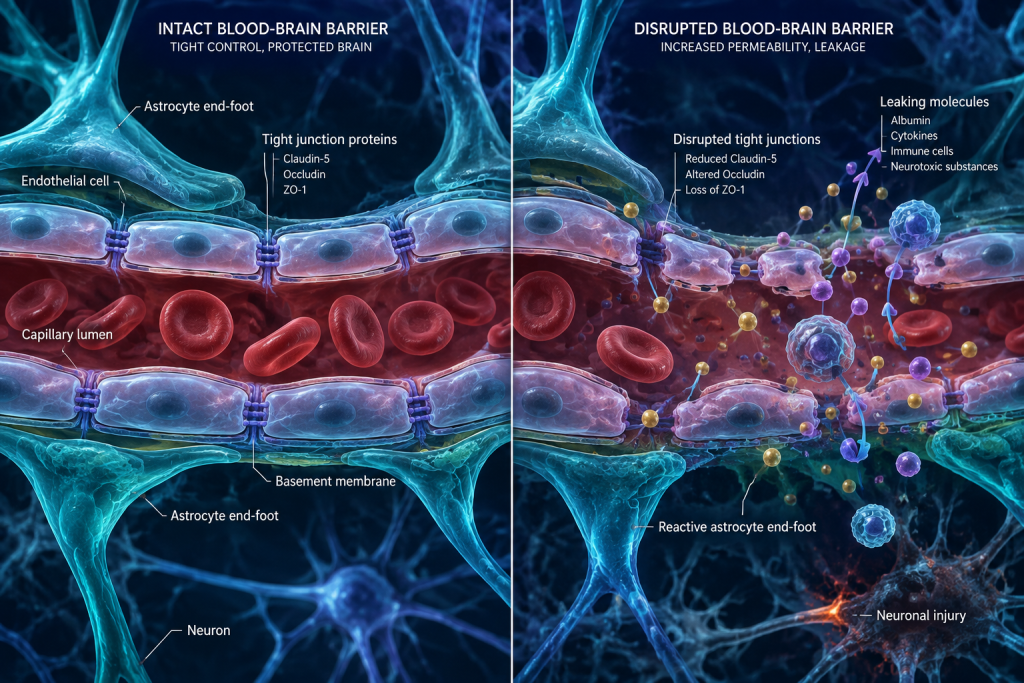
Image generated by AI
Your brain is perhaps the most heavily guarded organ in your body, surrounded by a molecular sentry so selective that it permits some substances to pass while barring others with ruthless efficiency. This guardian, called the blood-brain barrier, sits at the boundary between your bloodstream and your brain tissue, making life-or-death decisions about which molecules get access to roughly 86 billion neurons. Yet this same protection that keeps toxins and pathogens at bay also prevents most drugs from reaching the brain, making it one of medicine’s most frustrating obstacles. Understanding when and why this barrier fails—or is breached deliberately—has become essential to treating everything from Alzheimer’s disease to brain cancer.
In recent years, neuroscientists have realized that the blood-brain barrier is far more dynamic and vulnerable than once thought, actively breaking down in Alzheimer’s disease, stroke, and traumatic brain injury before symptoms even become apparent. Researchers are now developing entirely new strategies to exploit, repair, and reimagine this barrier, using everything from ultrasound to nanotechnology to deliver lifesaving medications to the brain. This convergence of basic science and clinical application makes the blood-brain barrier one of the most urgent frontiers in modern neuromedicine, with implications that stretch from treating neurodegeneration to understanding psychiatric disease.
What Is Blood-Brain Barrier Function and Dysfunction?
The blood-brain barrier is a highly selective biological interface composed of endothelial cells that form the walls of blood vessels in the brain, surrounded by supporting cells called pericytes and astrocytes. Unlike blood vessels elsewhere in the body, these brain capillaries are fused together by tight junctions—molecular locks that prevent most large or charged molecules from squeezing through the spaces between cells. Instead, the barrier uses active transport systems, specialized carrier proteins embedded in the endothelial cell membranes that ferry essential nutrients like glucose and amino acids into the brain while actively pumping out metabolic waste and potentially harmful substances. This combination of passive barriers and active gatekeeping creates an exquisitely selective filter that keeps the brain’s chemical environment stable and protected, a state neuroscientists call homeostasis. When this barrier breaks down—a condition called blood-brain barrier dysfunction—fluid, proteins, and immune cells leak into brain tissue, triggering inflammation and accelerating neuronal death.
The blood-brain barrier was first conceptualized in the late 19th century when scientists noticed that dyes injected into the bloodstream would color every organ except the brain. Paul Ehrlich, the pioneering chemist and physician, observed this phenomenon in 1885 and hypothesized that the brain must possess some unique protective property, though the mechanism remained mysterious for decades. It wasn’t until the 1960s and 1970s that electron microscopy revealed the tight junctions between endothelial cells, finally explaining the barrier’s molecular basis. Since then, advances in cell biology and molecular genetics have transformed our understanding from a simple passive filter into a sophisticated, metabolically active interface whose dysfunction is now recognized as a central feature of numerous neurological disorders.
How It Works in Nature
The blood-brain barrier operates through multiple overlapping mechanisms, beginning with tight junctions formed by proteins called claudins and occludin that create a continuous seal between endothelial cells. These junctions are reinforced by adherens junctions and supported by a dense network of cytoskeletal proteins that anchor the seal from within the cell. Beyond this passive barrier, the endothelial cells express hundreds of different transporter proteins that perform active surveillance and transport, including pumps that recognize and eject foreign substances, nutrient carriers that bring in glucose and amino acids, and efflux transporters like P-glycoprotein that actively pump many drugs back into the bloodstream. The barrier is further supported by pericytes—muscle-like cells that wrap around blood vessels and regulate their permeability—and astrocytes, which are star-shaped brain cells that send foot-like projections to touch vessel walls and provide signaling molecules that strengthen the barrier. This multi-layered system works in concert to maintain precise control over the brain’s ionic balance, pH, and nutrient supply while keeping out pathogens, circulating immune cells, and most large molecules.
Think of the blood-brain barrier as airport security with multiple checkpoints: the tight junctions form the first perimeter fence, making it impossible to simply walk across unchecked. The active transporters function like customs agents who examine incoming luggage and either approve essential items or confiscate contraband. Pericytes act as supervisors who monitor overall security and can tighten procedures when they sense a threat, while astrocytes serve as intelligence officers who communicate warnings about potential dangers. A virus trying to cross this barrier must navigate not one but several independent defense systems, which is why most viral pathogens cannot readily infect the brain—and why treating brain infections is so challenging. Similarly, a cancer drug in the bloodstream may be potent enough to kill tumor cells anywhere else in the body, but most cannot penetrate the blood-brain barrier in sufficient concentrations to treat brain cancer, a problem that has frustrated oncologists for decades.
Medical and Scientific Relevance
Blood-brain barrier dysfunction has emerged as a key pathological feature in an astonishing range of neurological conditions, from neurodegenerative diseases like Alzheimer’s and Parkinson’s to neuroinflammatory disorders like multiple sclerosis and stroke. In Alzheimer’s disease, accumulating evidence suggests that barrier breakdown actually precedes cognitive decline by years or even decades, allowing toxic proteins like amyloid-beta to accumulate in brain tissue where they trigger a cascade of inflammation and neuronal death. Emerging research has shown that barrier dysfunction correlates with disease severity and progression, making it not merely a consequence of neurodegeneration but potentially a driving force. This paradigm shift has profound implications for treatment: rather than only targeting the toxic proteins themselves, researchers are now developing strategies to repair and reinforce the barrier, potentially preventing disease initiation or halting progression. Similarly, in stroke and traumatic brain injury, barrier breakdown is the mechanism by which cerebral edema—dangerous brain swelling—develops, making barrier stabilization a critical emergency intervention.
Current clinical applications of blood-brain barrier research span multiple domains: neurologists are testing drugs that strengthen tight junctions to prevent progression in Alzheimer’s disease; neuro-oncologists are using focused ultrasound to temporarily open the barrier and deliver chemotherapy to brain tumors; and immunologists are exploiting barrier function to understand why autoimmune T cells breach it in multiple sclerosis. Pharmaceutical companies are investing heavily in technologies to enhance drug delivery across the barrier, including nanoparticles engineered to mimic nutrients and hijack transporter proteins, antibody fragments designed to cross through transcytosis, and prodrug formulations that are modified in the bloodstream to penetrate the barrier but convert back to their active form in the brain. Gene therapy developers are working to deliver therapeutic genes to the brain by engineering viruses that can cross or bypass the barrier, offering potential treatments for inherited neurological disorders. These diverse applications illustrate how understanding barrier function has transitioned from basic neuroscience into a practical toolkit for addressing previously intractable brain diseases.
Recent Breakthroughs in Blood-Brain Barrier Function and Dysfunction
The past two to three years have witnessed a remarkable acceleration in blood-brain barrier research, driven partly by the growing recognition that barrier dysfunction is primary rather than secondary in many brain diseases. A landmark 2022 study published in Nature revealed that Alzheimer’s patients show blood-brain barrier breakdown years before amyloid plaques accumulate, suggesting that fixing the barrier might prevent disease rather than merely treating its consequences. Simultaneously, researchers have made striking discoveries about the molecular signals that regulate barrier tightness, identifying specific proteins and lipids that strengthen or weaken tight junctions, opening new avenues for pharmacological intervention. Advances in organ-on-a-chip technology have enabled scientists to model the blood-brain barrier in the laboratory with unprecedented accuracy, allowing rapid screening of drug candidates and exploration of how different diseases compromise barrier function. High-resolution imaging techniques, including two-photon microscopy and intravital imaging in living animals, have revealed that barrier breakdown is often focal and dynamic rather than global, with specific regions opening and closing in response to inflammatory signals and immune cell infiltration.
Researchers are currently pursuing several ambitious goals: developing biomarkers that detect barrier dysfunction in living patients, enabling early diagnosis of neurodegenerative diseases; engineering biomaterials and cell therapies to physically repair damaged barrier tissue; and creating better animal models that more faithfully recapitulate human barrier function and disease. Outstanding questions that drive current investigations include understanding why the barrier selectively opens in response to certain inflammatory molecules but not others, how pericytes and astrocytes sense damage and coordinate repair, and whether barrier dysfunction is reversible once it has progressed beyond a certain point. The integration of artificial intelligence and machine learning to analyze the vast complexity of barrier regulation represents an emerging frontier, with algorithms being trained to predict which patients will develop barrier breakdown and which drug candidates will successfully cross or repair the barrier.
Why Blood-Brain Barrier Function and Dysfunction Matters for the Future
As our population ages and neurodegenerative diseases become increasingly prevalent, the blood-brain barrier will likely become as central to neuromedicine as the immune system has been to general medicine. Understanding barrier dysfunction may ultimately provide the key to preventing Alzheimer’s disease, currently the leading cause of dementia affecting millions worldwide, by allowing intervention before neurodegeneration becomes irreversible. Beyond neurodegenerative disease, the barrier’s role in psychiatric disorders, addiction, and neuroinflammatory conditions suggests that manipulating barrier function could offer novel therapeutic approaches for conditions that have resisted conventional treatment. The convergence of nanotechnology, gene therapy, and immunotherapy with blood-brain barrier biology is creating unprecedented opportunities to deliver therapeutic agents to the brain with precision and specificity. Furthermore, as artificial intelligence becomes increasingly capable of modeling complex biological systems, it may unlock the barrier’s remaining secrets, leading to breakthrough treatments for conditions that currently have no cure.
Significant challenges remain: most drug candidates still cannot cross the barrier effectively, requiring expensive and time-consuming optimization; the barrier’s protective function must be preserved even while we seek to breach it therapeutically, necessitating extraordinary precision; and the barrier differs subtly between individuals and even between brain regions, making one-size-fits-all approaches problematic. Regulatory pathways for barrier-targeted therapies remain underdeveloped, as the field lacks well-established endpoints for measuring barrier function in clinical trials. Perhaps most fundamentally, the barrier’s incredible complexity—involving hundreds of genes, dozens of cell types, and intricate signaling networks—means that fully understanding it will require continued integration of multiple scientific disciplines and technological approaches.
Key Takeaways
- The blood-brain barrier is a highly selective biological interface that protects the brain by using tight junctions and active transport to control which molecules enter from the bloodstream, and its dysfunction is now recognized as a central feature of Alzheimer’s disease, stroke, and other neurological disorders.
- The barrier operates through multiple overlapping mechanisms including endothelial tight junctions, specialized transporter proteins, pericyte regulation, and astrocyte signaling, creating a multi-layered defense system that most drugs cannot penetrate—a major obstacle for treating brain diseases.
- The most promising therapeutic applications include using focused ultrasound to temporarily open the barrier for chemotherapy delivery, engineering nanoparticles to hijack barrier transporters for drug delivery, and repairing barrier dysfunction to prevent neurodegenerative disease progression.
- Recent breakthroughs have revealed that blood-brain barrier breakdown occurs years before symptoms in Alzheimer’s disease, new molecular mechanisms controlling barrier tightness have been identified, and advanced imaging reveals that barrier dysfunction is often focal and dynamic rather than global.
- Understanding and manipulating blood-brain barrier function will be essential for treating neurodegenerative diseases, delivering gene therapies to the brain, and developing new approaches to psychiatric and neuroinflammatory disorders, making it a central frontier in 21st-century medicine.
Explore TED Talks on Blood-Brain Barrier Function and Dysfunction:
TED content is used under CC BY-NC-ND 4.0. © TED Conferences, LLC.
Frequently Asked Questions
How does the blood-brain barrier selectively allow some molecules to pass while blocking others?
The blood-brain barrier acts as a molecular sentry through highly selective transport mechanisms, including tight junctions between endothelial cells and active transport proteins that recognize and permit only specific substances to cross. This selective permeability protects the brain from toxins and pathogens while maintaining the precise chemical environment needed for the 86 billion neurons to function properly.
Why does the blood-brain barrier's protective function create challenges for treating brain diseases with drugs?
Most pharmaceutical drugs are too large or have chemical properties that prevent them from crossing the blood-brain barrier's selective filters, meaning even effective medications cannot reach brain tissue where they are needed. This barrier that evolved to protect the brain from harmful substances inadvertently blocks the delivery of potentially lifesaving treatments for neurological conditions.
What happens to the blood-brain barrier in diseases like Alzheimer's and stroke before patients show symptoms?
Recent research shows the blood-brain barrier actively breaks down and becomes dysfunctional in Alzheimer's disease, stroke, and traumatic brain injury before clinical symptoms appear, allowing unwanted substances to enter the brain tissue. This early breakdown contributes to neuronal damage and disease progression, making barrier dysfunction a potential early biomarker and therapeutic target.
Can ultrasound and nanotechnology actually help drugs cross the blood-brain barrier?
Yes, emerging strategies use ultrasound to temporarily open blood-brain barrier tight junctions and nanotechnology to deliver medications by encapsulating drugs in particles small enough to cross or through receptors that actively transport them. These novel delivery methods represent a convergence of basic neuroscience and clinical application to overcome one of medicine's major obstacles in treating brain disease.