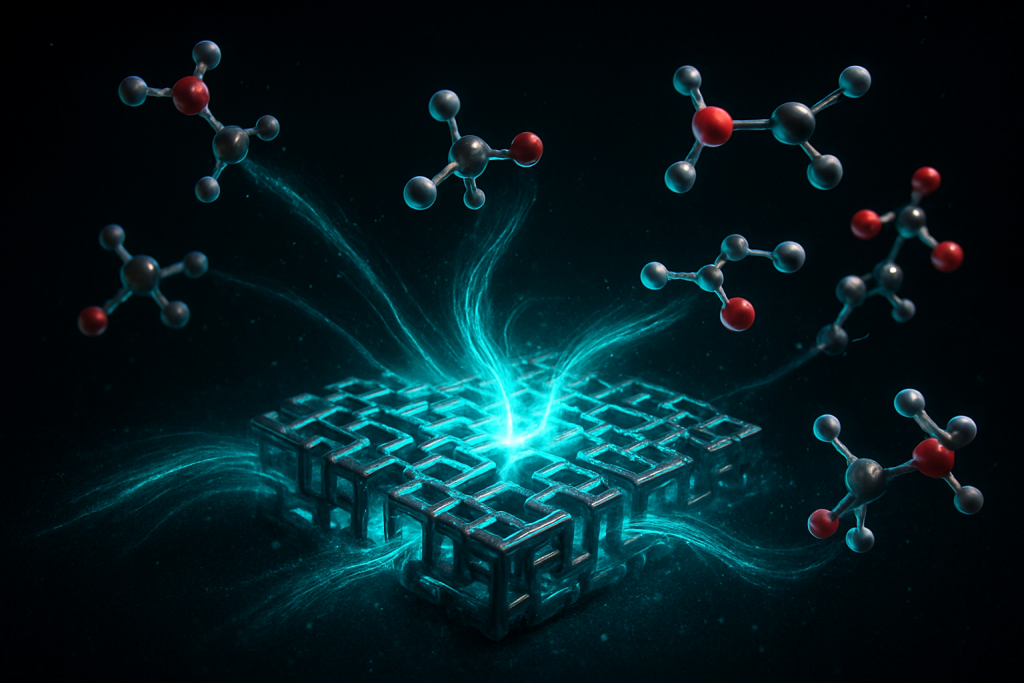
Image generated by AI
AI Insight
Catalysts are substances that accelerate chemical reactions by lowering activation energy through alternative reaction pathways, while remaining unchanged and reusable throughout the process. They exist in two main forms: heterogeneous catalysts that operate in a different physical state than reactants, and homogeneous catalysts that dissolve in the reaction mixture, with enzymes serving as nature's highly specific biological catalysts. Catalysis underpins 60 to 90 percent of global chemical manufacturing processes, from petroleum refining and ammonia synthesis for fertilizers to automotive emission control and pharmaceutical production.
Why it matters
Catalytic processes are essential for producing affordable fuels, fertilizers that feed half the world's population, pollution-reducing automotive converters, and pharmaceuticals at industrial scale. Advances in catalyst development are critical for renewable energy technologies, carbon capture, and sustainable chemistry needed to address climate change and environmental challenges.
Catalysts are the unsung heroes of chemistry, speeding up reactions without being consumed in the process. From the air you breathe to the fuel in your car, catalysts make countless industrial processes economically viable and environmentally necessary. Understanding how they work reveals why they’re fundamental to modern civilization.
The Chemistry Behind It
A catalyst accelerates a chemical reaction by lowering the activation energy—the minimum energy barrier molecules must overcome to transform into products. Think of it as creating a shortcut through a mountain rather than climbing over it. The catalyst provides an alternative pathway for reactants to interact, often by stabilizing intermediate structures or bringing molecules into optimal alignment. Crucially, the catalyst emerges unchanged at the end, ready to facilitate the reaction again and again, making it extraordinarily efficient.
Catalysts come in two main varieties: heterogeneous catalysts exist in a different physical state than the reactants (typically solid surfaces speeding up liquid or gas reactions), while homogeneous catalysts dissolve into the reaction mixture. Enzymes are nature’s catalysts—proteins that accelerate biochemical reactions with remarkable specificity, enabling life itself.
Where It Is Used Today
The industrial reach of catalysis is staggering. In petroleum refining, catalysts break down crude oil into usable fuels and chemicals worth hundreds of billions annually. Automobile catalytic converters contain platinum, palladium, and rhodium catalysts that transform toxic emissions like carbon monoxide and nitrogen oxides into harmless compounds—a regulation now standard across the developed world.
The chemical industry relies on catalysis for ammonia synthesis, producing fertilizer that feeds roughly half the global population. In food production, catalysts hydrogenate vegetable oils to create margarine and shortenings. Pharmaceutical manufacturing depends on catalysts to synthesize life-saving drugs efficiently and affordably. Even renewable energy benefits: catalysts help convert hydrogen into fuel cells and enable carbon capture technologies crucial for addressing climate change.
Without catalysis, many reactions would be prohibitively slow or expensive, making products unaffordable or impossible to manufacture at scale. The economic value is reflected in estimates suggesting catalysis supports 60 to 90 percent of all chemical manufacturing processes worldwide.
Key Takeaways
- Catalysts accelerate chemical reactions by lowering activation energy without being permanently altered themselves.
- Catalytic processes are essential to petroleum refining, fertilizer production, pollution control, and pharmaceutical manufacturing.
- Developing better catalysts—particularly for renewable energy and sustainability—remains a critical research frontier with profound implications for the global economy and environment.
Frequently Asked Questions
How does a catalyst lower the activation energy of a chemical reaction?
A catalyst provides an alternative reaction pathway that requires less energy by stabilizing intermediate structures and optimally aligning reactant molecules. This shortcuts the energy barrier molecules must overcome, similar to finding a lower pass through a mountain instead of climbing over the peak.
Why does a catalyst remain unchanged after speeding up a reaction?
A catalyst participates in forming intermediate products during the reaction but is regenerated in its original form at the end, meaning it is not consumed overall. This allows it to be reused repeatedly to catalyze many reaction cycles without depletion.
What is the key difference between heterogeneous and homogeneous catalysts?
Heterogeneous catalysts exist in a different physical state than the reactants (typically solid surfaces catalyzing liquid or gas reactions), while homogeneous catalysts dissolve directly into the reaction mixture. The choice between them affects efficiency, selectivity, and ease of catalyst recovery in industrial processes.
How do enzymes function as catalysts in biochemical reactions?
Enzymes are protein catalysts that accelerate biochemical reactions with high specificity by lowering activation energy through specialized active sites that bind and position reactants optimally. Their remarkable efficiency and selectivity enable the complex metabolic reactions necessary for life to occur at physiological temperatures and speeds.