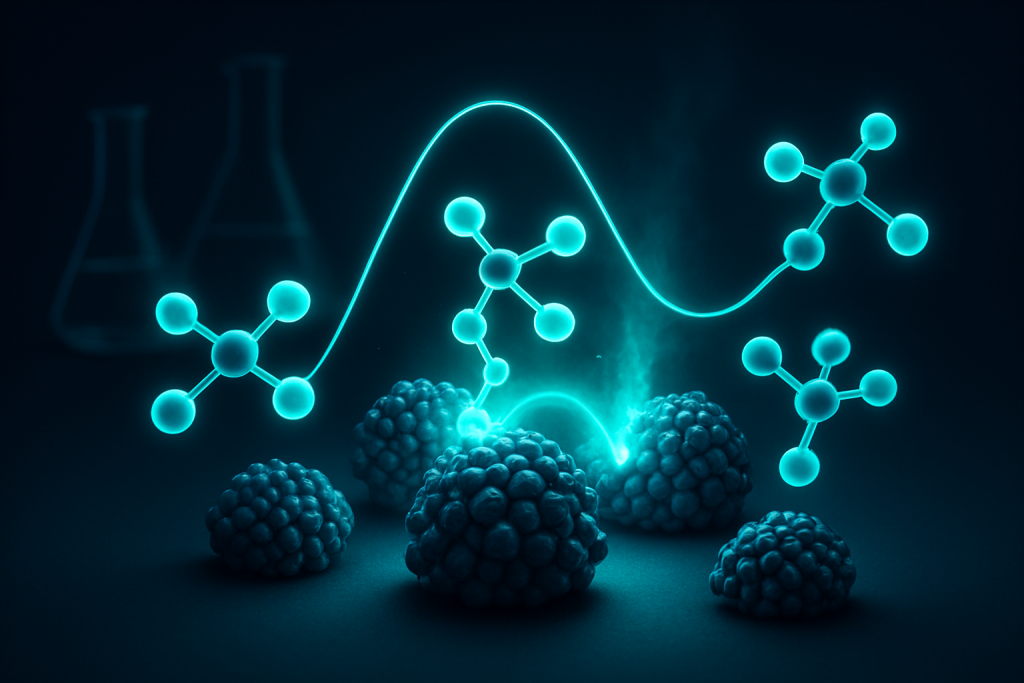
Image generated by AI
AI Insight
Catalysts are substances that accelerate chemical reactions by lowering activation energy while remaining unconsumed in the process, enabling reactions to proceed millions of times faster by providing alternative reaction pathways. A single catalyst molecule can facilitate thousands of reactions by forming temporary bonds with reactants and releasing products in a cyclical manner. Different types of catalysts, including metal-based catalysts, enzymes, and zeolites, are specialized for different chemical transformations in industrial and biological systems.
Why it matters
Catalysis is foundational to modern civilization, enabling industrial processes that feed approximately 40 percent of the global population through ammonia synthesis, producing fuels and pharmaceuticals, and reducing pollution through catalytic converters. Emerging catalytic technologies for green chemistry and sustainable fuel production from renewable biomass offer pathways to reduce fossil fuel dependence while maintaining economic viability.
Catalysts are the invisible workhorses of chemistry, speeding up reactions that would otherwise take centuries to complete in mere seconds. Without catalysis, modern life as we know it—from the gasoline in your car to the medicines in your cabinet—simply wouldn’t exist. Understanding how catalysts work reveals why they’re so critical to everything from energy production to drug manufacturing.
The Chemistry Behind It
A catalyst is a substance that accelerates a chemical reaction without being consumed in the process. Think of it as a chemical matchmaker: it brings reactants together in just the right way, lowering the energy barrier needed for them to transform into products. This energy barrier, called activation energy, is what normally prevents reactions from happening quickly at room temperature. When a catalyst lowers this barrier—sometimes by a factor of millions—the reaction speeds up dramatically, often becoming economically viable for the first time.
The catalyst works by providing an alternative pathway for the reaction, typically by forming temporary bonds with reactants before releasing the final product unchanged. This cyclical process means a single catalyst molecule can facilitate thousands of reactions before needing replacement. Different catalysts specialize in different reactions; platinum catalyzes some processes, enzymes catalyze biochemical reactions in living cells, and zeolites (porous minerals) excel at breaking down crude oil into useful products.
Where It Is Used Today
Catalysis is fundamental to modern industrial chemistry. The Haber-Bosch process, which synthesizes ammonia for fertilizers, feeds roughly 40 percent of the world’s population—and it relies entirely on iron catalysts. Petroleum refineries use catalytic cracking to convert heavy crude oil into gasoline, heating oil, and plastics. Pharmaceutical companies employ catalysts to synthesize everything from aspirin to cancer medications more efficiently and cheaply than would otherwise be possible.
Environmental applications are equally critical. Catalytic converters in cars use platinum and palladium to transform toxic nitrogen oxides and carbon monoxide into harmless nitrogen and carbon dioxide. In emerging green chemistry, catalysts enable the production of sustainable fuels and chemicals from renewable sources like biomass, offering hope for reducing our dependence on fossil fuels while lowering manufacturing costs.
Key Takeaways
- Catalysts speed up chemical reactions by lowering activation energy without being consumed themselves
- Industrial catalysis enables everything from fertilizer production to pharmaceutical manufacturing, affecting billions of lives daily
- Catalysis is central to both pollution control and the development of sustainable, green chemistry technologies
Explore TED Talks on Catalysis and Chemical Synthesis:
TED content is used under CC BY-NC-ND 4.0. © TED Conferences, LLC.
Frequently Asked Questions
How does a catalyst lower the activation energy of a chemical reaction?
A catalyst provides an alternative reaction pathway by forming temporary bonds with reactants, which requires less energy to reach the transition state compared to the uncatalyzed reaction. This alternative route allows the reaction to proceed much faster at the same temperature without the catalyst itself being consumed.
Why can a single catalyst molecule facilitate thousands of reactions before needing replacement?
The catalyst forms temporary bonds with reactants to assist the transformation into products, then releases unchanged after each cycle, allowing it to repeat this process indefinitely. Since the catalyst is regenerated after each reaction, it is not consumed and can catalyze multiple reaction cycles until it is eventually deactivated by impurities or physical degradation.
What is the difference between how enzymes and zeolites function as catalysts?
Enzymes are biological catalysts that speed up biochemical reactions in living cells through highly specific active sites that bind substrates with precision, while zeolites are porous minerals that catalyze reactions like crude oil breakdown through their microporous structure and surface properties. Both lower activation energy but operate through different chemical mechanisms suited to their respective environments.
Can a catalyst change which products are formed in a chemical reaction?
No, a catalyst cannot alter the thermodynamic outcome or final products of a reaction—it only speeds up the pathway to existing equilibrium products by lowering activation energy. However, different catalysts can favor different reaction pathways, potentially increasing the yield of a desired product relative to unwanted byproducts in reactions with multiple possible outcomes.