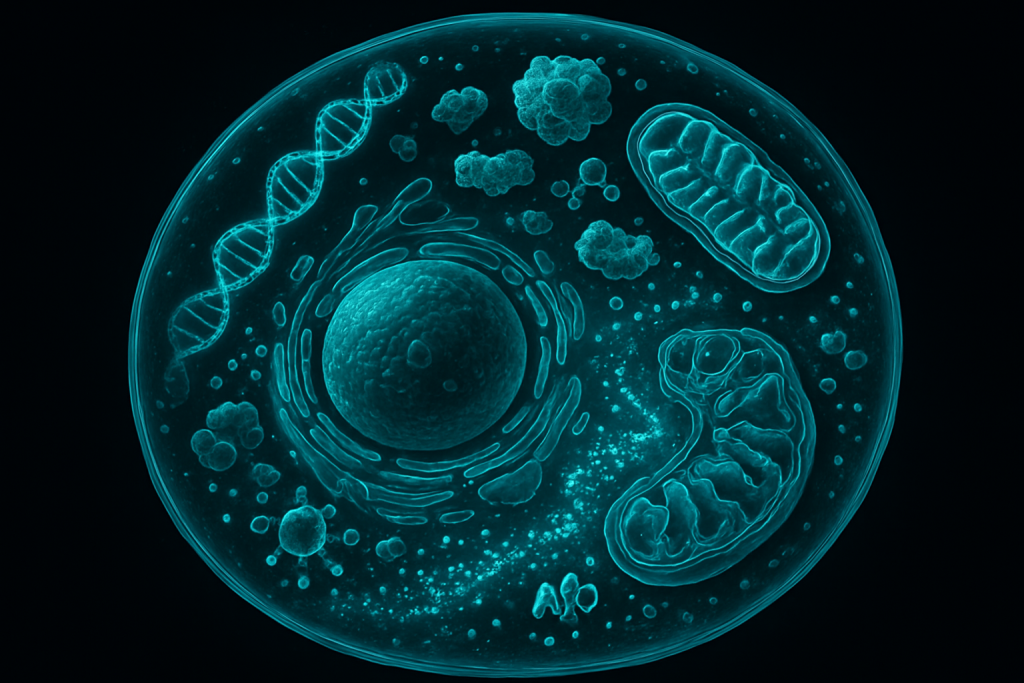
Image generated by AI
Every second, trillions of chemical reactions occur in your body, yet you remain blissfully unaware of the elaborate molecular choreography sustaining your life. From the moment a neurotransmitter binds to a receptor in your brain to the instant a glucose molecule is metabolized in a liver cell, cellular and molecular processes orchestrate the fundamental mechanics of existence. These processes are not merely biological busywork—they represent the elegant solutions evolution has engineered to solve the most pressing problems of survival, growth, and adaptation.
Understanding these processes has become increasingly urgent in an age of personalized medicine, synthetic biology, and emerging diseases. Scientists are harnessing knowledge of cellular mechanisms to develop targeted cancer therapies, regenerate damaged tissues, and design organisms that can remediate environmental damage. The COVID-19 pandemic demonstrated how comprehending viral molecular mechanics—from spike protein dynamics to mRNA translation—can accelerate vaccine development from years to months, potentially saving millions of lives.
What Is Cellular and Molecular Processes?
Cellular and molecular processes encompass the chemical reactions and physical mechanisms that occur within and between cells—the fundamental units of life. At the molecular level, these processes involve the precise interactions of proteins, nucleic acids, lipids, and carbohydrates that drive everything from energy production to genetic expression. At the cellular level, these molecular actions are coordinated into higher-order functions: membrane transport, cell division, signaling pathways, and metabolism. Together, these processes constitute the living machinery that transforms nutrients into energy, responds to environmental stimuli, replicates genetic information, and ultimately enables an organism to grow, reproduce, and adapt.
The modern study of cellular and molecular processes emerged in the early twentieth century, though its intellectual roots stretch deeper. In 1859, Rudolf Virchow proposed that cells arise only from preexisting cells, establishing the cell as biology’s fundamental unit. However, the real revolution came with biochemistry’s rise in the 1920s and 1930s, when scientists like Otto Warburg and Hans Krebs elucidated metabolic pathways—the sequential chemical steps cells use to extract energy from food. The discovery of DNA’s structure by Watson, Crick, Franklin, and Wilkins in 1953 was transformative, revealing how genetic instructions are physically encoded and copied. Yet the field truly accelerated with molecular biology’s maturation in the 1960s and 1970s, when researchers decoded how DNA instructions are transcribed into RNA and translated into proteins—the processes that remain central to modern molecular biology.
How It Works in Nature
At the heart of cellular and molecular processes lies a fundamental principle: information flows from DNA to RNA to proteins, and these proteins then orchestrate virtually all cellular functions. When a cell needs to perform a task—whether manufacturing an enzyme, responding to hunger, or preparing for division—it begins by accessing specific genes in its DNA. The enzyme RNA polymerase unzips the DNA double helix and synthesizes a complementary RNA copy called messenger RNA (mRNA). This mRNA molecule then travels to the ribosome, a complex molecular machine that reads the mRNA’s genetic code in three-letter chunks called codons. Each codon specifies which amino acid to add to a growing protein chain. Once the protein is complete, it folds into a precise three-dimensional shape—determined by the sequence of amino acids—and that shape determines its function.
Consider the protein insulin as a concrete example. When your blood glucose rises after eating, pancreatic beta cells recognize this change through molecular sensors and activate the gene for insulin. The cell manufactures thousands of insulin molecules, packages them into vesicles, and releases them into the bloodstream. These insulin proteins then bind to specific receptors on muscle and fat cells, triggering a cascade of molecular signals that causes these cells to absorb glucose from the blood. Without this elegantly coordinated molecular process—spanning from gene activation to protein synthesis to signal transduction—your body could not regulate blood sugar, and you would sicken rapidly. This is not an isolated example but rather a representative illustration of how billions of such processes operate simultaneously across your 37 trillion cells.
Medical and Scientific Relevance
The practical applications of understanding cellular and molecular processes have become staggeringly vast. In medicine, this knowledge has revolutionized how we diagnose and treat disease. Cancer, for instance, arises when mutations disrupt the molecular processes that normally prevent uncontrolled cell division. By understanding exactly which proteins are mutated or overproduced in specific cancers, oncologists can design targeted therapies—drugs that inhibit only the aberrant proteins while sparing healthy cells. Similarly, understanding how immune cells recognize pathogens at the molecular level has enabled the development of vaccines that train the immune system to recognize specific viral proteins. The molecular biology of inflammation has opened pathways to treat autoimmune diseases by selectively dampening overactive immune signaling.
Current clinical applications abound: monoclonal antibody therapies like trastuzumab (Herceptin) target HER2 proteins in breast cancer cells; CRISPR gene-editing technology corrects disease-causing mutations; CAR-T cell therapies reprogram immune cells’ molecular machinery to recognize and destroy cancer; and messenger RNA vaccines leverage cells’ own protein-synthesis machinery to produce immune-triggering antigens. Pharmaceutical companies now routinely screen millions of molecular compounds to find those that can inhibit disease-causing proteins. Agricultural biotechnology uses molecular techniques to enhance crop yields and disease resistance. Industrial biotechnology employs engineered microorganisms to produce insulin, antibiotics, and biofuels—all applications requiring precise manipulation of cellular and molecular processes.
Recent Breakthroughs in Cellular and Molecular Processes
The past three years have witnessed extraordinary advances in understanding and manipulating cellular processes. In 2023, researchers achieved a long-sought goal: engineering cells with entirely synthetic genomes, expanding an organism’s genetic alphabet beyond DNA’s normal four nucleotides. This work demonstrates that the molecular processes underpinning genetic information transfer are more flexible than previously believed, opening possibilities for organisms with novel functions. Simultaneously, advances in single-cell technologies have enabled scientists to observe cellular processes with unprecedented granularity—tracking how individual cells respond to stimuli and revealing hidden diversity within apparently homogeneous cell populations. Artificial intelligence has become increasingly powerful in predicting protein structure and function, with AlphaFold and its successors essentially solving the protein-folding problem that has vexed biochemists for decades.
Current research frontiers include programming cells to sense and respond to specific molecular environments, creating “living medicines” that can diagnose and treat diseases from within the body. Researchers are exploring how to reverse cellular aging by manipulating the molecular processes that cause DNA damage accumulation and cellular senescence. Others are investigating how to reprogramme differentiated cells back into pluripotent stem cells—cells capable of becoming any cell type—by manipulating the molecular factors that control cellular identity. The challenge remains that cells operate as exquisitely complex systems where thousands of molecular processes interact in nonlinear ways, making it difficult to predict consequences of manipulating any single component.
Why Cellular and Molecular Processes Matters for the Future
As we face challenges from aging populations and emerging infectious diseases to climate change and food security, understanding and manipulating cellular and molecular processes will be increasingly central to solutions. Gene therapies promise to cure genetic diseases that have afflicted humanity for millennia. Synthetic biology could enable bacteria to break down plastics, manufacture sustainable fuels, or sequester carbon from the atmosphere. Regenerative medicine could grow replacement tissues and organs from patients’ own cells, eliminating transplant rejection and shortages. Personalized medicine will increasingly tailor treatments to an individual’s unique cellular and molecular characteristics, maximizing efficacy while minimizing side effects. Understanding cellular senescence and aging processes might eventually extend human healthspan—the years lived in good health—substantially.
Yet substantial challenges remain. Many cellular processes remain incompletely understood, particularly those involving complex interactions between thousands of molecular components. Translating laboratory discoveries into safe, effective therapies requires navigating regulatory pathways and manufacturing challenges that often take a decade or more. Off-target effects and unintended consequences of cellular manipulation remain concerns—modifying one molecular process often has ripple effects throughout cellular networks that prove difficult to predict. Ethical questions loom large: How far should we go in modifying human cells? What safeguards should govern editing of heritable genetic material? How can we ensure equitable access to cellular and molecular medicine-based therapies, particularly in developing nations?
Key Takeaways
- Cellular and molecular processes encompass the chemical reactions and physical mechanisms that occur within cells, ranging from energy metabolism to genetic expression to cell division.
- Information flows from DNA through RNA to proteins in a precisely regulated process, and those proteins then control virtually all cellular functions through specific molecular interactions.
- Understanding these processes has enabled development of targeted cancer therapies, vaccines, gene editing technologies, and other medical advances that save and improve human lives.
- Recent breakthroughs in synthetic biology, single-cell analysis, and artificial intelligence for protein prediction are expanding our ability to observe and manipulate cellular processes with unprecedented precision.
- Future applications in regenerative medicine, personalized therapy, and biological engineering will likely depend fundamentally on deeper understanding and more sophisticated control of cellular and molecular processes.
Frequently Asked Questions
How do neurotransmitters communicate information between nerve cells at the molecular level?
Neurotransmitters are chemical messengers that bind to specific receptor proteins on the surface of receiving cells, triggering a cascade of molecular events that alter the cell's activity. This binding initiates intracellular signaling pathways that can either excite or inhibit the receiving cell's response.
What is the relationship between glucose metabolism and energy production within liver cells?
Glucose molecules enter liver cells and are broken down through cellular respiration, a series of chemical reactions that extract energy stored in the glucose bonds and convert it into ATP (adenosine triphosphate), the cell's primary energy currency. This ATP then powers virtually all other cellular and molecular processes requiring energy.
Why can understanding viral spike protein dynamics accelerate vaccine development?
Spike proteins are the molecular structures viruses use to attach to and infect human cells; understanding their precise three-dimensional shape and binding mechanisms allows scientists to design vaccines that teach the immune system to recognize and neutralize these proteins specifically. This knowledge shortens the discovery phase by enabling rapid identification of effective immune targets.
How does mRNA translation differ from other cellular processes in producing functional proteins?
mRNA translation is the process where messenger RNA molecules are decoded by ribosomes to assemble amino acids into functional proteins in a precise sequence dictated by the genetic code. Unlike transcription (which copies DNA into RNA), translation directly converts genetic information into the working machinery that performs most cellular functions.