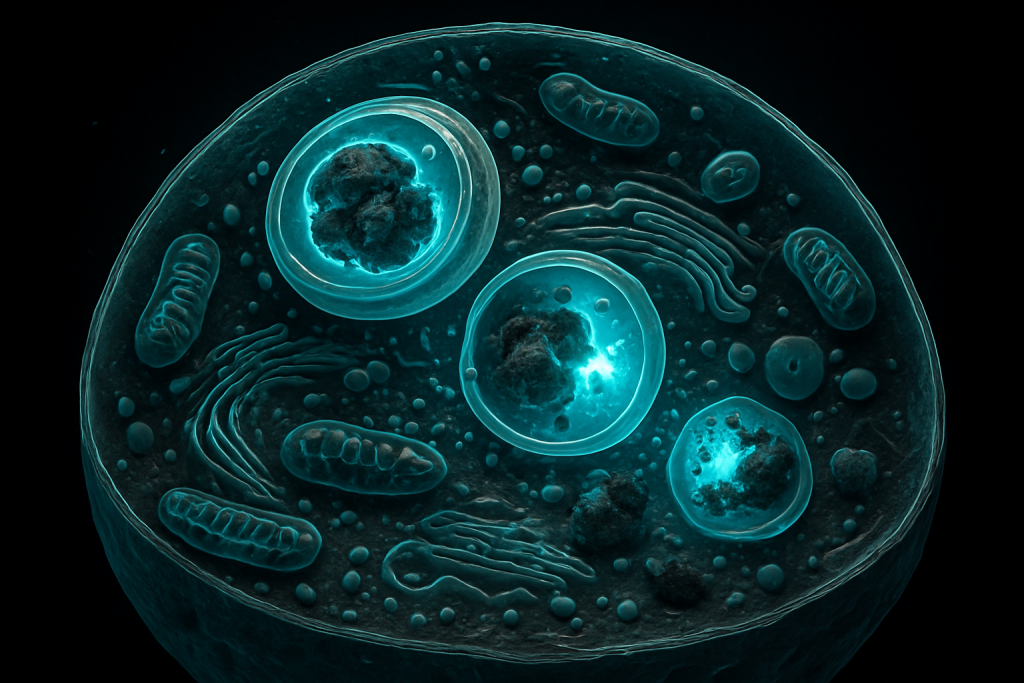
Image generated by AI
Inside every living cell, a microscopic cleanup crew works ceaselessly, breaking down damaged proteins, recycling worn-out organelles, and dismantling malfunctioning machinery. This isn’t janitorial work in the conventional sense—it’s a process so fundamental to life that without it, cells would suffocate under their own refuse within days. The system is called autophagy, derived from the Greek words for “self” and “eating,” and it may be one of the most important biological processes you’ve never heard of. When autophagy fails, the consequences can be catastrophic: aging accelerates, cancer emerges, and neurodegenerative diseases like Parkinson’s and Alzheimer’s take root.
The discovery of autophagy’s molecular mechanics earned three scientists the 2016 Nobel Prize in Physiology or Medicine, signaling a seismic shift in how biologists understood cellular health. Yet autophagy remains poorly understood by the general public, despite its relevance to nearly every major disease afflicting modern society—from diabetes to heart disease to dementia. Understanding how cells manage their waste isn’t merely an academic exercise; it’s becoming central to developing new therapies, designing better longevity interventions, and possibly even extending human healthspan. As researchers unlock autophagy’s secrets, they’re discovering that we may have been able to influence this process all along through diet, exercise, and emerging pharmaceutical interventions.
What Is Cellular Waste Management and Autophagy?
Autophagy is a cellular recycling program—a highly organized system through which cells engulf and digest their own damaged or obsolete components. At its core, autophagy involves the formation of specialized double-membrane compartments called autophagosomes that encapsulate cellular debris, fuse with acid-filled lysosomes, and break down the contents into molecular building blocks that can be reused. The process occurs continuously at a basal level in all cells, but accelerates dramatically during times of nutrient starvation, cellular stress, or intense physical activity. Unlike simple degradation, autophagy is selective and regulated—cells can target specific proteins or organelles for destruction based on sophisticated quality-control mechanisms that recognize damage or dysfunction. This elegant system represents one of evolution’s most brilliant solutions to a fundamental problem: how to maintain cellular health without constantly generating new waste that accumulates to toxic levels.
The scientific story of autophagy is relatively recent, though hints of the process appeared in electron microscopy images as early as the 1950s. Belgian biochemist Christian de Duve first observed cellular compartments filled with digested material and coined the term “autophagy” in 1963, but the molecular machinery remained mysterious for decades. The breakthrough came in the 1990s when Japanese researcher Yoshinori Ohsumi identified the first autophagy genes in yeast, demonstrating that the process was genetically encoded and could be systematically studied. This discovery transformed autophagy from a curiosity into a central focus of cell biology, eventually leading to the identification of over 40 autophagy-related genes in humans. Ohsumi’s work, honored with the 2016 Nobel Prize, fundamentally changed how scientists approached questions about cellular health, aging, and disease.
How It Works in Nature
Autophagy unfolds through a precisely choreographed series of steps, beginning with the formation of a crescent-shaped membrane structure called a phagophore. This membrane grows and elongates, enveloping portions of the cytoplasm along with any damaged proteins, misfiled enzymes, or worn-out mitochondria in its path. Once the autophagosome closes into a complete sphere, it seeks out lysosomes—cellular compartments packed with digestive enzymes—and fuses with them to form an autolysosome. Inside this fused compartment, a cocktail of over 60 different hydrolytic enzymes breaks down the contents into their molecular components: amino acids, nucleotides, sugars, and lipids. These molecular building blocks then get transported back into the cytoplasm, where they’re recycled into new proteins, energy, or membranes, completing a cycle that returns roughly 60 percent of the cellular material to circulation for reuse.
To understand autophagy’s elegance, imagine a city with a sophisticated recycling program. When buildings age and become unsafe, the city doesn’t demolish them haphazardly—instead, specialized crews carefully dismantle them, sort materials by type, and feed them back into construction pipelines for new buildings. Similarly, when a cell’s mitochondrion becomes dysfunctional and no longer produces energy efficiently, autophagy doesn’t simply incinerate it. Rather, specialized proteins recognize the damaged organelle, coat it with membrane material, and carefully transport it to the cellular recycling center where it’s systematically dismantled. The membrane components get reused for other cellular structures, the proteins get broken into amino acids for new protein synthesis, and any remaining problematic material gets safely neutralized. This system prevents the accumulation of toxic aggregates that would otherwise poison the cell from within.
Medical and Scientific Relevance
The medical implications of autophagy dysfunction are staggering. When autophagy fails, cells accumulate misfolded proteins—tangles of dysfunctional material that resemble molecular garbage heaps. This accumulation is the hallmark of neurodegenerative diseases: the amyloid plaques in Alzheimer’s disease, the alpha-synuclein aggregates in Parkinson’s disease, and the tau tangles found in frontotemporal dementia all represent failures of cellular waste disposal. Cancer, paradoxically, involves both excessive and deficient autophagy depending on the context—early in cancer development, defective autophagy allows mutations to accumulate, but once tumors form, high levels of autophagy help cancer cells survive starvation and chemotherapy. Heart disease, metabolic syndrome, and type 2 diabetes all involve impaired autophagy in key tissues. This disease connection has transformed autophagy from an obscure cellular curiosity into a major therapeutic target affecting billions of people worldwide.
Pharmaceutical companies and research institutions are racing to develop drugs that modulate autophagy for therapeutic benefit. Rapamycin, a drug originally discovered as an antifungal agent, enhances autophagy by inhibiting mTOR, a master regulator of cellular growth, and is being investigated for both aging and neurodegeneration. Spermidine, a naturally occurring polyamine found in fermented foods and aging cells, activates autophagy and has shown promise in extending lifespan in model organisms. Gene therapies targeting specific autophagy components are in development for lysosomal storage diseases, conditions where defective waste disposal leads to toxic accumulation of lipids or sugars. Meanwhile, behavioral interventions—fasting, caloric restriction, and high-intensity exercise—are known to dramatically upregulate autophagy, suggesting that optimizing this process might not require pharmaceutical intervention at all.
Recent Breakthroughs in Cellular Waste Management and Autophagy
Recent years have witnessed remarkable advances in understanding autophagy’s diversity and complexity. In 2022-2024, researchers discovered that autophagy isn’t a single monolithic process but rather comprises numerous specialized pathways, each targeting different cellular cargo with extraordinary specificity. Selective autophagy subtypes have emerged: mitophagy targets mitochondria, lipophagy disposes of lipid droplets, ribophagy recycles ribosomes, and dozens of others handle different types of cellular material. Structural biologists have elucidated the three-dimensional architecture of the autophagy machinery at near-atomic resolution using cryo-electron microscopy, revealing how proteins dynamically assemble into membrane-sculpting factories. Simultaneously, researchers have discovered that autophagy isn’t confined to the cytoplasm—selective autophagy occurs at the nuclear envelope, at mitochondrial contact sites, and even at the cell membrane, suggesting that cellular recycling is far more spatially organized and compartmentalized than previously appreciated.
Current research frontiers are exploring how autophagy connects to aging, neuroinflammation, and even metabolic disease prevention. Scientists are investigating whether autophagy defects in specific cell types—neurons, muscle cells, immune cells—drive particular age-related pathologies, and whether enhancing autophagy in these cells can prevent disease. Others are uncovering how gut bacteria influence host cell autophagy through secreted metabolites, opening a window into the microbiome’s role in systemic health. A major open question is why autophagy declines with age and whether this decline is a cause or consequence of aging. Additionally, researchers are working to understand how to selectively enhance “good” autophagy while suppressing pathogenic forms in diseases like cancer, a nuanced therapeutic challenge that likely requires cell-type-specific and disease-specific interventions.
Why Cellular Waste Management and Autophagy Matters for the Future
Autophagy sits at the intersection of fundamental biology and human longevity, making it central to the future of medicine. As the world’s population ages, neurodegenerative and age-related diseases are becoming the leading causes of disability and death in developed nations. If scientists can develop interventions that maintain or enhance autophagy function throughout life, the implications for healthy aging are profound—extending not just lifespan, but healthspan, the years spent free from disease. Autophagy research also promises breakthroughs in understanding metabolic disease; recent evidence suggests that impaired autophagy in insulin-producing cells and fat tissue contributes to type 2 diabetes, opening new therapeutic avenues beyond current medications. Furthermore, cancer researchers hope that modulating autophagy could make tumors more vulnerable to immune attack or chemotherapy, potentially improving treatment outcomes for the disease most feared globally.
However, significant challenges remain before autophagy-based therapies become mainstream. Most current autophagy-enhancing drugs lack specificity, affecting the entire cellular recycling system rather than targeting particular components or cell types, which can produce unwanted side effects. The timing of autophagy modulation matters enormously—enhancing autophagy in cancer cells might promote their survival, while reducing it might prevent immune clearance. Long-term safety data for autophagy modulators in humans is sparse, and we don’t yet understand whether chronically enhancing autophagy in young people is beneficial or harmful. Additionally, the complexity of autophagy regulation means that single-target interventions often fail to produce meaningful clinical effects, necessitating combination therapies or personalized medicine approaches tailored to individual genetic backgrounds and disease contexts.
Key Takeaways
- Autophagy is a cellular recycling system that breaks down damaged proteins and worn-out organelles, preventing toxic accumulation inside cells and recovering valuable molecular building blocks for reuse.
- The process involves the formation of double-membrane autophagosomes that engulf cellular debris, fuse with lysosomes, and digest contents through the action of over 60 hydrolytic enzymes.
- Autophagy dysfunction is implicated in virtually every major age-related disease, including Alzheimer’s, Parkinson’s, cancer, diabetes, and heart disease, making it a crucial therapeutic target.
- Recent research has revealed that autophagy comprises dozens of specialized pathways with exquisite cargo selectivity, operating at multiple cellular locations simultaneously, and showing structural complexity similar to molecular factories.
- Understanding and potentially enhancing autophagy through pharmaceuticals, gene therapy, or lifestyle interventions represents one of the most promising avenues for extending human healthspan and preventing age-related disease in the coming decades.
Explore TED Talks on Cellular Waste Management and Autophagy:
TED content is used under CC BY-NC-ND 4.0. © TED Conferences, LLC.
Frequently Asked Questions
How does autophagy physically break down damaged proteins and organelles inside cells?
Autophagy works by enclosing damaged proteins and worn-out organelles in a double-membrane structure called an autophagosome, which then fuses with lysosomes—specialized compartments filled with digestive enzymes that break down the trapped materials into recyclable components. These breakdown products are then either reassembled into new cellular structures or used as energy sources for the cell.
Why do neurodegenerative diseases like Parkinson's and Alzheimer's occur when autophagy fails?
When autophagy malfunctions, toxic protein aggregates and damaged mitochondria accumulate inside neurons, leading to cellular dysfunction and neuronal death. These toxic accumulations are characteristic hallmarks of Parkinson's and Alzheimer's disease, suggesting that impaired cellular waste removal is a key driver of neurodegeneration.
Can autophagy be deliberately activated or enhanced through external interventions?
Yes, autophagy can be triggered through caloric restriction, fasting, and certain pharmacological compounds that researchers are currently investigating as potential therapeutic agents. Exercise and specific dietary approaches have also been shown to upregulate autophagy in clinical studies, offering non-pharmaceutical pathways to enhance this cellular cleanup process.
What is the relationship between autophagy dysfunction and the aging process?
As cells age, their autophagy capacity naturally declines, allowing cellular waste to accumulate and contributing to age-related deterioration and disease susceptibility. Conversely, maintaining or enhancing autophagy function throughout life is thought to be a key mechanism for slowing aging and extending healthspan, making it a central target for longevity research.