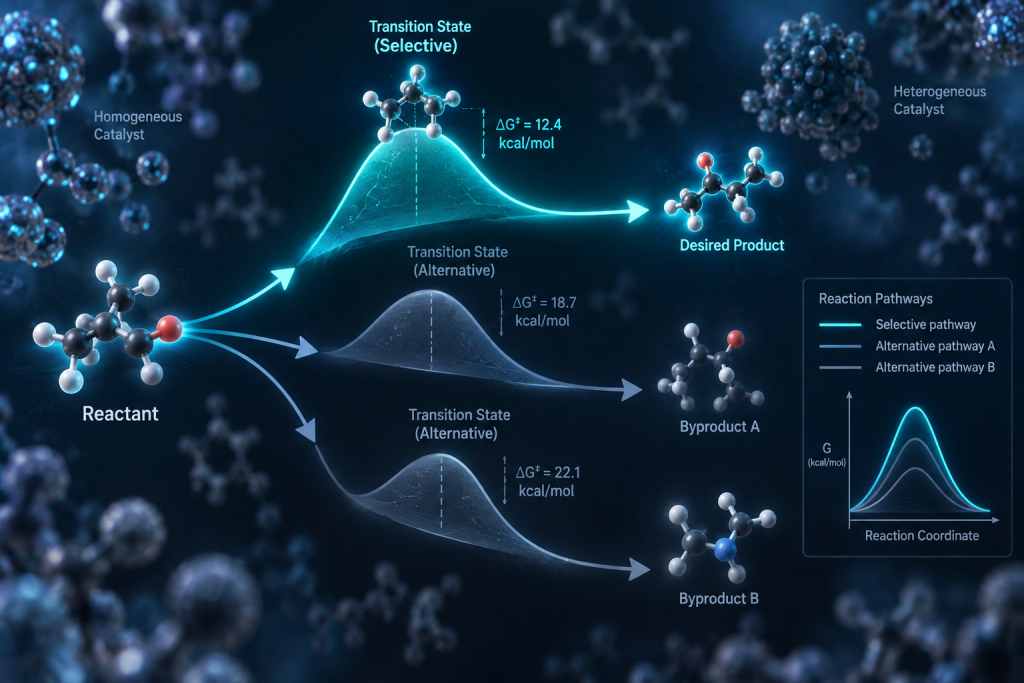
Image generated by AI
Imagine a molecular intersection where a single reactant faces multiple possible routes to transformation, yet a skilled chemist can coax it down just one path to produce a desired product with near-perfect precision. This is the essence of chemical reaction selectivity—the ability to steer molecules toward specific outcomes in a sea of chemical possibilities. For decades, this has been chemistry’s holy grail: not just making something happen, but making exactly what you want happen, and nothing else.
The consequences of mastering selectivity ripple through modern life in ways most people never notice. When pharmaceutical companies synthesize life-saving drugs, they cannot afford byproducts or wrong-handed molecular versions that might be toxic. When petrochemical plants refine crude oil into jet fuel or plastics, producing the wrong isomer means economic waste and environmental burden. Today, as chemists pursue more sustainable manufacturing and attempt to solve problems from carbon capture to drug discovery, understanding and controlling reaction selectivity has become more critical than ever.
What Is Chemical Reaction Selectivity and Mechanistic Pathways?
Chemical reaction selectivity refers to the degree to which a chemical reaction preferentially produces one desired product while minimizing the formation of unwanted byproducts. In essence, when molecules collide and react, they can follow multiple reaction pathways—different sequences of bond-breaking and bond-forming steps that lead to different products. Selectivity is the chemist’s measure of control: how many molecules follow the desired pathway versus the alternative routes. A reaction with 95% selectivity means that 95 out of every 100 reacting molecules form the intended product, while the remaining 5 become something else. Mechanistic pathways are the detailed step-by-step sequences of elementary reactions that occur at the molecular level, the actual choreography of atoms rearranging themselves as bonds break and form.
The roots of selectivity research run deep into twentieth-century chemistry. Early pioneers like Paul Walden in the 1890s noticed that the same starting material could yield different products depending on reaction conditions, hinting at multiple possible pathways. However, the real revolution came with transition metal catalysis—particularly the work of Karl Ziegler and Giulio Natta in the 1950s on polymerization reactions, which earned them the 1963 Nobel Prize. They demonstrated that catalysts could dramatically influence which pathway a reaction takes, achieving unprecedented control over product structure. This discovery transformed industrial chemistry and laid the foundation for modern catalysis, where selectivity is engineered through careful catalyst design.
The Chemistry Behind It
Understanding reaction selectivity requires grappling with energy landscapes—the metaphorical terrain that molecules navigate during chemical transformation. Every reaction pathway has its own energy profile, marked by activation barriers (the energy hill a molecule must climb to transform) and relative stability of products. When multiple pathways exist, the molecule preferentially follows the one with the lowest activation barrier, or sometimes the one leading to the most stable product, depending on reaction conditions like temperature and pressure. A catalyst—a substance that speeds up a reaction without being consumed—works by providing an alternative pathway with a lower activation barrier. The genius of modern catalysis is designing catalysts that selectively lower the barrier for one desired pathway while leaving other routes relatively unchanged, thereby funneling reactant molecules toward the intended product. This selectivity arises from the three-dimensional shape of the catalyst’s active site, which accommodates certain molecular orientations and configurations while excluding others, much like a lock accepting only its matching key.
Think of a highway system where multiple routes connect the same two cities. Some routes are scenic but slow; others are direct but crowded. A clever city planner might add tolls on certain roads or improve infrastructure on preferred routes, encouraging drivers to follow specific paths. A catalyst works similarly: it creates preferred routes through molecular space, lowering energy barriers (the tolls) for the desired transformation while keeping alternative pathways steeper and less favorable. The activation energy—the energy required for molecules to reach the transition state, that fleeting moment where old bonds stretch and new bonds form—is what catalysts manipulate. By stabilizing the transition state of one particular pathway more than others, catalysts achieve selectivity. This stabilization often comes from the precise geometry of the catalyst’s surface or the electrostatic environment it creates around the reacting molecules.
Where It Is Used Today
Chemical reaction selectivity is foundational to modern pharmaceutical manufacturing, where the stakes are literally life and death. Many drug molecules exist as enantiomers—mirror-image versions with identical chemical formulas but opposite three-dimensional arrangements. These can have drastically different biological effects; the wrong enantiomer might be inactive or even harmful. Producing pure enantiomers requires exquisite selectivity, often achieved through chiral catalysts designed to favor one handedness over the other. The development of enantioselective catalysis earned William Knowles, Ryoji Noyori, and Barry Sharpless the 2001 Nobel Prize in Chemistry, and their methods now underpin the synthesis of thousands of pharmaceuticals. Beyond drugs, selectivity matters in producing agrochemicals, fragrances, and specialty chemicals where product purity is non-negotiable.
The petrochemical industry depends on selectivity at massive scales. Oil refineries use zeolite catalysts—rigid, porous minerals with precisely shaped cavities—to selectively crack long hydrocarbon chains into shorter, more valuable products like gasoline or diesel. Polymer manufacturers employ single-site catalysts to produce plastics with controlled chain structure and properties. Even in the production of fine chemicals like vitamins or food additives, selectivity determines whether a process is economically viable. A reaction that produces 80% of the desired product and 20% waste might seem acceptable in theory, but when processing millions of tons annually, that 20% becomes a costly environmental and economic burden.
Recent Breakthroughs in Chemical Reaction Selectivity and Mechanistic Pathways
The past few years have witnessed remarkable advances in understanding and controlling selectivity at unprecedented levels. Machine learning and artificial intelligence are now accelerating catalyst discovery: researchers feed algorithms massive databases of chemical reactions and their outcomes, and the systems identify patterns that human intuition might miss, predicting which catalyst designs will achieve higher selectivity. In 2023 and 2024, several research groups successfully used computational methods combined with high-throughput experimentation to design catalysts for challenging transformations, achieving selectivities exceeding 99% for reactions previously thought difficult to control. Simultaneously, single-molecule imaging techniques have allowed scientists to literally watch individual molecules traversing reaction pathways, providing unprecedented insight into the actual mechanisms at play. This experimental validation of mechanistic theories has sometimes upended long-held assumptions about how certain reactions occur.
Current research frontiers include photocatalysis—using light to drive selective transformations, which promises sustainable alternatives to energy-intensive processes—and biomimetic catalysis, where scientists engineer artificial catalysts inspired by enzymes’ extraordinary selectivity. Researchers are also pursuing cross-coupling reactions that link different organic fragments with minimal side reactions, a capability revolutionized by Richard Heck, Ei-ichi Negishi, and Akira Suzuki (2010 Nobel Prize). Open questions remain: How can we achieve selectivity in reactions involving multiple substrates? Can we design catalysts that are simultaneously highly selective and robust enough for industrial scale-up? How do we predict mechanistic pathways for complex, multi-step processes?
Why Chemical Reaction Selectivity and Mechanistic Pathways Matters for the Future
As chemical manufacturing faces mounting pressure to become more sustainable, selectivity becomes increasingly crucial. A highly selective process produces less waste, consumes fewer raw materials, requires less energy for product purification, and generates smaller environmental footprints. In the context of green chemistry—an approach emphasizing pollution prevention over cleanup—maximizing selectivity is one of the twelve core principles. Future technologies like carbon capture and transformation rely on selective catalysts that can pluck CO2 from the air or convert it into useful chemicals without simultaneously producing unwanted side reactions. Similarly, the transition to renewable energy and bio-based chemicals demands selective catalysis to convert plant-derived molecules into fuels and materials efficiently. The economic argument is equally compelling: in fine chemical and pharmaceutical manufacturing, selectivity directly translates to profitability and competitive advantage.
Yet significant challenges remain. Achieving high selectivity often requires highly specialized, expensive catalysts that work only under narrow conditions, limiting their practical flexibility. Scaling laboratory selectivities to industrial production is notoriously difficult—conditions that work in a flask may fail in a reactor processing tons of material. Understanding mechanistic pathways in living systems, where catalysis occurs in crowded cellular environments with multiple competing reactions, remains largely mysterious. And for many important transformations, particularly those involving unreactive feedstocks or complex molecules, no adequately selective catalyst exists yet, representing both a scientific challenge and an opportunity for breakthrough innovations.
Key Takeaways
- Chemical reaction selectivity is the ability to steer a reaction toward one desired product while minimizing unwanted byproducts, measured as a percentage of molecules following the intended pathway.
- Mechanistic pathways are the detailed step-by-step molecular sequences through which reactions occur, and catalysts control selectivity by selectively lowering the activation energy for the desired pathway.
- The pharmaceutical industry’s production of pure enantiomers and the petrochemical industry’s refining processes depend entirely on achieving high selectivity through engineered catalysts.
- Recent breakthroughs combine machine learning, single-molecule imaging, and computational design to achieve unprecedented selectivities exceeding 99%, though scaling to industrial production remains challenging.
- Mastering selectivity is essential for sustainable chemistry, waste reduction, and economic efficiency, and will be critical for solving future challenges in carbon transformation and renewable chemical synthesis.
Explore TED Talks on Chemical Reaction Selectivity and Mechanistic Pathways:
TED content is used under CC BY-NC-ND 4.0. © TED Conferences, LLC.
Frequently Asked Questions
What is the fundamental difference between chemical reaction selectivity and chemical yield?
Yield measures the percentage of reactant converted to any product, while selectivity measures what fraction of the converted reactant becomes the desired product specifically. A reaction can have high yield but low selectivity if it produces many different products, or high selectivity but low yield if it preferentially makes one product but converts very little starting material.
How do mechanistic pathways determine which product is formed when a reactant has multiple possible transformation routes?
Different mechanistic pathways have different activation energy barriers, and molecules preferentially follow the pathway with the lowest activation energy under given conditions. Chemists can manipulate selectivity by changing temperature, pressure, catalysts, or solvents to alter which pathway becomes energetically favorable.
Why is controlling stereoselectivity particularly critical in pharmaceutical drug synthesis?
Drugs are often chiral molecules where only one stereoisomer (enantiomer) has the desired biological activity, while the other enantiomer may be inactive or toxic to patients. Producing the wrong stereoisomer represents wasted material and potential safety hazards, making stereoselectivity essential for safe and economical drug manufacturing.
Can a catalyst improve reaction selectivity without changing the overall thermodynamics of a reaction?
Yes, a catalyst can selectively stabilize the transition state for one mechanistic pathway over others, lowering its activation energy more than competing pathways and thus favoring one product formation. The catalyst does not change which products are thermodynamically possible, only which pathway the reaction preferentially takes kinetically.