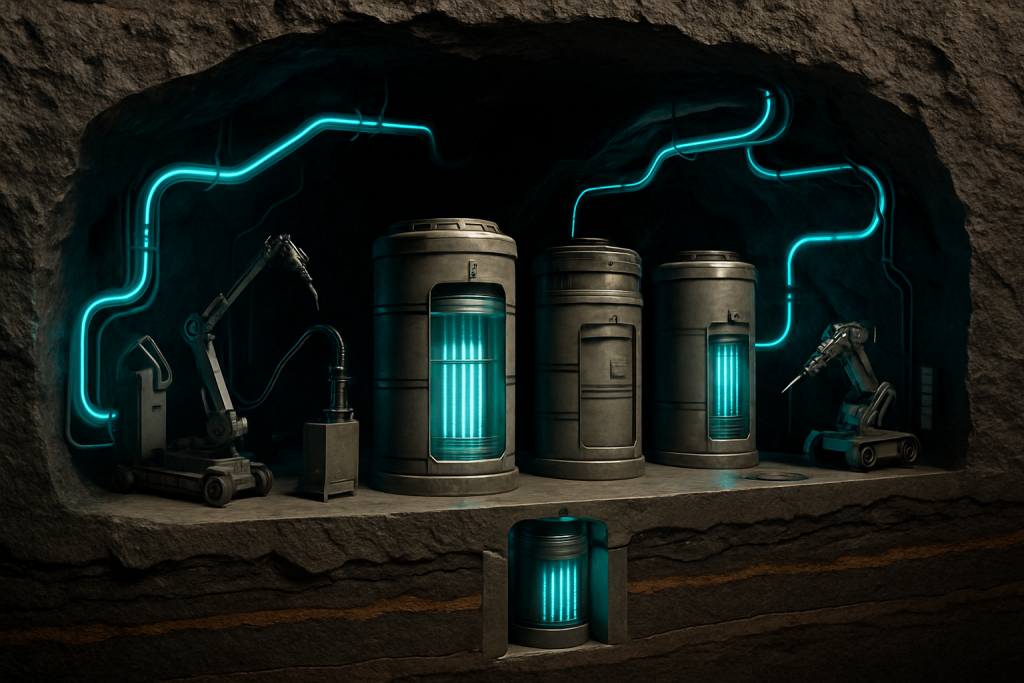
Image generated by AI
Every operating nuclear power plant produces something that will remain dangerous for thousands of years. Yet somehow, we have managed to operate over 400 reactors worldwide without a single catastrophic disposal failure. This paradox sits at the heart of one of modern science’s most consequential challenges: how do we safely handle, store, and ultimately neutralize the radioactive materials that power our cities? The answer involves chemistry so complex and stakes so high that it has reshaped how nations think about energy, security, and the very definition of sustainability.
As climate change accelerates and governments worldwide reconsider nuclear power as a carbon-free energy source, the question of what to do with radioactive waste has moved from a technical afterthought to a central policy debate. The United States alone has accumulated roughly 90,000 metric tons of spent nuclear fuel sitting in temporary storage facilities—a problem that only grows as we generate more electricity from atomic reactions. Understanding radioactive waste management and nuclear decommissioning is not merely an academic exercise; it determines whether nuclear power can truly be part of our energy future.
What Is Radioactive Waste Management and Nuclear Decommissioning?
Radioactive waste management encompasses all the processes involved in handling, treating, storing, and ultimately disposing of materials contaminated with radioactive substances—primarily the byproducts of nuclear fission. Nuclear decommissioning is the parallel process of safely dismantling nuclear facilities at the end of their operational life, which can span 40 to 60 years, and returning the site to an acceptable environmental state. Together, these two processes form the essential final chapter of the nuclear fuel cycle, the series of steps that begins with uranium mining and ends with the secure isolation of waste from the environment. The challenge lies in the fundamental physics of radioactivity: certain isotopes decay so slowly that their hazard persists for geologic timescales, requiring solutions that must work not just for years or decades, but for millennia.
The modern era of nuclear waste management began in earnest during the 1950s and 1960s, as early reactor operators confronted an unexpected consequence of splitting atoms for electricity: the process generates intense radioactivity that must be managed indefinitely. The U.S. Atomic Energy Commission and international bodies quickly recognized that temporary storage was untenable, spurring decades of research into permanent solutions. By the 1970s and 1980s, geologic repositories—deep underground facilities carved into stable rock formations—emerged as the favored approach in most developed nations. Finland’s Onkalo repository, which began receiving waste in 2025, represents the first permanent deep geological storage facility in the world, making operational the theories developed half a century earlier.
The Chemistry Behind It
Radioactive decay is a spontaneous nuclear transformation in which unstable isotopes shed excess energy by emitting particles or radiation. This process cannot be stopped or slowed through chemical reactions; it follows an immutable mathematical law described by the equation N(t) = N₀e^(-λt), where lambda represents the decay constant specific to each isotope. The waste streams from nuclear reactors are dominantly composed of uranium-238, plutonium-239, neptunium-237, and various shorter-lived fission products like cesium-137 and strontium-90. The chemistry of waste management focuses not on stopping decay itself—an impossible task—but rather on immobilizing these materials so that decay products cannot escape into the biosphere and reach human populations or water supplies.
Think of radioactive waste management like sealing a message in a series of increasingly durable envelopes. The innermost envelope is a glass or ceramic matrix created through high-temperature vitrification, a process that fuses radioactive materials into a silicate glass that has survived intact for hundreds of millions of years in nature, suggesting it could remain stable for the geological timescales required. This glass is then placed inside a metal canister, typically made of stainless steel or copper, which provides the next layer of containment. That canister goes into a larger metal or clay-based overpack within the geologic repository, and finally, the surrounding rock formation itself acts as the ultimate barrier. Each layer is designed to fail slowly and sequentially, ensuring that even if one barrier degrades over millennia, others remain intact—a principle called “defense in depth.”
Where It Is Used Today
Radioactive waste management systems operate in nearly every country with nuclear power plants, but they take radically different forms depending on national policy and geology. Sweden and Finland have committed to deep geologic repositories, while France reprocesses spent fuel to extract unused uranium and plutonium, reducing the volume of final waste but creating its own chemical challenges. The United States, which once planned the Yucca Mountain repository in Nevada, shifted toward extended on-site storage while continuing research into permanent solutions. Japan, South Korea, and China are developing their own geologic storage plans, while Russia uses a combination of storage and reprocessing. Each approach requires distinct chemistry: reprocessing facilities use liquid-liquid extraction with organic solvents to separate uranium and plutonium from fission products, while repositories rely on wasteform development and engineered barriers to prevent radionuclide migration.
Beyond power plant waste, radioactive waste management applies to medical isotopes used in cancer treatments and diagnostics, industrial radiography in manufacturing and quality control, research applications in universities and national laboratories, and legacy contamination from weapons production during the Cold War. Each category presents unique chemical challenges. Medical waste is often short-lived and can be held for decay; weapons production legacy sites contaminate soil and groundwater with long-lived isotopes like plutonium-239 and technetium-99, requiring soil remediation using chemical chelating agents that bind radioactive metals and prevent their spread. Decommissioning projects at retired nuclear plants worldwide generate enormous volumes of slightly contaminated or non-radioactive steel, concrete, and equipment that must be characterized, decontaminated using chemical solvents and electrolytic processes, and recycled or disposed of appropriately.
Recent Breakthroughs in Radioactive Waste Management and Nuclear Decommissioning
In the past three years, significant progress has emerged in several areas that could reshape how nations manage radioactive waste. Researchers at Idaho National Laboratory and several universities have achieved improved results with advanced fuel cycles that reduce the long-lived radiotoxicity of high-level waste by transmuting long-lived actinides into shorter-lived isotopes through neutron bombardment in specialized reactors. Simultaneously, advances in wasteform chemistry have produced synthetic minerals and crystalline ceramics that exceed the durability of traditional borosilicate glass, potentially lasting millions rather than thousands of years. Most dramatically, in 2024, South Korea announced success with a ceramic-metal composite wasteform that demonstrates dramatically reduced leaching rates—the speed at which radioactive elements dissolve and potentially escape containment—under simulated groundwater conditions.
Current research frontiers include advanced separation chemistry using new ligand molecules and ionic liquids that could more efficiently remove minor actinides from spent fuel, reducing the heat generation and chemical reactivity of stored materials. Scientists are also exploring whether certain naturally occurring minerals like zirconolite and pyrochlore, which have contained radioactive elements in the Earth’s crust for billions of years, could serve as templates for synthetic wasteforms. The fundamental open question remains: can we develop materials and systems with sufficient confidence in their performance over geological timescales? Testing inherently cannot extend beyond decades, forcing researchers to rely on natural analog studies—examining how radioactive and chemically analogous elements have been retained by minerals and rock formations over millions of years.
Why Radioactive Waste Management and Nuclear Decommissioning Matters for the Future
The future of nuclear energy as a climate solution depends entirely on solving the waste problem—or at least solving it convincingly enough that public and political trust can be maintained. As nations commit to net-zero carbon emissions by 2050, nuclear power’s role as a baseload energy source free of greenhouse gases becomes increasingly essential, with projections suggesting nuclear capacity must double or triple globally. Yet without demonstrable progress on waste disposal, nuclear expansion faces persistent opposition that cannot be dismissed as irrational; the concern that we are creating hazards for future generations is philosophically and ethically serious. The chemistry and engineering of waste management directly determines whether nuclear power remains politically viable and therefore whether humanity can deploy one of its most powerful carbon-free energy technologies.
The challenges that remain are not primarily scientific but rather institutional and social. Deep geologic repositories require decades to site, study, construct, and license—timescales that exceed political cycles and test the patience of funding institutions. The chemistry is largely solved; we can vitrify waste, engineer canisters, and select suitable rock formations. What remains uncertain is whether we can maintain the institutional commitment to isolation for millennia, ensure that future societies respect repository boundaries, and address legitimate concerns about equitable distribution of risks and benefits in a society divided by geography and wealth. Small modular reactors and advanced reactor designs now in development promise to generate less waste and different waste streams, potentially changing the waste management equation entirely—but deploying these reactors at scale also means grappling with multiply these challenges.
Key Takeaways
- Radioactive waste management prevents dangerous isotopes from reaching the biosphere through a multi-barrier approach combining glassification, metal canisters, overpacks, and geologic repositories.
- The chemistry of radioactive decay cannot be altered or accelerated, so waste management focuses on immobilization through transformation into durable wasteforms and isolation in stable geologic formations.
- Deep geologic repositories, exemplified by Finland’s Onkalo facility, represent the most promising permanent solution and combine engineered barriers with natural geological isolation over millions of years.
- Current research is advancing synthetic ceramic wasteforms, improved separation chemistries, and accelerated transmutation technologies that could reduce the hazard timescale of radioactive waste.
- The future of nuclear power as a climate solution depends on maintaining public confidence in waste management—a challenge that is now as much political and institutional as it is scientific or chemical.
Explore TED Talks on Radioactive Waste Management and Nuclear Decommissioning:
TED content is used under CC BY-NC-ND 4.0. © TED Conferences, LLC.
Frequently Asked Questions
What makes spent nuclear fuel remain dangerous for thousands of years?
Spent nuclear fuel contains long-lived radioactive isotopes, particularly plutonium-239 and uranium-235, which have half-lives measured in tens of thousands of years, meaning they decay extremely slowly and continue emitting harmful radiation over millennia. As these isotopes undergo radioactive decay, they release alpha, beta, and gamma radiation that can damage biological tissue and genetic material.
How does the chemistry of radioactive waste change during the decommissioning process?
During decommissioning, radioactive materials undergo chemical treatment to reduce their reactivity, stabilize their molecular structure, and prepare them for long-term storage or disposal, often through processes like vitrification where waste is mixed with molten glass to immobilize radioactive isotopes in a solid matrix. This chemical transformation converts reactive waste into a more stable, containable form that minimizes the risk of leaching or environmental contamination.
Why is temporary storage of spent nuclear fuel problematic from a scientific standpoint?
Temporary storage systems were designed for decades of use, not the centuries or millennia actually required for radioactive decay, and they rely on active cooling systems and regular maintenance that become unreliable over extended timescales. Additionally, spent fuel stored in pools or dry casks remains chemically and thermally active, generating heat and potential for corrosion, which increases the risk of containment failure over time.
What is the scientific principle behind geological repository storage for nuclear waste?
Geological repositories exploit the natural isolation properties of deep rock formations, which provide multiple barriers that slow radionuclide migration and allow radioactive decay to occur over geological timescales far from the biosphere. The rock's low permeability, combined with engineered barriers like clay and metal canisters, creates a multi-layer containment system that reduces the probability of radioactive material reaching groundwater or surface ecosystems.