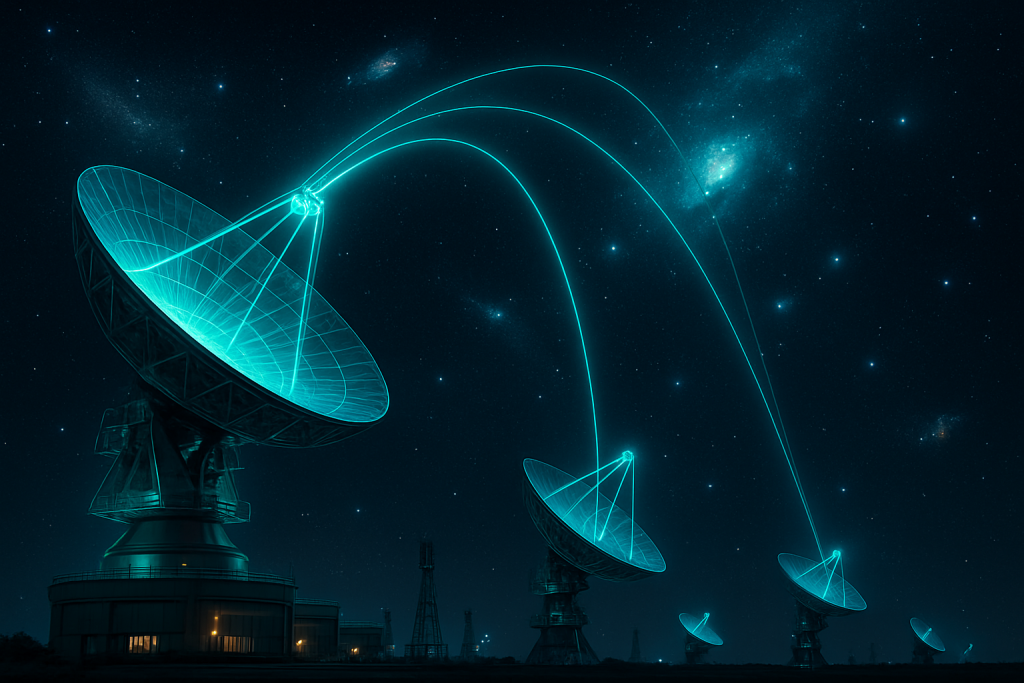
Image generated by AI
Every day, billions of miles from Earth, robotic explorers send back whispers of discovery—images of Mars’s rust-colored canyons, readings from Saturn’s icy moons, and data from the edge of our solar system. But these transmissions arrive as incredibly faint signals, traveling at the speed of light for hours or days before reaching our planet. The infrastructure that captures these cosmic messages, decodes them, and turns them into scientific revelation is one of humanity’s most ingenious yet underappreciated technological achievements: the global network of deep space communication systems and their ground-based receiving stations.
Without this vast, interconnected web of massive antennas, sophisticated electronics, and coordinated international partnerships, our exploration of the cosmos would grind to a halt. Today, as humanity prepares to return to the Moon, establish a presence on Mars, and send probes to the outer reaches of the solar system, the demands on these communication networks have never been greater. Understanding how these systems work, and why they’re essential to our future, reveals not just the mechanics of space exploration, but humanity’s enduring drive to reach beyond our world.
What Is Deep Space Communication Networks and Ground Station Technology?
Deep space communication networks are the sophisticated systems that maintain contact with spacecraft operating far from Earth—typically beyond the orbit of the Moon, where conventional communication methods become impractical. These networks consist of three primary components: the spacecraft’s transmitter and antenna, the vast interplanetary void through which signals propagate, and ground-based receiving stations equipped with enormous antennas and sensitive electronics designed to capture extraordinarily faint radio waves. The technology represents a convergence of physics, engineering, and mathematics, where even minor improvements in signal detection can mean the difference between mission success and silence. Deep space communication operates at radio frequencies and must overcome extraordinary challenges: the inverse square law means signals weaken dramatically over distance, interference from the Sun and Earth’s radiation belts can corrupt data, and the finite speed of light introduces communication delays that render real-time interaction impossible.
This field emerged from the earliest days of space exploration. In 1957, when the Soviet Union launched Sputnik 1, the world heard its beeping radio transmissions and realized that communicating with objects in orbit was not mere science fiction. NASA’s Jet Propulsion Laboratory (JPL) in Pasadena, California, and the Deep Space Network (DSN)—a collaboration between NASA, ESA, and JAXA—began systematic development of the infrastructure needed to track and communicate with increasingly distant spacecraft. The first deep space contact occurred with the Mariner 2 probe in 1962, which transmitted data from its journey to Venus. Since then, the technology has evolved dramatically, transforming from simple telemetry links to bidirectional communication systems capable of handling enormous volumes of high-resolution imagery and scientific data.
What We Know So Far
The mechanics of deep space communication rest on fundamental principles of physics and information theory. Radio waves carrying spacecraft data travel outward at light speed, roughly 186,000 miles per second, spreading in all directions according to the inverse square law—meaning the signal’s strength decreases proportionally to the square of the distance. A spacecraft orbiting Mars, roughly 140 million miles away at closest approach, broadcasts at relatively modest power levels, often just a few watts. By the time this signal reaches Earth, its intensity has diminished to roughly a billionth of a billionth of a watt—a level so minuscule that it’s comparable to receiving the heat from a candle flame located millions of miles away. To capture this faint whisper, ground stations employ enormous parabolic antennas, some measuring 230 feet in diameter, that collect radio waves across a vast area and focus them onto extremely sensitive receivers cooled to near absolute zero to minimize electronic noise.
Consider the analogy of listening for a distant thunderstorm. If you’re standing outside on a quiet night, you might hear thunder from a storm fifty miles away—a sound that has traveled enormous distances and been attenuated by air molecules and terrain. Similarly, a ground station antenna collects radio waves from across a massive surface area, focusing millions of individual radio photons onto a receiver. Inside the receiver, cryogenically cooled amplifiers boost the signal so it can be distinguished from background noise. Engineers use a figure called the “link budget” to calculate whether a given spacecraft and ground station combination can successfully exchange information, accounting for transmitter power, antenna gains, path losses, and noise levels. This discipline, refined over six decades, has become so sophisticated that engineers can predict mission success or failure years before launch based purely on signal propagation calculations.
The Future of Exploration
Deep space communication networks are undergoing a technological renaissance driven by humanity’s expanding ambitions in space exploration. NASA’s Artemis program aims to establish a sustained presence on the lunar surface and eventually send crewed missions to Mars—endeavors that will demand unprecedented bandwidth and reliability from communication systems. The emerging commercial space industry, including companies like SpaceX developing interplanetary transportation, further strains existing infrastructure and necessitates new capability. Meanwhile, proposed missions to the outer solar system—including orbiter and lander missions to Europa, Enceladus, and other potentially habitable moons—will operate at distances where communication delays exceed an hour, requiring spacecraft with substantially more autonomy and decision-making capability than current probes possess.
Current applications extend far beyond basic spacecraft tracking. NASA’s Perseverance rover uses the DSN to receive commands and transmit gigabytes of data daily, including high-resolution imagery that scientists analyze to plan the rover’s next moves. The James Webb Space Telescope, despite orbiting Earth at the Lagrange point 1 million miles away, relies on ground stations for command and data transmission. Beyond Earth orbit, missions like the Parker Solar Probe, which ventures within 3.9 million miles of the Sun’s surface, and the New Horizons spacecraft, which has traveled beyond Pluto, depend entirely on these networks. Commercial applications continue emerging as well, with companies developing satellite communication systems for remote Earth regions and working on cislunar communication infrastructure for cargo and passenger missions.
Recent Breakthroughs in Deep Space Communication Networks and Ground Station Technology
The past few years have witnessed significant technological advances that expand the capabilities and efficiency of deep space communication networks. In 2023, NASA demonstrated a laser communication system, the Optical Communications and Sensor Demonstration (OCSD), aboard the International Space Station that achieved data rates substantially higher than conventional radio systems—a development that promises to revolutionize bandwidth capacity for future deep space missions. Simultaneously, researchers at the Jet Propulsion Laboratory have been refining software-defined radio architectures that make ground stations more flexible and responsive to varying mission needs. The Deep Space Network itself has undergone modernization efforts, including upgrades to the 70-meter antenna at Goldstone, California, and improvements to receiver electronics that enhance sensitivity and reduce false-alarm rates.
Current research efforts focus on several critical frontiers. Quantum technologies, including quantum sensing and quantum error correction, could potentially improve signal detection capabilities beyond current limits. International collaborations are intensifying as space agencies from China, India, and the European Union develop their own deep space communication capabilities and begin coordinating with existing networks. Engineers are also exploring autonomous communication systems where spacecraft can intelligently adjust transmission parameters based on real-time signal quality assessments. Open questions remain regarding how to optimize communication networks for the exponentially growing number of spacecraft expected in cislunar space over the next decade, and how to maintain the vast infrastructure investments that ground stations require.
Why Deep Space Communication Networks and Ground Station Technology Matters for the Future
The implications of advances in deep space communication extend far beyond space exploration itself. As humanity expands its presence beyond Earth—establishing lunar bases, developing Mars settlements, and creating space-based industry—reliable communication infrastructure becomes as essential as roads and electricity grids are on Earth. The technological spinoffs from deep space communication have historically proven significant; error-correcting codes developed for spacecraft transmission found applications in digital television, compact discs, and internet protocols. The extreme precision engineering required for ground stations has advanced materials science, antenna theory, and signal processing in ways that benefit terrestrial telecommunications. Moreover, the expertise developed in maintaining communication across vast distances and through hostile environments informs our approach to challenges ranging from underwater robotics to medical imaging.
Yet formidable challenges remain. Ground stations require enormous capital investment, with single facilities costing hundreds of millions of dollars. Maintaining and upgrading these facilities against the backdrop of aging infrastructure and competing budgetary demands strains space agencies worldwide. The electromagnetic spectrum itself faces increasing congestion as commercial satellite operators, terrestrial wireless networks, and deep space missions all compete for frequency allocations. Climate change poses practical challenges as well—some ground stations in vulnerable locations face threats from rising sea levels or extreme weather. Additionally, the fundamental speed-of-light constraint means that as missions venture farther from Earth, communication delays become prohibitive for real-time control, requiring increasingly sophisticated autonomous systems aboard spacecraft.
Key Takeaways
- Deep space communication networks maintain contact with distant spacecraft by capturing and transmitting extraordinarily faint radio signals across billions of miles using massive ground-based antennas and sophisticated electronics.
- Signals from deep space weaken according to the inverse square law, diminishing to billionths of a watt, necessitating cryogenically cooled receivers and parabolic antennas exceeding 200 feet in diameter to detect and decode spacecraft transmissions.
- The most promising application for the future involves establishing reliable communication infrastructure for permanent lunar bases and crewed Mars missions, which will require substantially greater bandwidth and redundancy than current systems provide.
- Recent breakthroughs include demonstration of laser communication systems achieving higher data rates than radio, modernization of existing ground station hardware, and development of quantum sensing technologies that could further enhance signal detection capabilities.
- As humanity expands beyond Earth, deep space communication networks will become foundational infrastructure comparable to terrestrial utilities, while also driving technological innovations with applications throughout science and society.
Explore TED Talks on Deep Space Communication Networks and Ground Station Technology:
TED content is used under CC BY-NC-ND 4.0. © TED Conferences, LLC.
Frequently Asked Questions
Why do deep space communication signals become so faint by the time they reach Earth?
Electromagnetic signals from distant spacecraft weaken exponentially as they travel across billions of miles due to the inverse square law, where signal strength decreases with the square of the distance traveled. Additionally, the signals must pass through the interplanetary medium and Earth's atmosphere, which further attenuate and distort them.
How do ground stations manage to detect and decode extremely weak signals from deep space probes?
Ground stations use massive parabolic antennas to collect the faint signals over large surface areas, combined with ultra-sensitive amplifiers and signal processing electronics that can extract data from noise levels measured in billionths of a watt. Advanced error-correction algorithms and redundant transmission protocols allow scientists to reconstruct accurate data even when signal-to-noise ratios are extremely poor.
What physical challenges do communication delays impose on controlling deep space spacecraft?
Light-speed communication delays mean that commands sent to distant probes can take hours or days to arrive, making real-time remote control impossible and requiring spacecraft to operate with significant autonomous decision-making capabilities. This delay also creates timing challenges for coordinating observations and transmissions across multiple spacecraft and ground stations.
Why is a global network of ground stations necessary rather than using a single facility?
A distributed global network ensures continuous contact with spacecraft as Earth rotates, since a single station would lose signal when rotating away from a spacecraft's position; additionally, multiple stations provide redundancy, backup capability, and the ability to conduct simultaneous observations with different antennas for enhanced signal reception.